


The United Nations General Assembly designated 11 December “International Mountain Day”. As of 2003, it has been observed every year to create awareness about the importance of mountains to life, to highlight the opportunities and constraints in mountain development and to build alliances that will bring positive change to mountain peoples and environments around the world.
The Food and Agriculture Organization of the United Nations (FAO) is the coordinating agency for the preparation and animation of this celebration and is mandated to lead the observance of it at the global level. The Mountain Partnership Secretariat in the FAO Forestry Division is responsible for coordinating this international process.
International Mountain Day 2026 theme
Mountain pastoralists: Sustaining rangelands, knowledge and livelihoods
International Mountain Day 2026 celebrates the role of mountain pastoralists who, through their knowledge, mobility and care, raise animals, contribute to food security and steward fragile mountain rangelands.
Drawing on Indigenous and local knowledge developed over generations, their practices help regenerate vegetation, maintain healthy soils, water cycles and wildlife habitats, and respond to climate variability – while supporting rural mountain economies and preserving ecosystems.
As a contribution to the International Year of Rangelands and Pastoralists 2026, the Day highlights the environmental, social and economic importance of mountain rangelands and calls for greater recognition of mountain pastoralists as custodians of ecosystems that sustain life from the highlands to the lowlands.


How will you mark the day?
- Check out the International Mountain Day social media kit for resources that can be shared widely across your networks.
- Join the conversation on social media using the #MountainsMatter hashtag. Pass on some of this year's key messages or take a photo of your favourite mountain and share it online.
- Organize or join events celebrating mountains, such as hikes, symposiums, photo competitions, art exhibitions, craft fairs or school talks.
- Don’t forget to tell us about it by registering your event and send us photos so we can add them to the gallery of events happening around the world.
Key messages

Mountain pastoralists are stewards of land, livestock and livelihoods
Mountain pastoralists raise livestock and produce food, fibre and other goods in high-altitude regions. Drawing on generations of Indigenous Peoples' as well as local knowledge, they use daily and seasonal mobility, including transhumance, to sustainably manage rangelands, support animal welfare and contribute to food security. In India, an estimated 13 million pastoralists from more than 46 communities rely on pastoralism for their livelihoods. Across the Hindu Kush Himalaya, rangelands cover nearly 60 percent of the region and sustain millions of pastoralists and agro-pastoralists.

Healthy mountain rangelands benefit 1.2 billion people living in mountain areas
Rangelands cover around half of the Earth’s land surface, including significant mountain areas. Mountains regulate water flows to downstream areas. Mountain rangelands preserve habitats and biodiversity, store carbon and help reduce wildfire risk. For example, 70 per cent of Colombia’s freshwater begins in its mountain rangelands. More than one third of Swiss agricultural land is alpine pasture and 85 percent of agricultural land in Kyrgyzstan is pasture.

Mountain pastoral systems can build resilience in a changing climate
Climate change, land degradation and conversion to other land uses are reducing pastoral areas and disrupting livestock corridors, limiting access to water and markets, and affecting rangeland quality and herd mobility. Croplands are expanding into higher elevation rangelands as the climate changes, and urbanization and mining are fueled by population and economic growth. Yet mountain pastoral practices, such as community-based management supported by innovation and sound policies, can restore degraded lands and strengthen climate adaptation, biodiversity conservation and disaster risk reduction.

Mountain livestock breeds are living reservoirs of genetic diversity
Mountains support about one-quarter of the world’s terrestrial biodiversity and at least five domestic mammals – sheep, goats, yaks, alpacas and llamas – originated or were diversified in mountains. South America is home to about 7.5 million alpacas, and Peru has the world’s largest alpaca herd, with about 4.5 – 4.7 million animals providing livelihoods, natural fibre and animal-source food. Natural mountain materials like alpaca fibre, wool and cashmere, produced through low-input pastoral systems, offer a renewable, low-carbon alternative that supports a circular, climate resilient fashion industry.

Women and youth are driving the future of mountain pastoral systems
Pastoralist women play a crucial role in managing rangelands and production, supporting local economies and preserving traditional knowledge, yet many lack secure land rights and access to credit and resources. Pastoralist youth bring innovation and new skills but need greater access to education, digital tools, finance and entrepreneurship opportunities to prevent migration from mountain areas. Empowering women and youth pastoralists through mobile schooling, incentives and associations can help reverse rangeland abandonment and degradation.

Secure land rights are essential for sustainable mountain rangelands
Pastoral commons are essential resources for viable pastoral systems, functioning as insurance during droughts and other hazards. Strong pastoral governance and secure land tenure – backed by legislation, institutions, inclusive policies and community-based governance that recognize pastoralists' rights to move their animals as well as recognizing the role of Indigenous Peoples’ and local knowledge – are essential for productive, resilient mountain rangelands. They guarantee that mountain pastoralists can continue to manage rangelands sustainably for present and future generations.

Spread the word!
Join the #MountainsMatter campaign by sharing our free material on digital channels and raise awareness about mountains.

International Mountain Day 2026 observance
International Mountain Day will be observed in New York on 15 December with two events that will bring together global leaders, Members, mountain community representatives, youth innovators and fashion designers.
Related links
Contact us
Email: [email protected]
Past years

For more information on International Mountain Day 2025, visit the webpage.

For more information on International Mountain Day 2024, visit the webpage.

For more information on International Mountain Day 2023, visit the webpage.
‘Mountains matter for Youth’ is the theme of the 2019 International Mountain Day, which is celebrated on 11 December.
Young people are active agents of change and the future leaders of tomorrow. They are custodians of mountains and of their natural resources, which are being threatened by climate change.
The 2019 International Mountain Day’s theme is a great opportunity for young generations to take the lead and request that mountains and mountain peoples become central in the national and international development agendas, receive more attention, investments and tailored research.
The day was also an occasion to educate children about the role that mountains play in supporting billions up and downstream – by providing freshwater, clean energy, food and recreation.
International Mountain Day is a chance to highlight that for rural youth, living in the mountains can be hard. Many young people leave in search of a better life and employment. Migration from mountains leads to abandoned agriculture, land degradation and a loss of cultural values and ancient traditions. Education and training, market access, diverse employment opportunities and good public services can ensure a brighter future for young people in the mountains.

 Available in AR, ES, FR, RU, ZH

Mountains matter for Youth photo and recipe contest
FAO's International Mountain Day contest drew over 70 entries from 27 countries.
Ashmita Lama from Nepal's Sinja Valley won the contest with her “Jumla Special Kwati” recipe, a classic Nepalese mountain recipe made from high altitude Jumla beans, a product involved in the Mountain Partnership Products Initiative.
”#MountainsMatter” is the theme chosen for this year’s celebration of International Mountain Day.
Even though they are mentioned in the 2030 Agenda, mountains are still often forgotten. Considering the crucial role they play in providing key ecosystem goods and services to the planet and their vulnerability in the face of climate change, we need to step up and raise attention to mountains.
#MountainsMatter for Water as mountains are the world’s ‘water towers’, providing between 60 and 80 percent of all freshwater resources for our planet. However, all available records indicate that glaciers in mountain ranges around the world are retreating and disappearing due to climate change. At least 600 glaciers have disappeared completely over the past decades, affecting water supplies relied on by billions living downstream.
#MountainsMatters for Disaster Risk Reduction as climatic variations are triggering disasters. Avalanches, mudflows and landslides are tumbling downstream, stripping bare forests, flooding communities and populations.
#MountainsMatter for Tourism as mountain destinations attract around 15-20 percent of global tourism and are areas of important cultural diversity, knowledge and heritage. Although mountain tourism has the potential to foster economic development in remote and isolated regions, many mountain communities are still not benefiting and live in poverty.
#MountainsMatter for Food as they are important centres of agricultural biodiversity and are home to many of the foods that come to our table, such as rice, potatoes, quinoa, tomatoes and barley. Yet, they are home to some of the hungriest peoples in the world with a high vulnerability to food shortages and malnutrition, and climate change is affecting mountain agriculture.
#MountainsMatter for Youth as despite the beautiful landscapes, life in the mountains can be tough, particularly for rural youth. Abandoning their villages in search of employment elsewhere has led to an absence of young people and an increasing labour shortage. Migration from mountains leads to an increase in abandoned agricultural, land degradation and often forest fires. At community level, cultural values and ancient traditions are lost.
#MountainsMatter for Indigenous Peoples as many mountain areas host ancient indigenous communities that possess and maintain precious knowledge, traditions and languages. Mountain peoples have developed remarkable land use systems and have a wealth of knowledge and strategies accumulated over generations on how to adapt to climate variability.
#MountainsMatter for Biodiversity as half of the world’s biodiversity hotspots are concentrated in mountains and mountains support approximately one-quarter of terrestrial biological diversity. Mountains are home to rare animals such as gorillas, snow leopards and the majestic tahr as well as strikingly beautiful plants such as orchids and lobelias.
International Mountain Day 2018 will be an occasion to create a large social movement that can bring mountain issues on the tables of politicians. Through a global campaign, a social media strategy and events around the world, we plan to tell the world that the current neglect of mountains and mountain peoples must stop. We therefore ask everyone to use the hashtag #MountainsMatter in all their communications specifying why mountains matter for them.

Also available in: AR, ZH, FR, RU, ES.

Also available in: AR, ZH, FR, RU, ES.
#MountainsMatter photo contest winner
In collaboration with FAO, the MPS held the International Mountain Day photo contest to encourage people from all over the world to share images depicting why mountains matter to them and their communities.
More than 138 entries were received from 45 countries. Salar Arkan was the 2018 winner with the entry ‘Torches’ — depicting a ceremonial torch lighting in a mountainous region of Iran during Nowruz, or New Year, a festival that is held at the time of the northern hemisphere’s spring equinox.
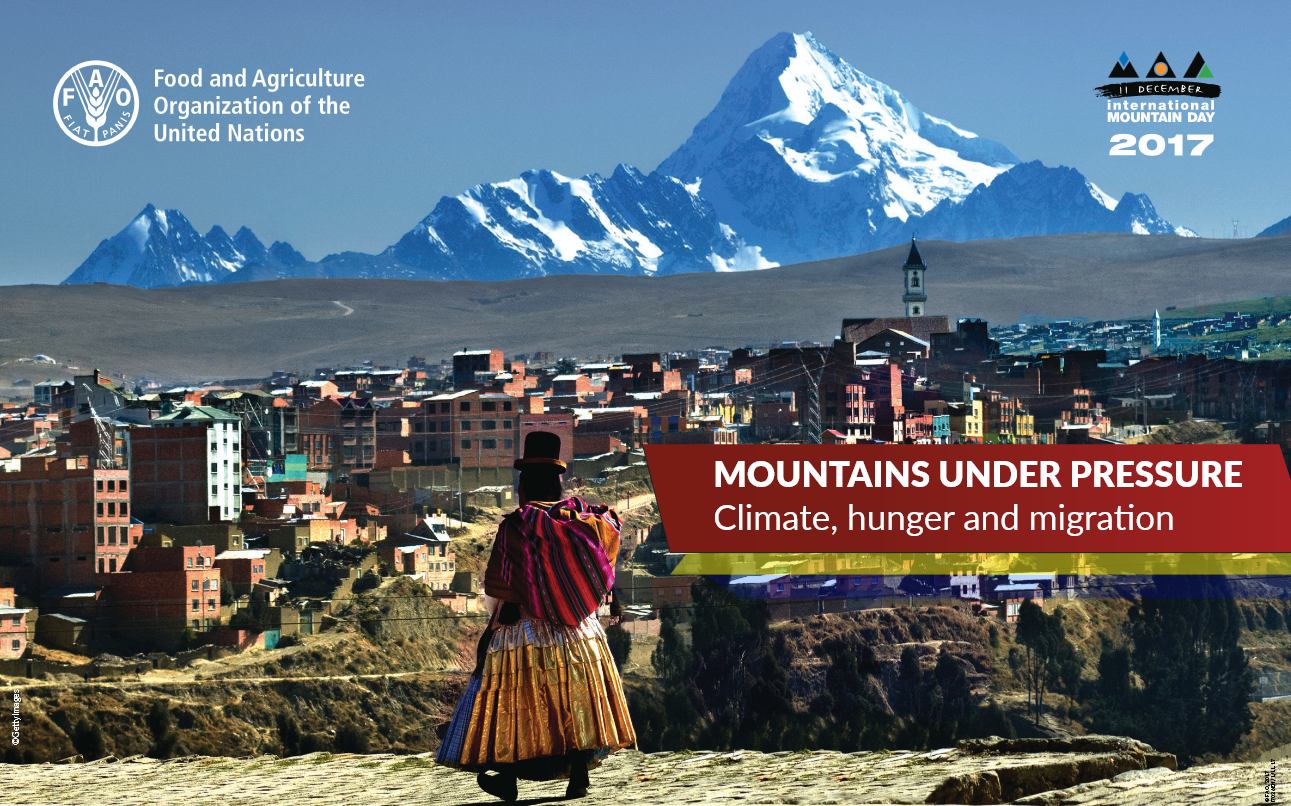
This year's theme is Mountains under Pressure: climate, hunger, migration.
Almost one billion people live in mountain areas, and over half the human population depends on mountains for water, food and clean energy. Yet mountains are under threat from climate change, land degradation, over exploitation and natural disasters, with potentially far-reaching and devastating consequences, both for mountain communities and the rest of the world.
Mountains are early indicators of climate change and as global climate continues to warm, mountain people — some of the world’s hungriest and poorest — face even greater struggles to survive. The rising temperatures also mean that mountain glaciers are melting at unprecedented rates, affecting freshwater supplies downstream for millions of people. Mountain communities, however, have a wealth of knowledge and strategies accumulated over generations, on how to adapt to climate variability.
Climate change, climate variability and climate-induced disasters, combined with political, economic and social marginalization, increase the vulnerability of mountain peoples to food shortages and extreme poverty. Currently, about 39 percent of the mountain population in developing countries, or 329 million people, is estimated to be vulnerable to food insecurity.
As the vulnerability of mountain populations grows, migration increases both abroad and to urban centres. Those who remain are often women, left to manage the farms but with little access to credit, training and land tenure rights. Out-migration from mountain areas will also result in an inestimable loss in terms of provision of ecosystem services and preservation of cultural and agrobiodiversity. Investments and policies can alleviate the harsh living conditions of mountain communities and reverse out-migration trends from mountain areas.
International Mountain Day 2017 provides an occasion to highlight how climate, hunger and migration are affecting highlands and to ensure that sustainable mountain development is integrated into the 2030 Agenda and in the implementation of the Paris Agreement.
This year, the theme is also linked to the Mountain Partnership Global Meeting, to be held on 11-13 December at FAO headquarters in Rome, Italy, which will focus on the challenges and opportunities in sustainable mountain development and will launch a Framework for Action to support concrete actions and establish policies that strengthen the resilience of mountain peoples and environments.
International Mountain Day 2016
This year's theme is Mountain Cultures: celebrating diversity and strengthening identity.
The concept of traditional heritage, culture and spirituality is intrinsically linked with peoples’ livelihoods in the mountains, where it is often traditional lifestyles that determine the way people make a living and subsist. Many mountain areas host ancient indigenous communities that possess and maintain precious knowledge, traditions and languages.
Mountains have a spiritual meaning for most religions: Mount Olympus, Mount Sinai, Machu Picchu, Mount Athos, the four Holy Buddhist Mountains, just to name a few. Mountain peoples have developed remarkable land use systems, which are rich in globally significant biodiversity and have evolved over centuries thanks to the harmonious co-existence of communities with the environment.
For mountain peoples, land, water and forests are not simply natural resources. Following in the footsteps of their ancestors, new generations understand that their well-being, their sense of identity and their children’s future depend on careful stewardship of the environment. Their traditional knowledge and techniques are key to managing and enhancing the resilience of fragile mountain ecosystems.
Mountains are also places of tourism and cultural trails. From skiing to climbing to visiting the rock churches in Ethiopia, mountains offer all types of possibilities to all kinds of tourists. If sustainably managed, mountain tourism can have a role in promoting and protecting traditional cultures as well as creating incentives for the protection of mountain ecosystems, their goods and services.
International Mountain Day 2016 provides an occasion to highlight the variety and richness of mountain cultures, promote the vast array of mountain identities and ensure that indigenous rights are recognized and traditional ways endure.

Also available in: AR, ZH, FR, RU, ES.
