Romania
Natural conditions, farming traditions and agricultural structures

Romania is a large agrarian country. In 1989 the share of agriculture in the GDP was 13.7 percent and the share of agriculture in total employment was 27.5 percent. Respective shares in 1997 were 18.5 percent and 39.7 percent (Trzeciak-Duval,1999). The growth of the relative importance of agriculture can be attributed not only to the basis of agricultural growth but in particular to the production decline in other economy sectors and to commuting (Florian and Toderoiu, 1999). In 1996 the Romanian labour force comprised around 11.3 million people of which 28 percent were employed in agricultural production or related enterprises. Overall, the number of people employed in agriculture has increased since 1989 because of the voluntary return of urban workers of rural origin to agriculture and the role of the agricultural sector as an important buffer. About 40 percent of farmers are supposed to retire within the next five years (Heidhues et al. 1998).

Of the total area, 23.8 mill. ha (or 28 percent) is forest and over 60 percent is in agricultural use. Approximately two-thirds of the agricultural land is arable and one third is pasture. The main crops are maize and wheat. (Please consult http://europa.eu.int./comm/dg06/publi/pe-co/romania/summary/sum_fi.htm .)

The private sector farms operate 86 percent of the arable land in Romania and contribute to 80 percent of agricultural production. The overwhelming majority of the 2.8 million private Romanian farmers (86 percent) own less than five ha on average. The average size of a privately owned farm is 2.2 ha. There is also a tendency for the more dynamic, individual private farmers to enlarge their operational farm size by forming associations, buying or leasing land (Heidhues et al. 1998). The 1997 figures according to Heidhues et al. (1998) ref. Toderoiu (1997) for agricultural land distribution and average farm size in Romania are presented in Annex Table 12.

Cereal production in 1990-1997 has roughly been at the level of 1989, except for the years 1992 and 1993. Maize and sunflower production appears to have increased, whereas wheat and rye production is slightly lower. Production figures for sugar beet, potatoes and vegetables have decreased whereas grape production has increased. On the animal production side, there is a clear increase in milk production in the range of 20 percent between 1989 and 1997. Egg, meat and wool production has decreased (Florian and Toderoiu, 1999).

From an agroclimatic viewpoint, Romania can be divided into three major regions or zones. The first zone comprises the plain in the southeast of the country and the western plain. This can be referred to as the plain region. The second zone is a hilly zone around the mountains, and the third zone is the mountain zone. Individual household farms dominate the mountain zone, while a mixture of state farms and private farms is common in the two first zones. In all three regions over 60 percent of holdings are split into three or more parcels (Florian and Toderoiu, 1999).

According to a sample survey, 4 percent of the people in rural households are illiterate, 27 percent have a primary school education, 24 percent have a secondary education, 30 percent have graduated from high school and 6 percent have graduated from university (Florian and Toderoiu, 1999).

Major types of farming systems resulting from the transition process

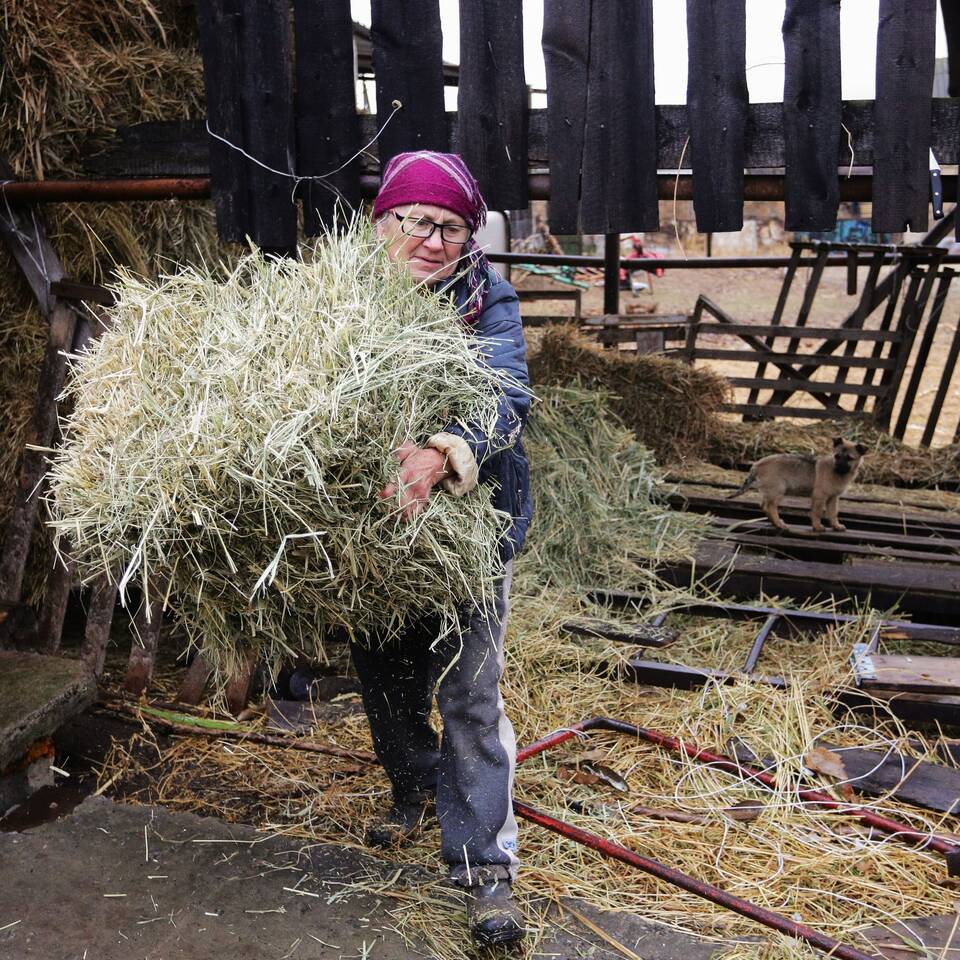
According to Florian and Toderoiu, the management and decision making process is of a traditional type, implying that family farms in Romania operate in a peasant economy. The farm economy is centered on self-consumption, with occasional commercial behaviour. One could say that a large portion of agricultural production of a subsistence type.

The impact of changes during the transition period on the environmental, social and economic sustainability of farming and farming systems

Toma reviews the problems related to agriculture and the environment (Toma, 1999). According to her, out of a total 16 million ha of agricultural land, 12 million ha are affected by factors such as erosion, water and salt excess, compacting, acidification, chemical pollution from pesticides, heavy metals, fluoride oil and similar substances. Only 3.7 million ha of the 10 million ha of arable land are suitable for a sustainable and efficient agriculture. Erosion is the biggest problem affecting about 6.3 million ha. Soil compaction has been observed on 6.5 million ha. Nutrient deficient areas, depending upon the nutrient, affect several million ha. Acidification is recorded to be present on 3.3 million ha, and chemical pollution on 0.9 million ha. Animal waste, like other discharges, affect watercourses and cause a high degree of deterioration.

Pollution from agriculture affects both surface and groundwater. The Danube basin is under particularly great pressure. The quality of drinking water is in many places low because of a high nitrate content. As far as air pollution is concerned, acid rain seems to be a problem of great concern. Methane (CH4), nitrous oxide (N2O) and ammonium nitrate (NH3) is emitted to the air.

Major constraints to more efficient and sustainable development of farming units

Toma notes that Romania is a country with a rich biodiversity, and an increasing awareness of environmental concern is taking place there (Toma, 1999). However, the financial constraints are large. The concern for ecologically sound cultivation methods is increasing. The problems are, however, very large. Therefore, one can assume that the constraints relating to adapting codes of good agricultural practices are an important aspect also in Romania. Dumitru regards the absence of an efficient land market as an important constraint blocking the development of the agricultural sector in Romania (Dumitru, 1997).

Florian and Toderoiu mention two critical factors affecting farm adjustment to structural change (Florian and Toderoiu, 1999): (a) still unclear legal ownership of land and related productive assets and (b) a lack of coherent sectoral strategies for agricultural development, both from the perspective of the utilization of available resources and from Romania’s agrifood sector complying with European competition rules and standards. These authors have also made a number of conclusions related to the increase of farm efficiency and food security. These recommendations should be taken into account in order to develop a sustainable farming system. Their observations are the following:

    1. The efficiency of resource and input utilization on family farms is diminished by the increase in the number of the active population employed in agriculture, as a result of the restructuring of the industrial sector and of the low capacity of employment in the services sector. As a direct consequence of this tendency, one can notice a increase of the population’s underemployment on family farms.
    2. The aggravation of this situation is also a consequence of reduced activity on family farms, for which there is no local turnover demand or demand in the markets in the surrounding area. At the same time, the human capital absorbed by agriculture from the industrial sector in recent years has professional skills and structures that are inadequate for an agriculture adjusted to the rigors of the market economy.
    3. Family farms can be characterized by a chronic decapitalization caused by:
Their recommendations are the following: In summary, farming systems in Romania are connected with large environmental and economic problems. Ownership rights are often unclear. Farmers are constrained by technical abilities, inputs and marketing. Farmers lack many institutions vital for agricultural development.

 
Next
Back to Table of contents