


At the UNFSS+4, FAO Director-General points to unlocking private sector investment by de-risking innovation and creating enabling environments
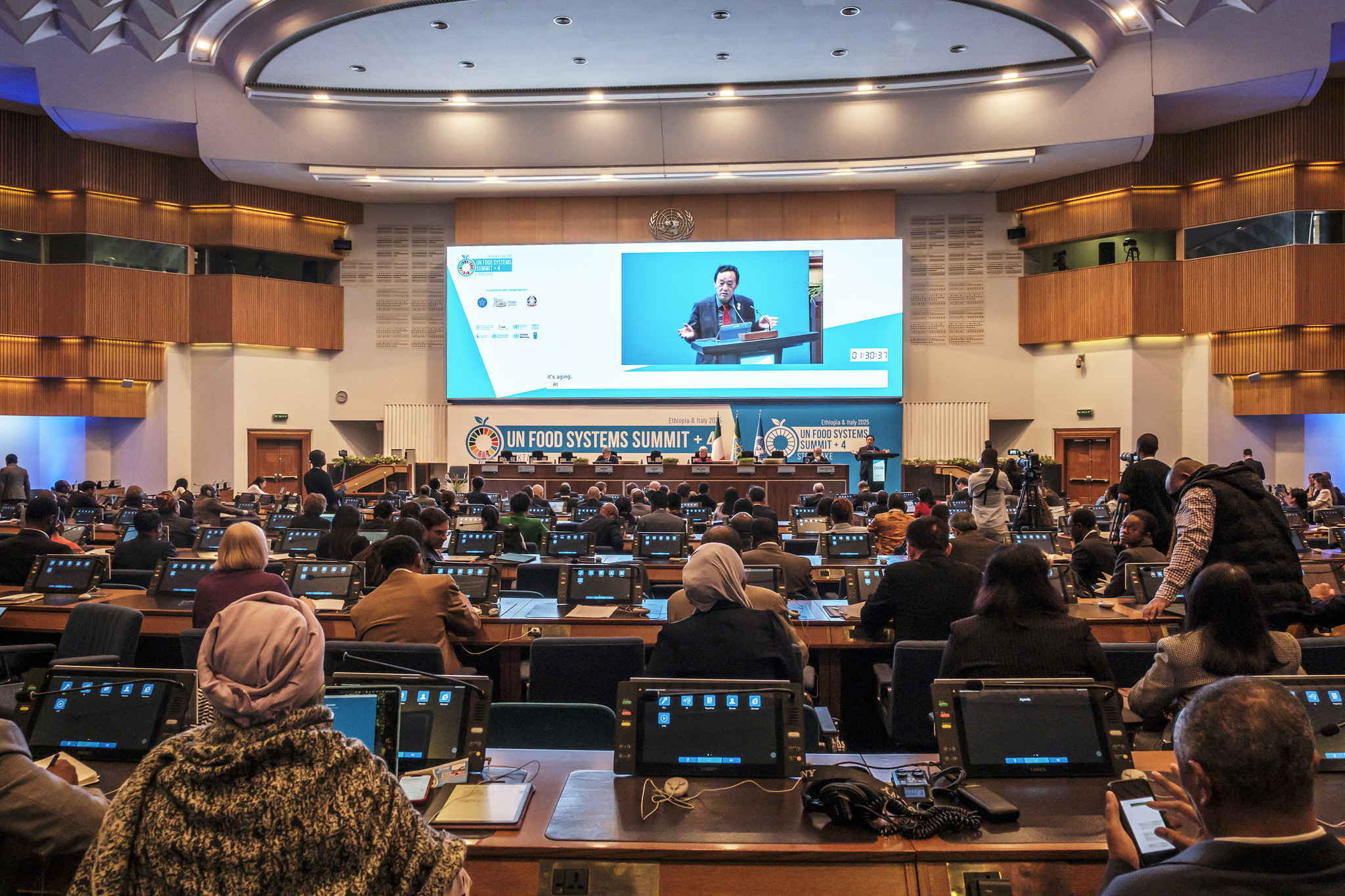
©FAO/Eduardo Soteras
Addis Ababa – “As we embark on this discussion on the transformation of agrifood systems it is critical that we be reminded of the global situation to have a clear understanding of the critical need for closer collaboration, on the need to align our actions for investments, and on the need to hold ourselves accountable,” FAO Director-General, QU Dongyu said today in his opening remarks of the “Transforming Food Systems Together” plenary session of the United Nations Food Systems Summit +4 Stocktake (UNFSS+4).
Taking place on the summit’s last day the event co-led by FAO, the International Fund for Agricultural Development (IFAD) and the World Food Programme (WFP) focused on the need for coordinated national and global action, inclusive governance, and collaboration for more sustainable, equitable, and resilient agrifood systems.
Amid limited resources, governments often struggle with disconnected initiatives that do not always align with national priorities. Agrifood systems, which sustain over 4.5 billion people but remain vulnerable to shocks, must be central to global efforts to end hunger, reduce poverty, and address escalating climate events.
Addressing the financing gap is key.
The FAO Director-General noted “financing should not only be through the public sector and traditional donors, but it is also time to focus on closer collaboration with the private sector.” The Business Engagement Work of the Summit played a critical role in forging this partnership forward. It is imperative that we unlock private sector investment, from small to global agribusinesses, and we should remember that smallholder farmers are important investors, he said.
The event featured diverse perspectives from speakers including Roberto Albino Mito, Minister for Agriculture, Environment and Fisheries of the Republic of Mozambique and Franklyn Derick Wasi, Minister for Agriculture and Livestock of Solomon Islands and Marco Antonio Oviedo Cajas, Vice Minister for Rural Development, Ministry of Agriculture and Livestock of Ecuador. They were joined by representatives from international financial institutions, the private sector, civil society, and academia to spotlight transformative efforts that demonstrate how investment in agrifood systems can generate both financial returns and social and environmental impact. The closing remarks were delivered by Salah Ahmed Jama, Deputy Prime Minister of the Federal Republic of Somalia.
The session charted a path forward, addressing the investment gap, while stressing that leaders should be held accountable not only for how resources are mobilised and aligned but also for their commitment to long-term transformation.
More inclusive agrifood systems at local and national levels
Building on the broader vision set by plenary session, the Ministerial Roundtable event, co-led by the Government of Italy and the African Union, focused on strengthening food sovereignty as a catalyst for agrifood systems transformation, backed by policies and investments to scale up local solutions.
The session highlighted how traditional agricultural, fishing, and pastoral practices are at risk and in need of adaptation to environmental, social, and economic challenges. As multifaceted risks - including the climate crisis, biodiversity loss, geopolitical conflicts and disruptions in global supply chains - continue to threaten food availability and access, scaling up local production and resilience is increasingly important.
In his remarks, the FAO Director-General underscored the need to scale up action in rural communities, emphasizing initiatives such as FAO’s Digital Villages Initiative which integrates tools, digital technologies and finances to ensure smallholder famers can also benefit.
The Roundtable event brought together Ministers from Ethiopia, Italy, Mozambique, Senegal, Somalia, South Africa and Tanzania, along with representatives from international organizations and agricultural producers’ groups, to share good practices that demonstrate how local cultures, and traditional knowledge can drive food sovereignty and self-determination.