


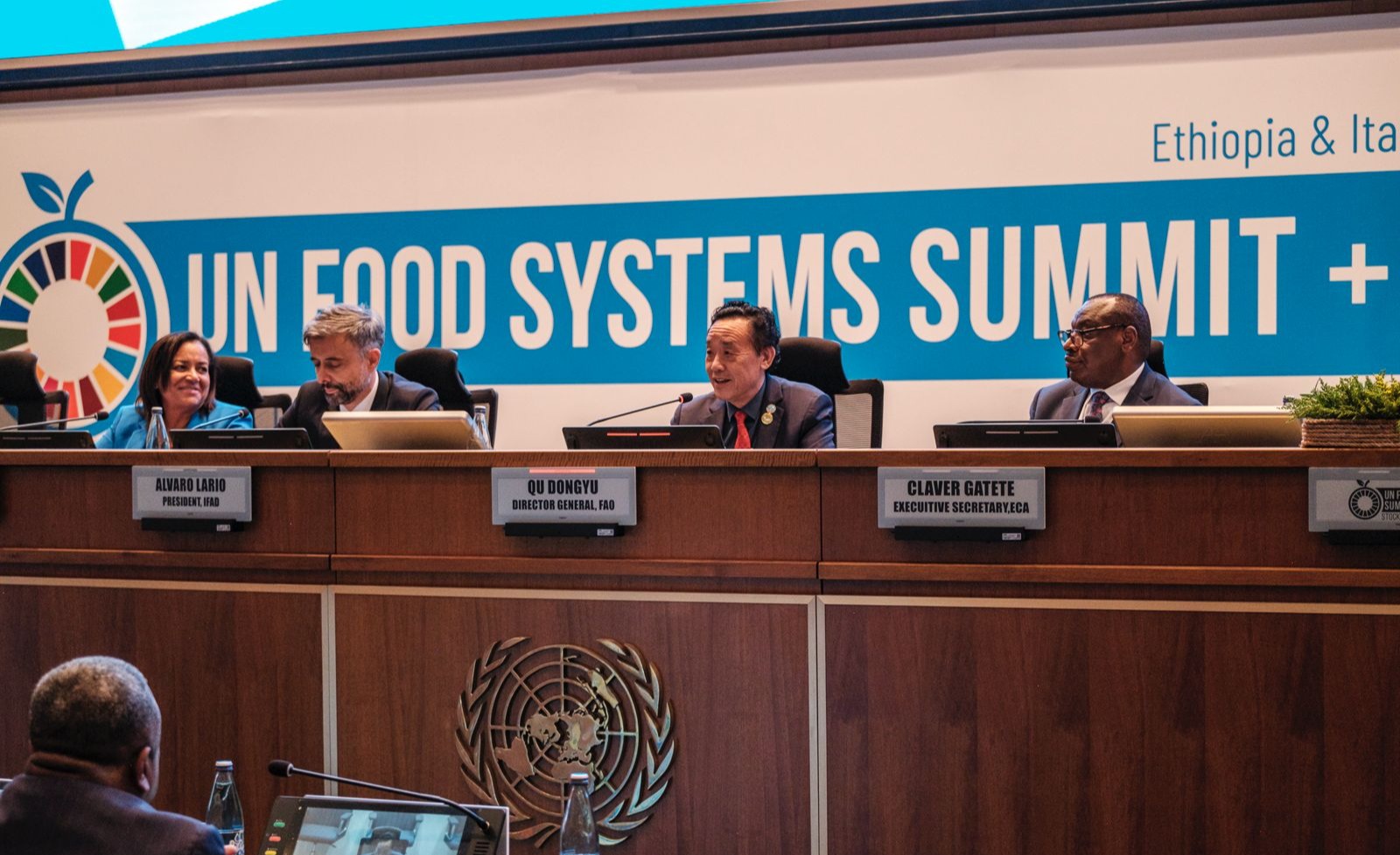
At UNFSS+4 closing, FAO Director-General says youth, science, technology and innovation, targeted investments and trust-based partnerships are key to transform agrifood systems
©FAO
Addis Ababa - FAO Director-General QU Dongyu in his remarks to the closing of the United Nations Food Systems Summit +4 Stocktaking Moment here today urged for targeted investment, youth empowerment, and stronger partnerships to drive forward the transformation of global agrifood systems.
Speaking to delegates attending the three-day summit, the Director-General described the gathering as a “pivotal moment” and an opportunity to reflect on the global community’s progress towards building more efficient, inclusive, resilient and sustainable agrifood systems. “We must feed a growing population, ensure food security, and guarantee access to healthy diets for all - today and for generations to come,” said Qu.
At a special summit event on Monday, FAO and its partners launched the 2025 edition of the State of Food Security and Nutrition in the World (SOFI) report, which, the FAO Director-General said, presented “sobering” new figures.
According to SOFI 2025, an estimated 8.2 percent of the global population, or about 673 million people, experienced hunger in 2024, down from 8.5 percent in 2023 and 8.7 percent in 2022. However, progress was not consistent across the globe, as hunger continued to rise in most subregions of Africa and western Asia.
Qu outlined four key takeaways from the summit discussions:
1. Youth must be at the center of transformation. “Youth are not only future farmers, processors, and service providers - they are also future leaders and policymakers,” the Director-General said. He noted that FAO recently launched the first global assessment on youth in agrifood systems, revealing that 1.2 billion young people will enter the workforce in the next decade. Inclusive access to land, finance, markets, education, and decision-making is vital.
2. Science, technology, and innovation are essential. “Science, technology, and innovation are not optional - they are a necessary condition,” he said. “We must scale up the solutions that work, and fast
3. Targeted and scaled-up investment is urgently needed. Traditional development finance alone is insufficient to drive agrifood systems transformation. “Financing remains inadequate, fragmented, and misaligned - especially in countries most vulnerable to food crises,” Qu said. He outlined the requirement of a “new financing paradigm” which could include three components: public resources to be used as catalysts; innovative financial tools; and a choice of instruments that must align with each country’s capacity and risk profile. The Director-General emphasized that only by changing the business model will lead to transformative impacts. He noted approvingly that these issues feature prominently during the summit’s Investment Dialogues.
4. Strong partnerships, especially with the private sector, are essential. The Director-General emphasized that transformation “demands strong, trust-based partnerships,” particularly with the private sector. “The private sector is not a supporting actor - it is a core partner in scaling innovation, deploying technologies, and unlocking capital,” he said. He called for a new model of collaboration based on shared value and mutual trust.
The Director-General reaffirmed FAO’s commitment to continue supporting countries in transforming agrifood systems in line with the Organization’s vision of the Four Betters: better production, better nutrition, a better environment, and a better life, leaving no one behind.
“Let us continue on this Long March together,” he concluded. “We have already taken the first steps until mission accomplished.”