


Director-General addresses future of agrifood systems at UN General Assembly events in New York
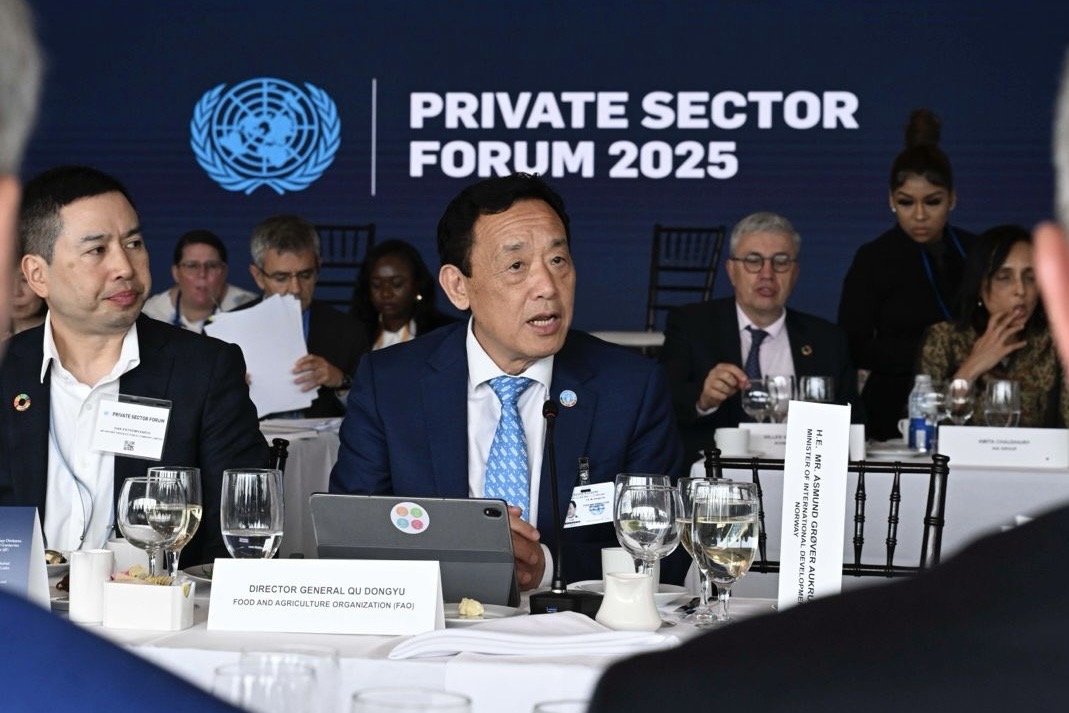
©FAO/Roberto Schmidt
New York – Over two days (22 and 23 September) during the 80th Session of the United Nations General Assembly, the Director-General of the Food and Agriculture Organization of the United Nations (FAO), QU Dongyu, together with a high-level delegation, participated in several high-level events to advocate for strategic pathways to transform global agrifood systems to be more efficient, inclusive, resilient, and sustainable.
One of the highlights was the FAO-organized event on 23 September to promote the Financing for Shock-Driven Food Crisis Facility (FSFC), an innovative mechanism aimed at addressing crises through anticipatory action.
The Director-General noted how the FSFC “offers a new model of anticipatory action ... to act before a crisis becomes a catastrophe.” It leverages FAO’s technical expertise in food security, early warning, and vulnerability analysis, along with its global data systems and field presence, to identify where and when shocks are most likely to drive hunger. The Director-General further emphasized that the Financing for Shock-Driven Food Crisis Facility “is about changing the logic of how we finance crises – moving from reaction to anticipation. From humanitarian aid to development.”
On the same day, FAO also participated in two other events: one on the Tropical Forest Forever Facility, an initiative proposed by the Government of Brazil, for which FAO and the World Bank collaborated to design an innovative, transparent, and robust monitoring approach; and the other on the Global Development Initiative (GDI), a multilateral development initiative announced by China in 2021, whose primary focus areas include ending poverty and hunger, expanding access to affordable clean energy, and reducing inequality while cutting pollution.
At the Tropical Forest Forever Facility event, FAO highlighted that the Organization continues to be a global leader in innovative forest monitoring and has supported 68 countries in developing their National Forest Monitoring Systems. FAO has launched Open Foris, one of the UN’s first open-source initiatives, and has worked closely with six tropical forest countries – Brazil, Colombia, Democratic Republic of Congo, Indonesia, Papua New Guinea and Peru (which together represent 70 percent of the world’s moist tropical forests) – to deploy Open Foris solutions for the collection of robust Facility-compliant datasets.
Regarding the Global Development Initiative (GDI), FAO noted that efforts to reduce global hunger have been lagging, with around 673 million people facing hunger and around 2.3 billion who were moderately or severely food insecure in 2024. The Organization emphasized that its readiness to work with all partners to strengthen the synergies between the Global Development Initiative, the Global Alliance Against Hunger and Poverty, and the Global Partnership for Poverty Alleviation and Development, among other important global initiatives.
First day at UNGA
On the opening day of UNGA, FAO Director-General QU Dongyu participated in four high-level events. The first was the World Economic Forum round table of The Stewardship Board on Agrifood Systems. FAO’s use of data and digital innovations, including artificial intelligence, are key to accelerating progress and unlock high-impact solutions across regions.
FAO also recognizes that innovation must be inclusive, ethical, and aligned with the needs of farmers, consumers, and communities. Achieving this requires strong partnerships across governments, the private sector, civil society, and the research community, with a focus on scaling digital public goods; fostering responsible innovation; and mobilizing investment and capacity.
Qu also spoke at the UN Private Sector Forum, hosted annually by the United Nations Global Compact on behalf of the UN Secretary-General. This forum provides a unique platform for private sector engagement with the UN and its global partners.
FAO emphasizes the indispensable role of the private sector in driving agrifood systems transformation as most investments in the sector originating from private actors, and over 1 billion people are employed globally in agrifood systems.
The third event of the day marked a high-level meeting to commemorate the 30th anniversary of the Beijing 4th World Conference on Women, a landmark moment for gender equality and women's empowerment. Women play a critical role in agriculture, and FAO recognizes that empowering women is central to ending hunger and malnutrition.
Yet, persistent barriers limit their access to resources, technology, and opportunities. The FAO 2023 Report on the Status of Women in Agrifood Systems shows that closing the gender gap between men and women in farm productivity could boost global GDP by nearly $1 trillion and reduce food insecurity for 45 million people.
To conclude the first day of activities in New York, the Director-General addressed the High-Level Event on Social Business, Youth and Technology.
Qu underscored that science and technology and big data, together with a holistic understanding of the two realities of society, both the rural and the urban society, are key to eradicating poverty, based on the business model of “small investment, big impact”.
He also stressed that social business means changing the way of thinking, especially when bringing together scientists and politicians. He further highlighted that “effective policy needs inclusive partnerships working together”. He described how FAO has embraced science and innovation, particularly through the establishment of the World Food Forum in 2021 “to bring together ideas and partners” for the benefit of the world’s most vulnerable, especially smallholder farmers.