


Director-General calls for forward-looking, agile Organization at 3rd Global Working Conference of FAO Representatives
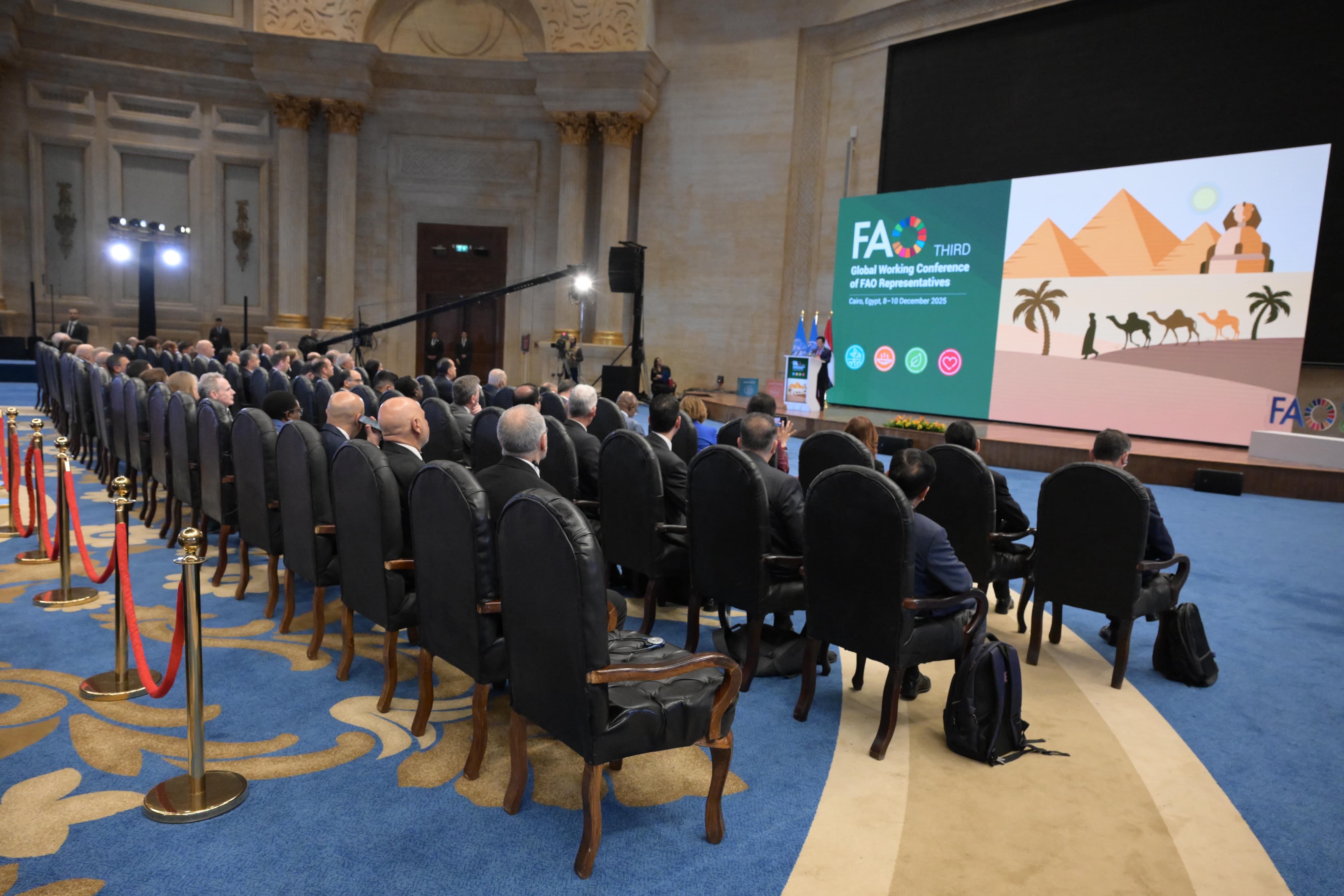
©FAO/Ahmed Elsheemy
Cairo/Rome – Director-General QU Dongyu opened the Third Global Working Conference (GWC) of FAO Representatives on Monday by calling on participants to adopt a proactive, agile, and forward-looking approach to ensure FAO’s strategies, programmes, and technical support remain aligned with the evolving needs of its Members.
Held from 8 to 10 December in Cairo and hosted by the Government of Egypt, the 3rd GWC facilitates direct dialogue between the Director-General, FAO Representatives, Core Leaders, and Senior Managers. The event aims to strengthen coordination between headquarters and decentralized offices. QU opened the conference by expressing gratitude to Prime Minister Mostafa Madbouly for his hospitality and support.
The gathering comes at a pivotal moment as FAO continues to seek even greater effectiveness and efficiency as it embarks with implementation of the Organization’s Programme of Work and Budget (PWB) 2026-2027 for the next biennium. The GWC’s Sessions will focus on consolidating FAO’s strategic positioning, accelerating transformation of global agrifood systems, and exploring innovative financing mechanisms and partnerships to maximize impact.
Unprecedented global environment
In his opening remarks, the Director-General reminded Representatives that the Organization is operating in an “unprecedented global environment, with food insecurity, conflicts, climate shocks, and economic uncertainty slowing down or even reversing the progress we achieved, leaving millions at greater risk of hunger.”
QU stressed that FAO must position itself to respond proactively to the rapidly evolving global context, which directly affects the scope and sustainability of its support to countries. He underscored that FAO’s work must be modern, fit-for-purpose, and strategically integrated across all levels of the Organization. Transformative partnerships, innovation, and technology are not optional, he added. “They are essential tools to enhance our technical capacity, fill knowledge gaps, and deepen collaboration, opening new pathways for transformation.”
Crucially, FAO must “move from crises response to resilience building,” the Director-General said.
FAO’s efforts in disaster risk reduction and anticipatory action are vital for safeguarding livelihoods and sustaining agrifood systems. Thanks to its country teams, FAO is recognized as a global leader in anticipatory action. Between 2023 and 2024, FAO supported around 2 million people annually and assisted governments and regional bodies in developing and adopting legislation, policies, and action plans.
FAO must also intensify advocacy and investment in anticipatory action, which QU described as critical to saving lives and protecting rural livelihoods.
The need for agility, innovation and continuous improvement
QU noted that increasingly complex environments require agility, innovation, and continuous improvement in programme delivery. Through its Efficiency Roadmap, FAO will keep streamlining processes, cutting costs, and boosting effectiveness across finance, procurement, logistics, HR, IT, and shared services.
To strengthen confidence among beneficiaries and donors in FAO’s operational capacity, the Organization has introduced a Supply Chain Action Plan - a modern, end-to-end approach to ensure critical inputs are delivered reliably to the right place at the right time.
Procurement has also been transformed into a more strategic, enabling, and decentralized function. Key achievements include the progressive Delegation of Authority to Decentralized Offices, reinforced risk management and internal controls, streamlined technical clearance processes, and the expanded use of digital tools and AI to improve efficiency, QU said.
Science and innovation remain central to the Director-General’s vision for a reinvigorated FAO, underpinning its Strategic Framework 2022-31 and demonstrating its commitment to the Four Betters: Better Production, Better Nutrition, a Better Environment and a Better Life – leaving no one behind.
As FAO celebrates its 80th Anniversary in 2025, the Director-General encouraged Representatives to engage fully, share experiences, and challenge assumptions.
“By working as One FAO, across headquarters, Decentralized Offices, and in partnership with Members, and all partners, we can ensure that our mandate translates into meaningful impact on the ground where it is needed the most,” Qu said.