
Towards a blue future: advancing sustainable fisheries and aquaculture in the western Mediterranean

The western Mediterranean is a highly productive area with significant biodiversity, supporting substantial aquatic food production and coastal economies. At the same time, it faces pressures such as overfishing, pollution and climate change, thus requiring strong management.
The western Mediterranean is one of the five subregions of the General Fisheries Commission for the Mediterranean (GFCM) of the Food and Agriculture Organization of the United Nations (FAO). It is supported by the GFCM Western Mediterranean Technical Unit in Málaga, Spain, which plays an active role in promoting cooperation and facilitating dialogue on major regional issues and cross-border challenges related to fisheries and aquaculture in Algeria, France, Italy, Morocco and Spain.
According to the recent report on The State of Mediterranean and Black Sea Fisheries 2025, the western Mediterranean accounts for the second highest number of landings (nearly 20 percent) in the GFCM area of application. Catches are widely diversified, with sardine (Sardina pilchardus) and sardinellas nei (Sardinella spp.) representing the most important species. The western Mediterranean leads in revenue and is among the GFCM subregions with the highest numbers of fisheries jobs, reflecting a strong and balanced sector.
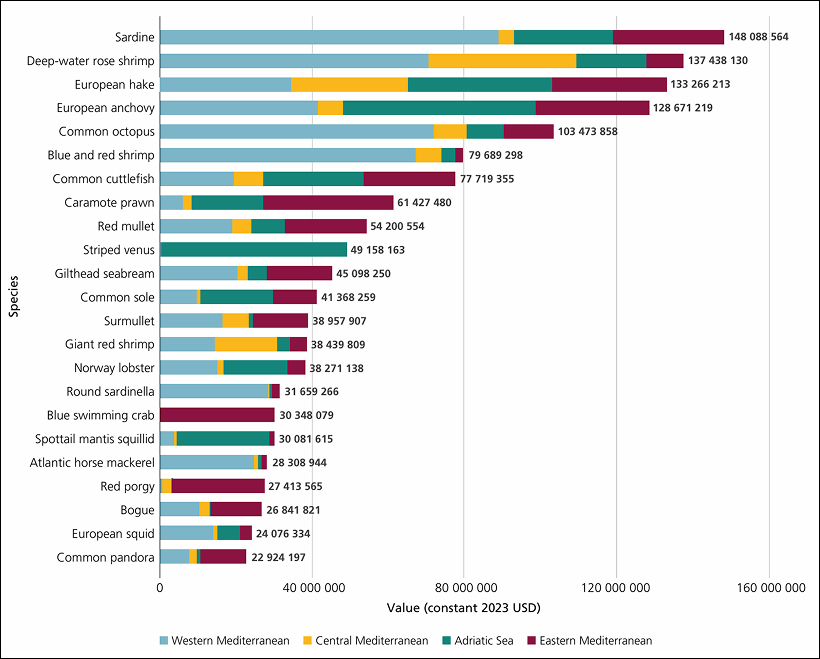
Main commercial species (in terms of value) in the GFCM Mediterranean subregions
Source: FAO. 2025. The State of Mediterranean and Black Sea Fisheries 2025. General Fisheries Commission for the Mediterranean. Rome.
Supporting the recovery of blackspot seabream
In the Alboran Sea, blackspot seabream (Pagellus bogaraveo) has traditionally been an important economic resource for local fishing communities in Morocco and Spain. It is listed as a priority species by the GFCM, which closely monitors its status to detect signs of overexploitation and identify possible management actions.
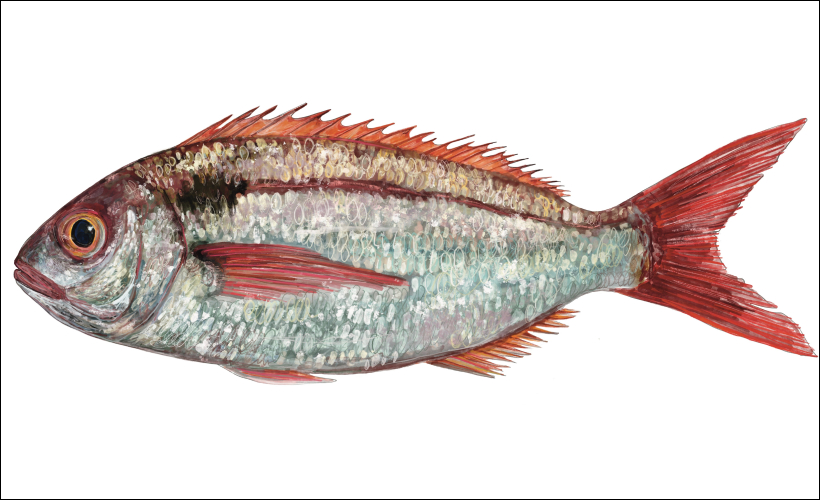
Blackspot seabream, a GFCM priority species ©GFCM/Ali Elly
In 2017, after detecting evidence of overfishing and overexploitation, the GFCM introduced two-year transitional management measures for this fishery. Building on this, the GFCM adopted its first multiannual management plan for the western Mediterranean in 2022, aimed at restoring the blackspot seabream stock to sustainable levels. Additional measures were adopted in 2024 to further strengthen the management plan.
Now entering its long-term phase, the management plan reached a key milestone in November 2025 when the GFCM adopted a harvest control rule to guide future annual catch limits for blackspot seabream. This marked the culmination of eight years of dedicated scientific and management efforts and is expected to guide the fishery towards achieving sustainability goals.
Promoting better science to support better management
In recent years, the GFCM has intensified its efforts to ensure a level playing field in the western Mediterranean and enhance the science available to inform good fisheries management.
The GFCM is actively promoting more and better science and strengthened cooperation between scientists and administrations. The MedSea4Fish capacity-development programme has been instrumental to this end and has enabled all countries in the subregion to participate on equal footing in a variety of activities, such as biological and socioeconomic data collection activities, surveys-at-sea, discards and incidental catch of vulnerable species monitoring programmes, and different research programmes, such as on European eel (Anguilla Anguilla), red coral (Corallium rubrum), recreational fisheries, and blue crabs (Callinectes sapidus and Portunus segnis).
“Through the implementation of the MedBycatch project and of the different follow-up activities under MedSea4Fish, Morocco has strengthened its capacity to monitor interactions between fisheries and vulnerable species, collect information, identify areas and gear types most associated with different types of interactions and test practical mitigation measures at sea”, said Mohammed Malouli Idrissi, Scientific Coordinator of the MedSea4Fish capacity development programme in Morocco. “The work carried out in the southern Alboran Sea has improved our understanding of bycatch patterns and supported trials to reduce interactions, in close collaboration with fishers. These initiatives are providing a solid scientific basis for more effective, ecosystem-based and science-based fisheries management, while supporting the sustainability of fisheries and fisher livelihoods.”
In addition, national research teams have received technical and scientific support through dedicated data preparation meetings and ad hoc trainings, such as the summer schools on stock assessment held in 2017 and 2024, to regularly complete high-quality scientific assessments of the most relevant stocks of priority species.
As a result of these efforts, the western Mediterranean now ranks first among all subregions in the number of assessed stock units, increasing from 26 in 2008 to 65 in 2023. This expansion is also reflected at the country level, with Spain and Italy, in this order, showing the largest increase in assessment coverage over time, particularly since 2018.
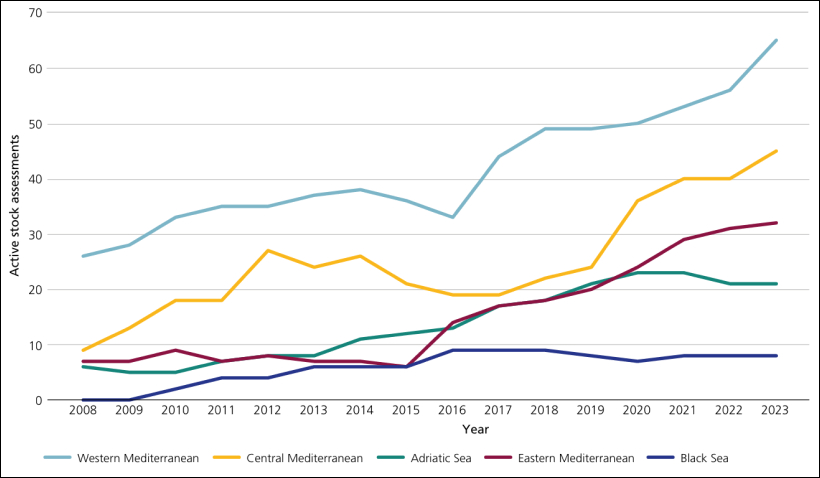
Active stock assessments per year by GFCM subregion, 2008–2023
Source: FAO. 2025. The State of Mediterranean and Black Sea Fisheries 2025. General Fisheries Commission for the Mediterranean. Rome.
By collecting and standardizing data, the GFCM can assess the health of fish stocks, identify key habitats and formulate sound advice for fisheries management.
“MedSea4Fish has significantly strengthened our capacity to collect and monitor fisheries data”, said Abderrahmane Hentour, Director of Monitoring and Technical Support for Fisheries and Aquaculture Activities at the Ministry of Agriculture, Rural Development and Fisheries of Algeria. “As a result, our country recently presented its first ever assessment for round sardinella (Sardinella aurita) – a species that represents 30 percent of our total catches. This year, our scientific team from the National Research Centre for the Development of Fisheries and Aquaculture will also conduct an acoustic survey-at-sea to assess the abundance of pelagic fish and collect crucial information to improve the quality of future fish stock assessments.”
Reducing and mitigating seabird bycatch
Between September 2023 and August 2025, GFCM-funded mitigation trials carried out by SEO/BirdLife in partnership with BirdLife International aimed to address the issue of seabird bycatch in the Balearic Islands, Spain, focusing on small-scale demersal longliners operating in the area (geographical subarea 5). This area is of relevance as the entire global population of Balearic shearwaters (Puffinus mauretanicus) breeds within the Balearic archipelago, along with an important population of Scopoli’s shearwater (Calonectris diomedea). The project was developed with the collaboration of local small-scale fishers, as well as the fisheries authority of the Balearic Islands, who provided support in the testing of mitigation measures.
The project improved data collection on incidental seabird catches, tested technical solutions to reduce bycatch from demersal longliners and assessed post-release mortality risks.
One of the main measures tested was a combined tori-line with coloured streamers and towed buoys, attached behind the vessel to scare away seabirds and prevent them from interacting with the fishing line. This measure was trialled during the peak bycatch season in 2025 in Mallorca, Spain with remarkable results in terms of deterring birds and preventing them from attempting to catch the bait. Additional tests in Catalonia found the method to be operationally feasible on commercial vessels.
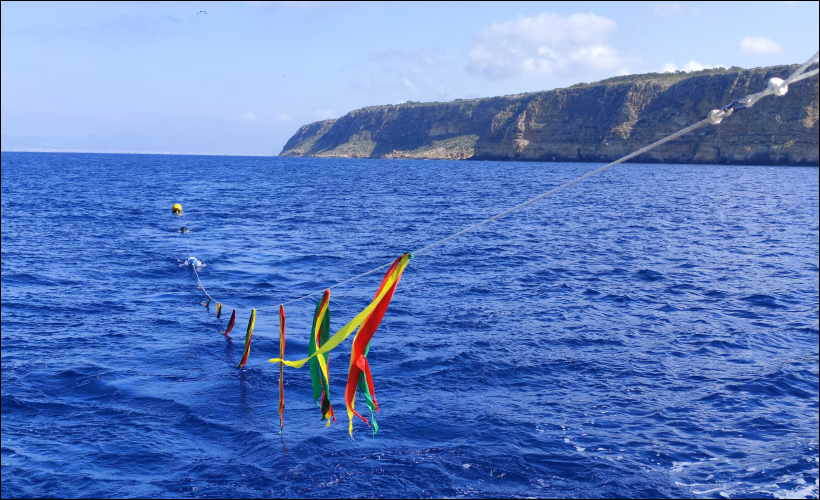
Tori-line in Mallorca, Balearic Islands, Spain ©SEO/BirdLife/Daniel Rey
Advancing restorative aquaculture
The GFCM is actively promoting restorative aquaculture – a farming approach that enhances ecosystem services while producing seafood – and species diversification towards lower trophic levels. Benefits of restorative aquaculture include improved water quality, habitat provision, climate resilience, ocean acidification regulation and the provision of livelihoods to coastal societies.
To this end, in 2025, the GFCM and the Department of Agriculture, Livestock, Fisheries and Food – Government of Catalonia inaugurated the Mediterranean Restorative Aquaculture Demonstration Centre, hosted at the facilities of the Institute of Agrifood Research and Technology (IRTA), in La Ràpita, Spain.
The centre held its first training on techniques for supporting restorative aquaculture practices in October 2025. Ten experts from seven countries attended the training which focused on bivalves, algae and grey mullet farming. Since its inauguration, the centre has become fully operational and expanded its role beyond training. It now contributes to the work of the GFCM by supporting the development of the first-ever regional guidelines on restorative aquaculture.
“Through discussions with colleagues from across the Mediterranean, we realized that many of the challenges we face are shared: rising water temperatures, sudden mortality events and non-indigenous species. By pooling expertise and working together, we can accelerate solutions, build on collective experience and strengthen responses across the region”, said Enric Gisbert, Head of the Aquaculture Programme at IRTA.
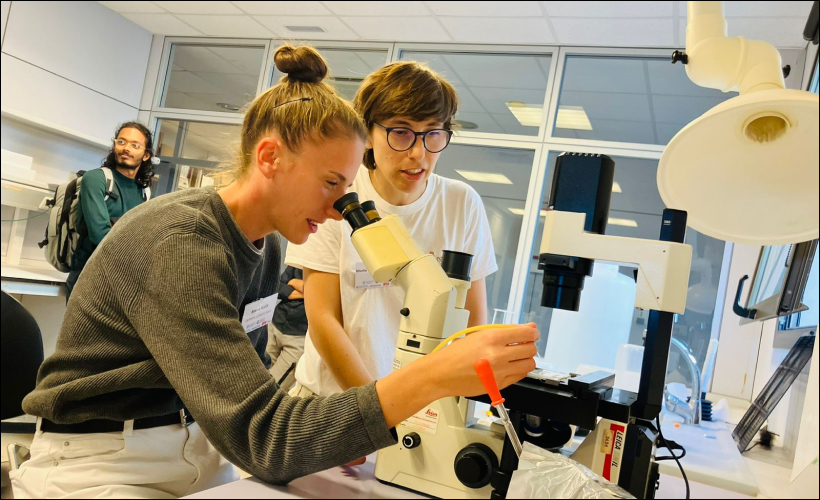
First training on restorative aquaculture at the Mediterranean Restorative Aquaculture Demonstration Centre in la Ràpita, Spain ©FAO-GFCM/Georgios Paximadis
Strengthening regional cooperation for restorative aquaculture and aquatic animal health
In the context of climate change, and building on its ongoing efforts in capacity development and coordinated regional action, the GFCM has mobilized through its Technical Advisory Group on Aquatic Animal Health leading Mediterranean experts, notably from Italy, France and Spain among others, to generate strategic knowledge on emerging pathogens and key aquatic animal health challenges affecting the aquaculture sector. This collective effort contributes to strengthening regional preparedness, improving knowledge sharing and supporting coordinated responses to transboundary risks impacting aquaculture sustainability.
Training national inspectors to support the fight against illegal, unreported and unregulated fishing
Illegal, unreported and unregulated (IUU) fishing remains a complex challenge in the region, particularly where monitoring and enforcement systems face resource and capacity constraints.
To address IUU fishing, the GFCM organizes training sessions for inspectors focused on strengthening national capacities in monitoring, control and surveillance (MCS), including the use of innovative technologies such as drones for sightings.
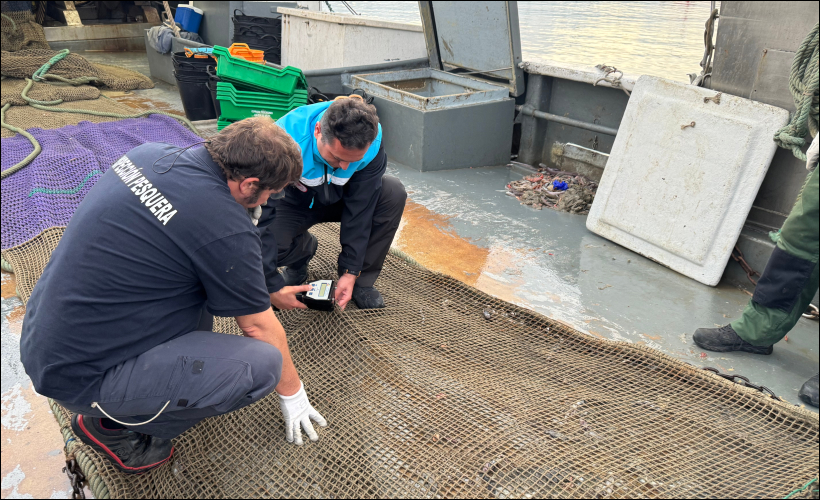
Monitoring, control and surveillance training, Málaga, Spain ©FAO-GFCM/Ahmed Siliman
In April this year, the GFCM Western Mediterranean Technical Unit in Málaga organized a regional training for inspectors from seven countries, including from Morocco and Spain in the western Mediterranean subregion. The training aimed to strengthen national capacities in MCS and to lay the groundwork for comprehensive national and regional assessments of IUU fishing.
Organized within the framework of the Global Environment Facility-funded project “Fisheries and ecosystem-based management for the blue economy of the Mediterranean” (FishEBM MED), the training combined legal, methodological and operational components, including guidance on harmonizing national frameworks with regional and international instruments, notably the series of FAO methodologies and indicators for quantifying IUU fishing. Participants benefited from targeted capacity development on risk assessment methodologies, MCS data collection and MCS tools, complemented by hands‑on training and field visits. Practical sessions included inspections of small‑scale fishing fleets and a simulated inspection at sea with the Spanish Civil Guard.
The initiative brought together Mediterranean and Black Sea countries, the GFCM Western Mediterranean Technical Unit, and Málaga-based national inspection authorities, including experts from the General Secretariat for Fisheries of the Ministry of Agriculture, Fisheries and Food of Spain.
The GFCM’s work in the western Mediterranean is made possible thanks to the financial support of the European Union, the main donor of the GFCM, as well as the support provided by the Global Environment Facility and the Government of Spain.
Cover image: School of fish swimming underwater ©Rich Carey