


Achieving SDG 2 without breaching the 1.5 °C threshold: A Global Roadmap
Hybrid Event, 24/01/2024
In 2022, 738.9 million people faced hunger, nearly 2.4 billion in 2022 lacked regular access to adequate food, and over 3.1 billion could not afford healthy diets. The pandemic added 120 million to the number of the chronically undernourished. In 2030, an estimated 590.3 million will suffer hunger. The planet faces crises, exceeding safe limits on six of nine planetary boundaries, and much of them is due to agrifood systems, which contribute 30 percent of anthropogenic greenhouse gas (GHG) emissions and impede climate goals.
Despite the Paris Agreement’s aims, warming rates point to a serious gap in meeting targets. Agrifood systems appear to face a dilemma: intensifying efforts to increase productivity while endangering climate goals – or curbing production to reduce emissions. This perceived trade-off has led to inaction and emboldens climate action skeptics who argue climate action harms efforts to address global hunger and malnutrition. Agrifood systems should address food security and nutrition needs and facilitate a large number of actions aligned with mitigation, adaptation and resilience objectives under the larger umbrella of climate action. The climate agenda itself could and should transform agrifood systems and mobilize climate finance to unlock their hidden potential.
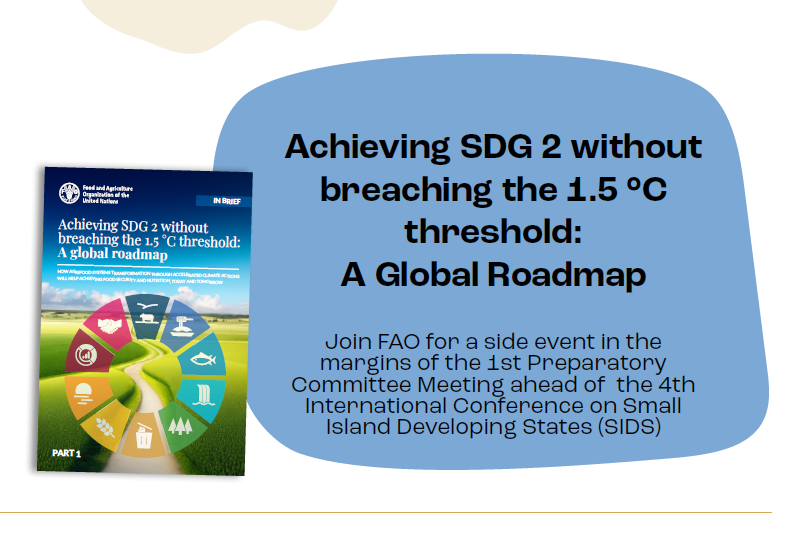
In the unfolding narrative of our global commitment to transform agrifood systems, FAO embarks on a presenting a Global Roadmap; Achieving SDG2 without breaching the 1.5C threshold.
Wednesday 24 January 2024
1.15 p.m.–2.30 p.m (EDT) in Conference Room 8 (UN HQ, New York) or stream on UN Web TV
AGENDA
Presentation of Achieving SDG 2 without breaching the 1.5 °C threshold: A global roadmap, Part 1 (fao.org)
- Máximo Torero Cullen, FAO Chief Economist (video message)
High-Level Panel with
- H.E. Walton Alfonso Webson, Ambassador and Permanent Representative of Antigua and Barbuda to the UN in New York
- Natalia Winder Rossi, UNICEF, Director of Social Policy and Social Protection
- David Laborde, Director, FAO Agrifood Economics and Policy Division
Closing remarks by
- H.E. Fatumanava-o-Upolu III Dr Pa’olelei Luteru, Ambassador and Permanent Representative of Samoa to the UN and Chair, Alliance of Small Island States (AOSIS)
Moderated by
- Angélica JácomeDirector, FAO Office of Small Island Developing States, Least Developed Countries and Landlocked Developing Countries