


TCP Changemakers
63f088688c104a16aa9b76b21832215d.png?sfvrsn=99e0c223_0 "Screenshot 2025-10-22 154347")
TCP as a Catalytic Project: Strengthening Subregional Fisheries Governance in the Horn of Africa
The Technical Cooperation Programme TCP SFE 3805, Assistance to Strengthen Governance of the Fisheries Resources of Somalia, Kenya, Djibouti and Eritrea during and after the COVID-19 crisis, has emerged as a catalytic intervention that significantly advanced subregional fisheries governance in the Horn of Africa. The highly productive and biodiverse Red Sea and the Indian Ocean face significant threats due to climate change, rising sea temperatures, and Illegal, Unreported, and Unregulated (IUU) fishing. IUU causes substantial economic losses, undermines sustainable stock management, and weakens long-term food security and livelihoods for fishing communities. In Somalia alone, unlicensed foreign vessels were estimated to harvest approximately 132 000 tonnes of fish annually, more than three times the official national production of 40 000 tonnes. Similar pressures were observed in Djibouti, Eritrea and Kenya, where vessels from several countries operated unlawfully across their maritime zones and routinely landed catches in neighbouring ports.
The TCP provided the first coordinated platform for four countries to assess their challenges and define a common approach jointly. Recognizing that no single country could effectively address these transboundary threats, the TCP supported a structured assessment and initiated cooperation processes across all four governments. FAO mobilized legal, policy and operational fisheries experts who applied a consistent methodology to evaluate each country’s implementation of the Port State Measures Agreement and other complementary monitoring, control and surveillance instruments. National workshops brought together key stakeholders, including fisheries administrations, port inspectors, customs services, and law enforcement agencies such as the navy and coast guard.
This was the first opportunity for many institutions to collectively examine their respective mandates, operational gaps and opportunities for strengthened cooperation. These discussions significantly improved interagency coordination and provided clarity on roles necessary for effective fisheries monitoring, control and surveillance.
Each country developed a strategy and roadmap outlining priority actions to improve legislation, institutional capacity, inspection procedures, information sharing and operational systems. At the subregional level, the project supported the development of a framework for a collaborative task force to increase information exchange, strengthen coordinated inspection processes and address cross-border IUU fishing more effectively. The TCP also facilitated exchanges with experts from East and West Africa, enabling participating institutions to learn from operational experiences in other regions and to identify practical measures to strengthen the implementation of the Agreement on Port State Measures and related enforcement tools.
Catalytic Effect and the New Trust Fund Project
The impact of the TCP extended well beyond its immediate technical results. The evidence generated, the strengthened partnerships and the clear prioritization of needs positioned Djibouti, Eritrea, Kenya and Somalia to attract further investment in long term fisheries governance strengthening. Building directly on the outputs of TCP SFE 3805, FAO successfully secured a new trust fund of 1.3 million USD from the African Development Bank through IGAD. This programme will further enhance fisheries governance, strengthen national capacities, harmonize regulatory frameworks, reinforce cooperation on monitoring, control and surveillance (MCS) and improve post-harvest value chains through targeted support such as cold chain upgrades and capacity building for cooperatives, with a particular focus on women involved in aquatic food handling.
TCP SFE 3805 is a clear example of how a technically focused and well-designed intervention can generate significant and lasting impact. By creating a platform for cooperation, building national capacity and providing high-quality evidence for decision-making, the TCP shifted the subregion from fragmented national responses to a coordinated and informed approach to marine resource management. It now serves as the foundation for sustained investment, improved fisheries governance and enhanced food security outcomes for coastal communities across the Horn of Africa.
Country: Sub Regional East Africa TCP Title: Strengthening Subregional Fisheries Governance in the Horn of Africa TCP/SFE/3805 (USD 300 000) Team: Phiri, David (Formulator); Farayi Zimudzi (Budget Holder); Woldemichael, Mesfin (Field Programme Support and Monitoring Officer) Nyarko-Badohu, Kwami Dzifanu (Funding Liaison Officer); Krifsa, Suela (Funding Liaison Officer); Van Der Knaap, Martinus (LTO Officer); Mbabazi, Dismas (LTO Officer); Camilleri, Matthew (HQ Technical Officer) |
|
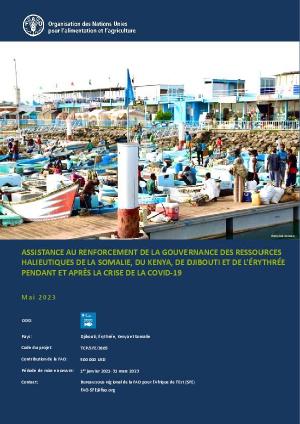 | Assistance au renforcement de la gouvernance des ressources halieutiques de la Somalie, du Kenya, de Djibouti et de l’Érythrée pendant et après la crise de la covid-19 |