

Water footprint of the banana industry

Agriculture consumes 70% of the world’s freshwater, drawn from aquifers, streams, and lakes. With the global population continuing to grow, food production is expected to increase by 70% by 2050, placing additional pressure on water resources. Banana plantations require a consistent and abundant water supply, as shortages can negatively impact crop growth and yields. As a long-duration crop, bananas have high annual water requirements, ranging from approximately 1,200 mm in humid tropical regions to 2,200 mm in dry tropical regions.
Given the critical role of irrigation and drainage in banana production, water consumption and pollution have long been key concerns for the industry, especially as consumers increasingly demand products with lower environmental impact 2. In response, the banana sector has implemented improved water management practices, significantly reducing its water footprint—defined as the measure of freshwater consumption and contamination associated with the production of goods and services 3.
Water footprint assessment
Water footprint assessment is a relatively new concept, and only a limited number of studies have been published on the topic. At the international level, efforts have been made to compare existing methodologies for quantifying environmental footprints related to water resource use 4.
Comparison of methodologies - environmental footprints and water use
Details | Hoekstra et al, 2011 | ISO, 2014 |
Methodology denomination | The Water Footprint Assessment Manual | ISO14046:2014, Environmental management – Water footprint – Principles, requirements and guidelines |
Author | Water Footprint Network (WFN) | International Standard Organization (ISO) |
Footprint denomination | Water footprint (Spanish: “huella hídrica”) | Water footprint (Spanish: “huella de agua”) |
Footprint definition | "Volumetric measurement of water consumption and pollution" | "Metrics that quantify the possible environmental impacts related to water" |
Scope | Defines a series of criteria and procedures for the calculation of the water footprint (WFP), classified in: blue, green, and grey. The blue WFP contemplates the consumptive uses of surface water and groundwater, and the green WFP those in which the source is rainwater. Grey WFP is the fresh water needed to assimilate contaminant loads. | Establishes principles, requirements, and guidelines for the development and reporting of a water footprint assessment, based on the LCA, of products, processes, and organizations. |
Footprint assessment steps | (i) Definition of the objective and scope, (ii) Accounting for the water footprint, (iii) Evaluation of the sustainability of the water footprint, (iv) Formulation of the water footprint response. | (i) Definition of the objective and scope, (ii) Analysis of the water footprint inventory, (iii) Evaluation of the impact of the water footprint, (iv) Interpretation of results. |
Results | Volume of consumptive water classified by the type of source from which it is taken (blue and green WFP) and volume of fresh water required to assimilate the pollutant load (grey WFP). The volumes are given per unit of product or time according to the scope definition. | Individual value of the impact or a profile of its results. The results are given according to the functional unit defined in the scope, which is a "quantitative indicator of the performance of the process or system, which is used as a reference and comparison unit.” |
Comments | This methodology was developed by professional members of the WFN partner organizations. Its application tends to be complex, so it includes a section of examples for different cases and frequently asked questions. It clarifies that WFP "is not a measure of the severity of local environmental impacts of water consumption and pollution." | Developed by the ISO / TC 207 Technical Committee of Environmental Management, and integrated by professionals from different fields and countries. A study can only be called "water footprint" if it is comprehensive (principle of integrality), meaning it includes all significant environmental impacts in relation to the availability and degradation of the resource. |
The steps to measure the water footprint of products, processes, and organizations are as follows:
- Definition of objectives
- Determination of the evaluation scope (in terms of geography and time)
- Data collection and accounting for each stage of the production process
- Calculation of the water footprint
- Assessment of the sustainability of the water footprint
- Recommendations for reducing the water footprint
Studies assessing the water footprint of banana cultivation and processing measure the impact in terms of water volumes consumed and contaminated per unit of product. Results vary significantly between countries. According to the Water Footprint Network (WFN), the global average water footprint for bananas is 790 m³/tonne6. The results depend on the production and processing system used, as well as the water source.
Activities contributing to the banana industry water footprint
Irrigation

Banana cultivation requires a large and frequent water supply throughout the production cycle to ensure productivity and fruit quality 7. The types of irrigation used for banana plantations include sub-foliar spray, supra-foliar spray, drip, or gravity-fed systems. The choice of irrigation system depends on the availability of resources and access to technology. Factors such as moisture retention, infiltration rate, evaporation, and overall water balance must also be considered 8.
Water management in banana plantations is a major concern since excessive pumping alters groundwater and surface water levels through the construction of wells, irrigation pumps, canal systems, and drainage networks. These changes affect the water balance and availability in nearby communities 9. To minimize social and environmental impacts, appropriate water management practices must be implemented.
Impact of Irrigation
Studies on large 10 11 and small 7 plantations have concluded that about 99% of the water footprint corresponds to the agricultural production phase. According to WFN analysis, the distribution of the blue, green, and grey water footprint depends on:
- The type of irrigation: In Costa Rica 10, where no irrigation is needed, 100% of the water footprint is green. In contrast, in Peru 7, where irrigation is heavily relied upon and systems are inefficient, 94% of the water footprint is classified as blue. Intermediate cases such as Honduras 10 or Ecuador 7 have blue water footprints between 20% and 34%, as they depend less on irrigation or employ more efficient systems.
- The production system: In conventional production systems, such as in Ecuador 7, the grey water footprint is approximately 18%, mainly due to nitrogen leaching from fertilization. In organic production systems, the grey water footprint is zero.
Several practices can improve water efficiency in banana plantations:
- Determining irrigation needs based on meteorological data.
- Measuring soil moisture levels at regular intervals. In multinational banana plantations, soil moisture is measured every 15 hectares at five monitoring points, with samples taken at depths of 0–15 cm and 15–30 cm.
- Applying irrigation based on water infiltration rate, soil physical conditions, moisture retention capacity, and evapotranspiration.
- Using thick layers of mulch to retain water and reduce evapotranspiration 11.
- Planting cover crops with native species along drainage canals and plantation areas.
- Using tensiometers to assess water needs. Two tensiometers can be placed at different depths (e.g., 25 cm and 60 cm), and irrigation is adjusted accordingly. In mixed soils or slopes, additional tensiometers may be required.
- Training irrigation staff on banana taxonomy, water needs calculation, environmental conditions affecting irrigation, and efficient irrigation system management.
- For sprinkler irrigation, ensuring uniform water distribution across the plantation by adjusting sprinkler distances or pipe diameters. Sprinklers closer to the pumping station tend to receive more water. In cases of significant discrepancies, spacing adjustments may be necessary.
- In gravity-fed irrigation systems, such as those in Peru 7, studies recommend reducing the total water volume per irrigation cycle while increasing frequency. This improves water efficiency and reduces overall consumption.
Packing stations
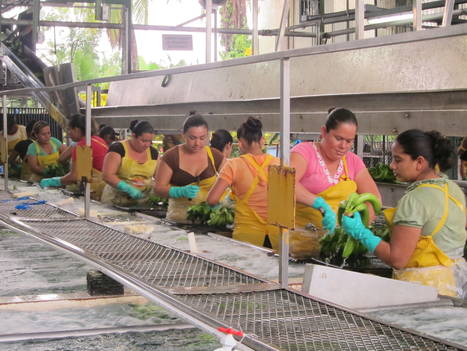
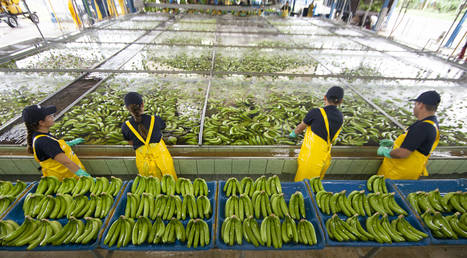
Banana Packing Stations and Water Use
Banana packing stations use water to remove waste, insects, and latex from the fruit. Water consumption varies depending on the processes used and the availability of water sources.
An analysis conducted in packing stations in Ecuador7, where water is abundant and inexpensive, found that the water footprint is higher than in Peru, where water access is limited and each station pays for the water it consumes. In Ecuador, the calculated water footprint was 576 m³ per tonne, with a WFN-based assessment showing that 48% was green water, 34% was blue water, and 18% was grey water. In Peru, the water footprint was 599 m³ per tonne, with 94% classified as blue water and 6% as green water.
Water-Saving Practices in Packing Stations
Banana companies have adopted water conservation measures7 11, including water recirculation and water quality monitoring to prevent fungal contamination. Some packing stations have implemented water recirculation systems that remove solids and latex, add chlorine, and allow water reuse for up to two weeks in the packing process.
Reducing water use in cleaning tanks and frequently monitoring discharged water quality—including microbiological and pesticide residue analysis— ensures that reused water meets quality standards. Water samples must be taken for laboratory analysis, with testing frequency varying based on packing station operations.
Other water-saving measures include:
- Performing de-handing and de-latexing in the field instead of in packing stations10.
- Using alum or latex-removal products in banana cleaning pools for more efficient latex removal and lower water consumption7.
- Adopting dry de-handing packing methods.
Results of Water Conservation Measures
Water recirculation systems reduce water consumption by approximately 80%12. According to a water footprint study of different processing plants11:
- A packing station without recirculation uses 1.3 liters of water per kg of banana.
- A packing station with water recirculation uses 0.05 liters per kg.
- A system incorporating de-handing and de-latexing in the field further reduces water use to 0.02 liters per kg.
These volumes are significantly lower compared to the water required for irrigation, which is around 500 liters per kg.
Similarly, Costa Rica’s National Banana Association (CORBANA) reported that implementing water recirculation systems resulted in:
- 55% less water consumption,
- 23% savings by reducing water depth in cleaning pools, and
- 19% savings by using additional cleaning agents to improve water quality13.
References
References
1 FAO; Earthscan. 2011. The state of the world's land and water resources for food and agriculture
2 Roibás, L. Elbehri, A. & Hospido, A. 2015. Evaluating the sustainability of Ecuador bananas: Carbon footprint, water usage and wealth distribution along the supply chain
3 Water Footprint Network. What is a water footprint?
3 HIDROCEC-UNA. Aplicación del cálculo de huella hídrica para regiones de cultivos de café, bananao y arroz en Costa Rica
4 Ana Lorena Vallejo. 2015. Metodología práctica para la cuantificación de la huella de agua en Plantas Empacadoras de banano en Costa Rica” Ana Lorena Vallejo Chaverri
5 Hoekstra, A., Chapagain, A., Aldaya, M. & Mekonnen, M. 2011. The water footprint assessment manual
6 Mekonnen, M. & Hoekstra, A. 2011. The green, blue and grey water footprint of crops and derived crop products
6 Water Footprint Network. Product gallery
7 Zarate, E; Kuiper, D. 2013. Water Footprint Assessment of Bananas Produced by Small Banana Producers in Peru and Ecuador
8 AUGURA. 2009. Buenas prácticas agrícolas en el cultivo de banano en la región del Magdalena
9 University of Victoria. 2002. The Ecological footprint of a Dole Banana
10 Soil & More International. 2011. Water Footprint Assessment Bananas and Pineapples Dole Food Company
11 LimnoTech. 2012. Water Footprint Assessment Banana and Lettuce Products Produced by Chiquita
12 Chiquita Brands International, 2012. Corporate Social Responsibility Report
13 CORBANA. 2013. Planificación e investigación para ahorrar agua en la industria bananera