Natural conditions, farming traditions, agricultural structures
Croatian agriculture had already been dominated by family farms before
the socialist era. Croatian farming between the two world wars and during
the socialist period was characterized by a significant percentage of predominantly
small farms rather than jointly-owned or state-owned, large farms. For
example, 75 percent of arable land and 97 percent of cattle were owned
by approximately 530 000 farms (Budin, 1999). Juračak and Kovačić mention
two prevailing agricultural production systems today in Croatia: (a) business
entities and (b) family farms (Juračak and Kovačić, 1999). After Croatia
gained independence in 1991, the former co-operative
farms were privatized and are now organized as private enterprises
or joint-stock companies. Part of the nationalized agricultural land has
been given back to its former owners or they have received some form of
compensation (Grgić et al. 1999).
The size distribution of individual farms is presented in Annex Table
6. From Table 6 it is evident that approximately a third of the farms are
1 ha in size or smaller. About one half of all farms are in the size class
comprising between 1 and 5 ha. According to Grgić et al , the average farm
size was about 3 ha in 1998 after the process for private purchase of the
state land (Grgić et al., 1999). Less than 3 000 farms have a size greater
than 20 ha.
Major types of farming systems resulting from the transition process
Grgić et al. state that out of more than 530 000 family farms about
100 000 to 150 000 are expected to develop commercial production. Agricultural
protection has been reduced with the aim of Croatia joining the World Trade
Organization (WTO). There is, however, a system of agricultural support
in Croatia whereby strategically important products are given a direct
price support. These products are protected by tariffs and variable levies,
while import quotas and special import taxes have recently been removed.
Average producer prices including state subsidies and prices of basic inputs
in 1997 have been reported (Grgić et al., 1999, p. 91-92).
In 1997, the total agricultural land area in Croatia was approximately
three million ha of land. Of this, around 1.9 million ha were arable and
around 1.1 million ha were pastures. The cultivated land is presented in
Annex Table 7.
The impact of the transition-period changes on the environmental, social and economic sustainability of farming and farming systems
Grgić et al. note that Croatian agriculture has been a rather insignificant
polluter of the environment and that family farms in particular have used
less potentially harmful inputs in agriculture (Grgić et al,1999). However,
these authors add that because of only secondary concern for the environment,
insufficient extension has caused an inadequate use of inputs and a disorganized
disposal of the waste and by-products of agricultural production. A legal
and institutional capacity for handling waste exists today. More important,
they note that a "considerable pressure of agriculture on the environment
is expected in the future due to an increased need for intensifying agricultural
production as one of the basic economic activities in Croatia.... There
is also a need to develop the concept of sustainable agriculture through
its basic elements, in particular land resources, sustainable land management,
and integrated pest management". In other words, there is a danger that
agriculture will intensify, without paying enough attention to the sustainability
issues.
In 1997 the average consumption of fertilizer was 205 kg/ha and the
average consumption of pesticides was 1.7 kg/ha of active ingredients.
For agricultural companies the consumption of fertilizers was higher, an
average 304 kg/ha, while it was 173 kg/ha on private family farms.
Like most other countries’ agriculture, Croatian agriculture emits
greenhouse gases and ammonia. Agriculture’s share of total methane (CH4)
emissions is 25 percent. Its share of total nitrous oxide (N20) emissions
is 66 percent, as is its share of ammonia (NH4) emissions. In certain areas,
such as at the basins of the rivers Drava and Neretva, some damage in biodiversity
has been caused. Erosion is a problem in some areas, like in the center
of the Istra peninsula. More than 90 percent of the soils in Croatia are
subject to varying degrees of erosion (Grgić et al., 1999).
Judging from the report by Grgić et al., it can be concluded that the
environmental problems connected with agriculture currently are of a smaller
magnitude than in many other countries on the whole (Grgić et al., 1999).
It can be debated whether it will stay so in the future. Measures to prevent
the emergence of unsustainable farming systems may be appropriate.
Major constraints on more efficient and sustainable development of farming units
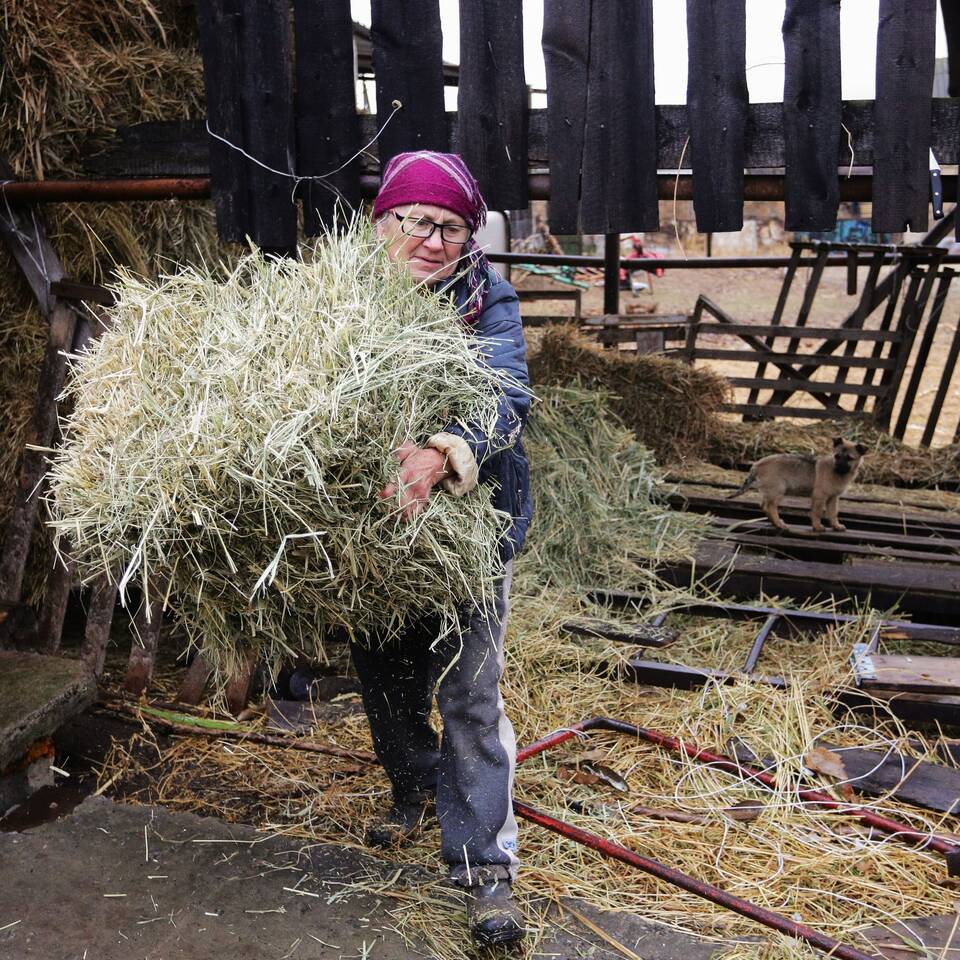
Farming in Croatia is essentially family farming. Constraints on economic
sustainability and on more efficient and sustainable development of farming
units seem to be related both to inadequate resources and equipment and
a lack of extension and training. Traditional methods of production in
combination with the unfavorable economic situation of family farms have
caused a decrease in inputs. Pollution from agriculture seems to be much
less pronounced than in many other countries. Anticipated technological
process and intensification implies a potential danger for the environment
in Croatia. Furthermore, a system for collecting detailed information about
soil conditions seems to be lacking.
In order to guarantee sustainability of the farming systems of Croatia
as a whole, it seems necessary to create conditions for the economic development
of farms combined with preventive measures combating a degradation of the
environment. Environmental problems connected with agriculture are small
or at least have not been reported in the studies encountered.
|
|
|