Reports on Surveys with R/V Dr. Fridtjof Nansen
NORAD/UNDP/FAO PROGRAMME
Institute of Marine Research, Bergen
|
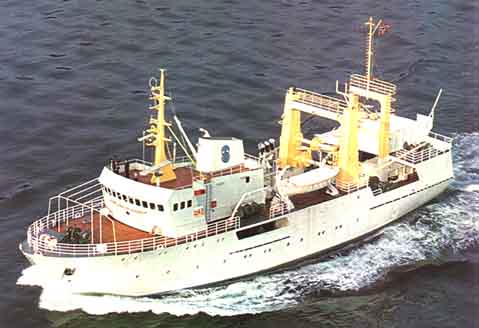
«Dr. Fridtjof Nansen» The fishery research vessel «Dr. Fridtjof Nansen" belongs to the Norwegian Agency for Development Cooperation (NORAD). It was designed and built for scientific and exploratory investigations of fishery resources of developing countries, under a joint plan with the Fisheries Department of FAO. A list of the vessels operational assignment from 1975 to 1987 is shown on the back cover. The Institute of Marine Research. Bergen is under a subcontract with NORAD responsible for the operation of the vessel, and the various research programmes were planned and conducted jointly with FAO and the relevant fisheries research organizations in the countries concerned. Results of the previous surveys have been presented in a
number of cruise-and progress reports under each programme. |
Bergen, November 1989
The designations employed and the presentation of material in this publication do not imply the expression of any opinion whatsoever on the part of NORAD or the Food and Agriculture Organization of the United Nations concerning the legal status of any country, territory, city or area or of its authorities, or concerning the delimitation of its frontiers or boundaries.
This report was prepared at the Institute of Marine Research (IMR), Bergen, Norway under the responsibility of T. Strømme and G. Sætersdal. Chapter 2.1 Hydrography was kindly contributed by dr. ph. H. Gade, Institute of Geophysics, University of Bergen and chapter 2.2 Faunistic Regimes by Gabriella Bianchi, Institute of Fisheries Biology, University of Bergen. Diana Zaera from the National Fund for Agricultural Investigations, Venezuela has kindly translated the report into the Spanish language. The invaluable assistance of O. Alvheim and H. Ullebust is acknowledged as is also the considerable input of work from the scientists of the region who participated in the surveys. A list of these scientists is shown under 1.4 below.
This electronic document has been scanned using optical character recognition (OCR) software and careful manual recorrection. Even if the quality of digitalisation is high, the FAO declines all responsibility for any discrepancies that may exist between the present document and its original printed version.
1.1 OVERVIEW OF THE FISHERIES AND PREVIOUS RESEARCH IN THE REGION
1.2 PROGRAMME OBJECTIVES
1.3 METHODS OF INVESTIGATION, INSTRUMENTS AND EQUIPMENT
1.4 EFFORT OF INVESTIGATION
1.5 FISH TAXONOMY
CHAPTER 2. THE ENVIRONMENT - ECOLOGICAL REGIMES
2.1 HYDROGRAPHY
2.2 FAUNISTIC REGIMES
2.3 THE SHELF AND SLOPE, AREAL EXTENTIONS AND BOTTOM CONDITIONS
3.1.1 Small pelagic fish
3.1.2 Demersal resources
3.1.3 Overview and discussion of survey results3.2.1 Small pelagic fish
3.2.2 Demersal resources
3.2.3 Overview and discussion of survey results3.3.1 Small pelagic fish
3.3.2 Demersal resources
3.3.3 Overview and discussion of survey results3.4.1 The north coast
3.4.2 The east coast
3.4.3 The Joint Fishing Zone
3.4.4 Review of survey results for Trinidad and including the Joint Fishing Zone3.6 The west coast from Cabo Codera to the Paraguana Peninsula
3.7.1 Small pelagic fish
3.7.2 Demersal resources
3.7.3 Overview and discussion of survey results3.8 The Guajira Peninsula to Sta. Marta
3.9 Sta. Marta to Gulf of Morrosquillo
3.9.1 Small pelagic fish
3.9.2 Demersal resources
3.9.3 Overview and discussion of survey results
ANNEX 1. ACOUSTIC INSTRUMENTS AND THEIR CALIBRATION, DESCRIPTION OF THE FISHING GEAR