


New FAO course on Geospatial Planning for Territorial Development reaches more than a thousand enrollments in just four weeks
28/11/2025
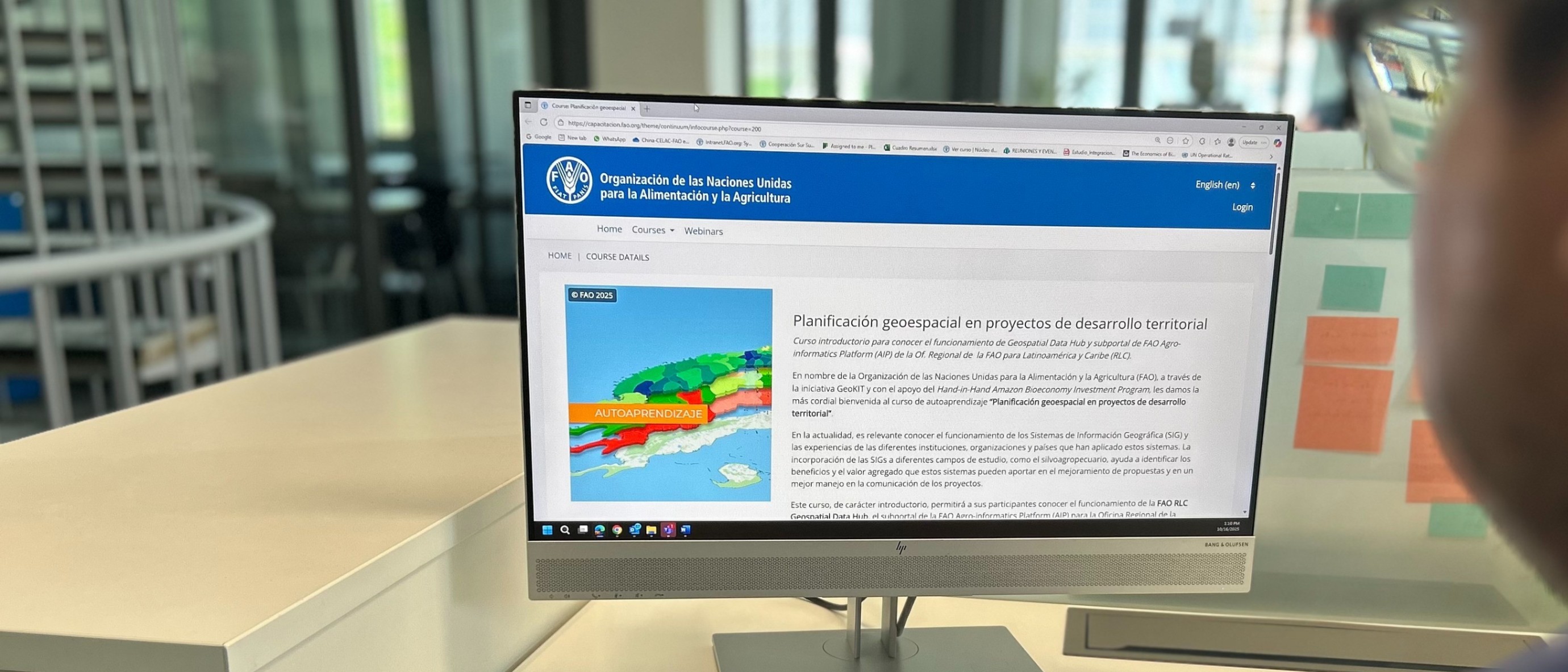
FAO’s new Spanish-language course “Geospatial Planning for Territorial Development” (Planificación geoespacial en proyectos de desarrollo territorial) has achieved remarkable success, surpassing 1000 enrollments only four weeks after its launch on FAO Campus, the capacity development and knowledge management area of the FAO Regional Office for Latin America and the Caribbean.
Presented during the World Food Forum (WFF) flagship event, this self-placed and free course offers an introduction to the Hand-in-Hand (HiH) methodology and provides practical tools to understand how the FAO RLC Geospatial Data Hub, FAO Agro-informatics Platform (FAIP)’s subportal for the FAO Regional Office for Latin America and the Caribbean (RLC), operates. The Platform is one of FAO’s most powerful tools for evidence-based planning, supporting governments in collecting, visualizing, and analyzing data to identify opportunities and investment priorities.
“The FAIP represents a milestone in FAO’s digital agenda,” said Karl Morteo, Senior Technology Officer of the Digital FAO and Agro-informatics Division. He added, “this course is a direct example of how we are translating our digital progress into learning that really helps users understand the data and apply the tools we offer.”
Designed as a hands-on course, the “Geospatial Planning for Territorial Development” guides participants through the uses of geographic information systems (GIS). Through practical exercises, it demonstrates how to plan and communicate development projects using geospatial data.
After only four weeks, the course has already attracted a notably young and diverse audience: nearly 50% of learners are under 30, and the institutional distribution includes 26% from academia, 22% independent professionals, 21% public administration, 13% NGOs and international organizations, and 10% private sector actors. Participants come from 27 countries, with the highest representation from Colombia, Ecuador, Chile, and Peru.
Welcoming the strong interest, Luiz Beduschi, FAO Senior Policy Officer for Territorial Development, encouraged governments, decision-makers, and strategic partners to explore this remarkable tool. “I invite everyone to take advantage of this learning opportunity and join us in building a more prosperous and sustainable future. Together, we can use technology and evidence-based planning to transform our agrifood systems and improve the lives of millions of people around the world,” he said.
The course is open to students, professionals, and public officials with no prior GIS experience, aiming to make digital agriculture tools more accessible and inclusive. By promoting open access to knowledge and digital solutions, FAO continues to strengthen evidence-based decision-making and facilitate the identification of solutions that effectively respond to local challenges and generate a positive impact on rural livelihoods.
Through FAO Campus, which offers more than 90 free courses covering a wide range of topics aimed at government officials, decision-makers, academics, and students, the Organization continues to promote learning opportunities for sustainable development.
With this initiative, FAO reaffirms its commitment to transforming agrifood systems to make them more efficient, inclusive, resilient, and sustainable — leaving no one behind.
Access the course here
Read the Launch press release - October 16th, 2025 (Spanish)
Presented during the World Food Forum (WFF) flagship event, this self-placed and free course offers an introduction to the Hand-in-Hand (HiH) methodology and provides practical tools to understand how the FAO RLC Geospatial Data Hub, FAO Agro-informatics Platform (FAIP)’s subportal for the FAO Regional Office for Latin America and the Caribbean (RLC), operates. The Platform is one of FAO’s most powerful tools for evidence-based planning, supporting governments in collecting, visualizing, and analyzing data to identify opportunities and investment priorities.
“The FAIP represents a milestone in FAO’s digital agenda,” said Karl Morteo, Senior Technology Officer of the Digital FAO and Agro-informatics Division. He added, “this course is a direct example of how we are translating our digital progress into learning that really helps users understand the data and apply the tools we offer.”
Designed as a hands-on course, the “Geospatial Planning for Territorial Development” guides participants through the uses of geographic information systems (GIS). Through practical exercises, it demonstrates how to plan and communicate development projects using geospatial data.
After only four weeks, the course has already attracted a notably young and diverse audience: nearly 50% of learners are under 30, and the institutional distribution includes 26% from academia, 22% independent professionals, 21% public administration, 13% NGOs and international organizations, and 10% private sector actors. Participants come from 27 countries, with the highest representation from Colombia, Ecuador, Chile, and Peru.
Welcoming the strong interest, Luiz Beduschi, FAO Senior Policy Officer for Territorial Development, encouraged governments, decision-makers, and strategic partners to explore this remarkable tool. “I invite everyone to take advantage of this learning opportunity and join us in building a more prosperous and sustainable future. Together, we can use technology and evidence-based planning to transform our agrifood systems and improve the lives of millions of people around the world,” he said.
The course is open to students, professionals, and public officials with no prior GIS experience, aiming to make digital agriculture tools more accessible and inclusive. By promoting open access to knowledge and digital solutions, FAO continues to strengthen evidence-based decision-making and facilitate the identification of solutions that effectively respond to local challenges and generate a positive impact on rural livelihoods.
Through FAO Campus, which offers more than 90 free courses covering a wide range of topics aimed at government officials, decision-makers, academics, and students, the Organization continues to promote learning opportunities for sustainable development.
With this initiative, FAO reaffirms its commitment to transforming agrifood systems to make them more efficient, inclusive, resilient, and sustainable — leaving no one behind.
Access the course here
Read the Launch press release - October 16th, 2025 (Spanish)