
Private Sector Brown Bag Lunches Series: Women in Agribusiness – Stories from the frontlines
On 26 June 2025, the Private Sector Unit (PSUS) of the Partnerships and UN Collaboration Division (PSU) hosted its third Brown Bag Lunch session, "Women in Agribusiness: Stories from the Frontlines”. The event highlighted the pivotal role women play in transforming agrifood systems. The session brought together entrepreneurs and mentors for a candid conversation on empowerment, equity, and private sector partnerships.
Carlos Watson, Chief of PSUS, opened the session by emphasizing the critical need for inclusivity in agrifood systems: “Achieving the 2030 Agenda is simply not possible if women, who make up a huge part of the world’s agricultural workforce, continue to face unequal access to land, finance, technology, and markets,” he stated.
Carlos also highlighted the success of the Women's Accelerator Programme – an initiative launched in partnership between FAO and the International Agri-Food Network (IAFN), which has supported over 150 women entrepreneurs across Africa since 2022.
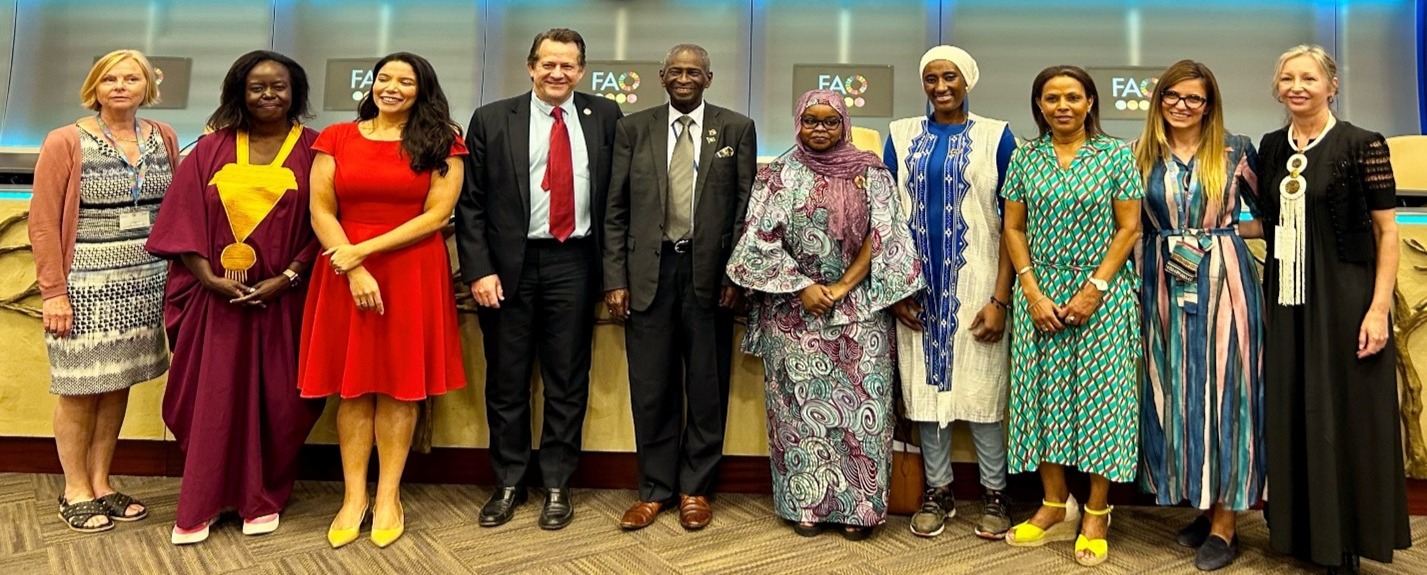
The panel, moderated by PSU Deputy Director Fatouma Seid, featured three mentees and one mentor from the programme. Each participant shared a compelling and unique narrative shaped by subjective experiences, professional ambition, and a shared determination to reshape the sector.
Zainab Lawal Gwadabe, who leads The Seed Project Co. Ltd., one of Nigeria’s few women-run seed companies, described navigating a male-dominated industry where loans for women can carry interest rates as high as 38 percent. She further described the cultural and institutional hurdles she faces: “I went to a community leader to lease land for seed multiplication. He put his head down, he felt insulted that a young woman would come to him for business.” Undeterred, Zainab has trained over 45 000 farmers across six Nigerian states and advocates for more inclusive financing and mentorship opportunities for women in agriculture.
Rokiatou Traoré, founder of Herou Alliance in Mali and a mentee, is using agroforestry not only to restore degraded land but also to empower women economically. Through sustainable value chains built around the native Moringa tree, she is creating jobs and revitalizing ecosystems. By 2030, her goal is to support 15 000 women and youth.
In Kenya, Bella Akinyi, founder of Bolena, is transforming fish farming, especially tilapia fish, in a region where it is traditionally taboo for women to even board fishing boats. She has helped build a thriving network of over 2 000 fish farmers – most of them women. Her approach promotes sustainable aquaculture, fosters job creation, community engagement, and improved access to local food sources.
From a mentor’s vantage point, Tatiana De Paula Campos, Executive Director of the International Fruit and Vegetable Juice Association (IFU), underscored the power of mentorship in connecting the global private sector to grassroots innovation. She described how it creates bridges between the global private sector and grassroots entrepreneurs. Through knowledge-sharing and access to global networks, mentors help women entrepreneurs to turn ideas into scalable, impactful businesses.
Across the discussion, one message stood out clearly: women in agribusiness need more than encouragement – they need real investment. This includes financial products tailored to women, support access to and strengthen local markets, and training that addresses gender norms along the agrifood value chain.
The event closed with a graduation ceremony for the third cohort of the Women’s Accelerator Programme, led by IAFN’s Robynne Anderson. It was a moment of celebration to recognize achievements, but also a call to action. Empowering women in agribusiness is not just a matter of equity, it is essential for building resilient food systems, reducing poverty, and achieving the Sustainable Development Goals. These women are not only surviving in a challenging sector, but they are also redefining it.