


Walking the talk on environmental sustainability
The FAO Corporate Environmental Responsibility (CER) Strategy 2020-2030 serves as a framework and blueprint for action, to mainstream environmental sustainability throughout the Organization’s processes, operations and decision-making.
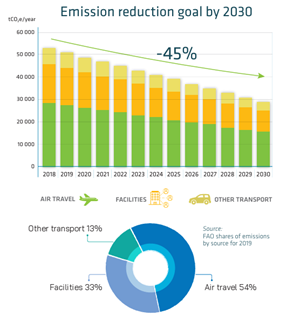
The Strategy sets the objective of reducing FAO total GHG emissions by 45% by 2030 compared to 2018 levels, compensating the unavoidable emissions and reducing its overall ecological impact. This target is fully aligned with the United Nations Strategy for Sustainability Management 2020–2030 which aims to align principles of environmental sustainability of UN management (facilities and operations) with environmental and social standards in UN programming.
The Strategy defines FAO’s commitment and strategic direction, positioning the Organization as an active participant in the global sustainability agenda and a contributor to environmental stewardship worldwide.
CER's objectives
The goals of the CER Strategy will require the systematic integration of environmental considerations throughout FAO's facilities and operations, projects and programmes. To this end, the following objectives have been established, to be met by 2030:
- achieving a 45 percent reduction in total GHG emissions related to the Organization’s operations by 2030 (compared to a 2018 base year);
- environmental mainstreaming in programmes and operations;
- integrating considerations regarding environmental sustainability into procurement processes, operations, and staff core competencies;
- updating travel policies to significantly reduce travel-related GHG emissions;
- promoting the increased use of renewables and avoiding the use of diesel generators, while concurrently reducing energy needs through energy audits, behavioural changes, and awareness campaigns;
- improving waste management practices by undertaking activities that integrate systematic waste monitoring, minimize solid waste generation to reduce landfilling, increase waste separation, and improve recycling schemes, circularity of goods and take-back schemes, and phase out single-use plastics; and
- improving water use by enhancing efforts to monitor, measure, and report water usage while encouraging the implementation of measures to strengthen water efficiency, and improving waste water treatment to avoid pollution of air, soil, and water bodies.

To achieve these goals, FAO works through the Corporate Environmental Responsibility (CER) team within the Logistics Services Division (CSL). The CER team is responsible for advancing these objectives across headquarters facilities and operations, while also providing guidance and support to Decentralized Offices, in accordance with FAO's Corporate Environmental Responsibility Policy.
Each year, the team carries out its Environmental Inventory Exercise to measure the environmental footprint of FAO.
The Environmental Inventory goes beyond tracking numbers; it provides actionable insight into FAO’s environmental performance and areas for improvement.
Main areas of intervention


Resources
- FAO Corporate Environmental Responsibility (CER) Strategy 2020-2030
- FAO Corporate Environmental Responsibility (CER) Strategy 2020-2030 brochure
- FAO Corporate Environmental Responsibility Policy
- Strategy for Sustainability Management in the United Nations System 2020-2030
- FAO's corporate environmental responsibility. Annual report 2025