FAO.org

ITPS | Soil letters
The series of the ITPS soil letters aim to provide to the general public concise and clear information on one topic linked to the work and activities led by the Intergovernmental Technical Panel on Soils (ITPS). It is planned to publish about 8 letters per year. This series are in line with the Sustainable Development Goals and the FAO’s Strategic Objectives and contributes to the efforts of ending hunger, malnutrition, climate change adaptation, land degradation and overall sustainable development.

Towards a definition of soil health #1
Year of publication: September, 2020
Place of publication: Rome, Italy
Author: FAO/ Intergovernmental Technical Panel on Soils
Publisher: FAO
Abstract: The Intergovernmental Technical Panel on Soils (ITPS) defines soil health as “the ability of the soil to sustain the productivity, diversity, and environmental services of terrestrial ecosystems”. In managed systems, soil health can be maintained, promoted or recovered through the implementation of sustainable soil management practices. As with human health, there is no single measure that captures all aspect of soil health. The preservation of these soil services requires avoiding and/or combating all types of soil degradation.

Soil organic carbon and nitrogen: Reviewing the challenges for climate change mitigation and adaptation in Agri-food systems #2
Year of publication: March, 2021
Place of publication: Rome, Italy
Author: FAO/ Intergovernmental Technical Panel on Soils
Publisher: FAO
Abstract: Carbon and nitrogen participate directly in a wide variety of soil processes that are key to the food system and for the provision of ecosystem services. Soil organic carbon (SOC) is the main indicator of soil health and constitutes the backbone of the molecules that, together with nitrogen, build soil organic matter (SOM), which is responsible for much of the multifunctional nature of soils, optimizing soil health and productivity. Furthermore, the use of reactive nitrogen in agriculture is essential for plant growth and food security. However, the adverse effects of nitrogen use in agriculture impose global challenges that add to other major challenges such as global population growth, urban expansion, dietary shifts, climate change and soil degradation.

Salt-affected soils are a global issue #3
Year of publication: May, 2021
Place of publication: Rome, Italy
Author: FAO/ Intergovernmental Technical Panel on Soils
Publisher: FAO
Abstract: Naturally saline or sodic soils host valuable ecosystems, including a range of rare plants, that are adapted to the extreme conditions. However, salt-affected soils may develop quickly in response to human activities. Soils may thus become affected by salinity and sodicity due to inappropriate management or through saline water intrusion from sea, river or groundwater and undergo a rapid decline of health, losing their capacity for biomass production, natural filtration, carbon sequestration and other necessary ecosystem functions.
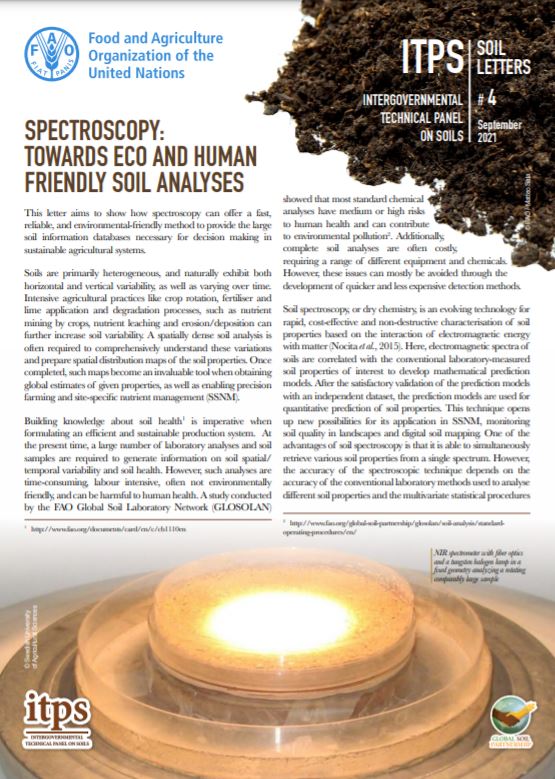
Spectroscopy: Towards eco and human friendly soil analysis #4
Year of publication: September, 2021
Place of publication: Rome, Italy
Author: FAO/ Intergovernmental Technical Panel on Soils
Publisher: FAO
Abstract: A study conducted by the FAO Global Soil Laboratory Network (GLOSOLAN) showed that most standard chemical analyses have medium or high risks to human health, can contribute to environmental pollution and are often costly, requiring a range of different equipment and chemicals. These issues can mostly be avoided through the development of quicker and less expensive detection methods. This letter aims to show how spectroscopy can offer a fast, reliable, and environmental-friendly method to provide the large soil information databases necessary for decision making in sustainable agricultural systems.
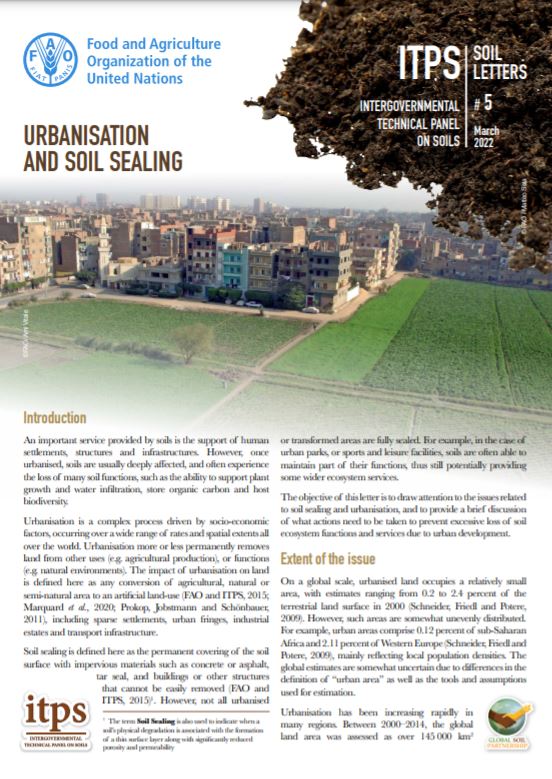
Urbanisation and soil sealing #5
Year of publication: March, 2022
Place of publication: Rome, Italy
Author: FAO/ Intergovernmental Technical Panel on Soils
Publisher: FAO
Abstract: An important service provided by soils is the support of human settlements, structures and infrastructures. However, once urbanised, soils are usually deeply affected, and often experience the loss of many soil functions, such as the ability to support plant growth and water infiltration, store organic carbon and host biodiversity. The objective of this letter is to draw attention to the issues related to soil sealing and urbanisation, and to provide a brief discussion of what actions need to be taken to prevent excessive loss of soil ecosystem functions and services due to urban development.

Soils, where food begins: how can soils continue to sustain the growing need for food production in the current fertilizer crisis? #6
Year of publication: February, 2023
Place of publication: Rome, Italy
Author: FAO/ Intergovernmental Technical Panel on Soils
Publisher: FAO
Abstract: Soils are directly and indirectly involved in the provision of most ecosystem services vital for humans, including food production, which is fundamental for food security and sovereignty. Soils are the basis for producing more than 95 percent of our food. However, one-third of the world’s soils are degraded to some extent due to erosion, loss of organic carbon and biodiversity, salinization, acidification, compaction, and nutrient imbalance, among other causes. This ITPS Soil Letters reflects on the close link between soil degrading processes and fertility loss and proposes a portfolio of solutions focused on soil health with the ultimate goal of achieving food security.
A call to protect the world’s food basket: black soils #7
Year of publication: June, 2023
Place of publication: Rome, Italy
Author: FAO/ Intergovernmental Technical Panel on Soils
Publisher: FAO
Abstract: Black soils have played a crucial role in global agriculture for many decades, supporting the production of cereals, tuber crops, oilseeds, pastures, and forage systems. Despite covering only 5.6 percent of the global land area, these soils not only provide sustenance for the 223 million people residing on them but also contribute to the global economy through the export of various commodities. However, this invaluable resource is facing multiple threats due to land use changes, unsustainable management practices, and excessive use of agrochemicals. Most black soils have already lost at least half of their carbon stocks, suffer from moderate to severe erosion, nutrient imbalances, acidification, compaction, and loss of soil biodiversity. This ITPS letter emphasizes the need for independent policies and agricultural development programs to address these threats. It highlights the importance of adopting good practices and cropping systems, and proposes a series of actions and recommendations to ensure the sustainable use of black soils.
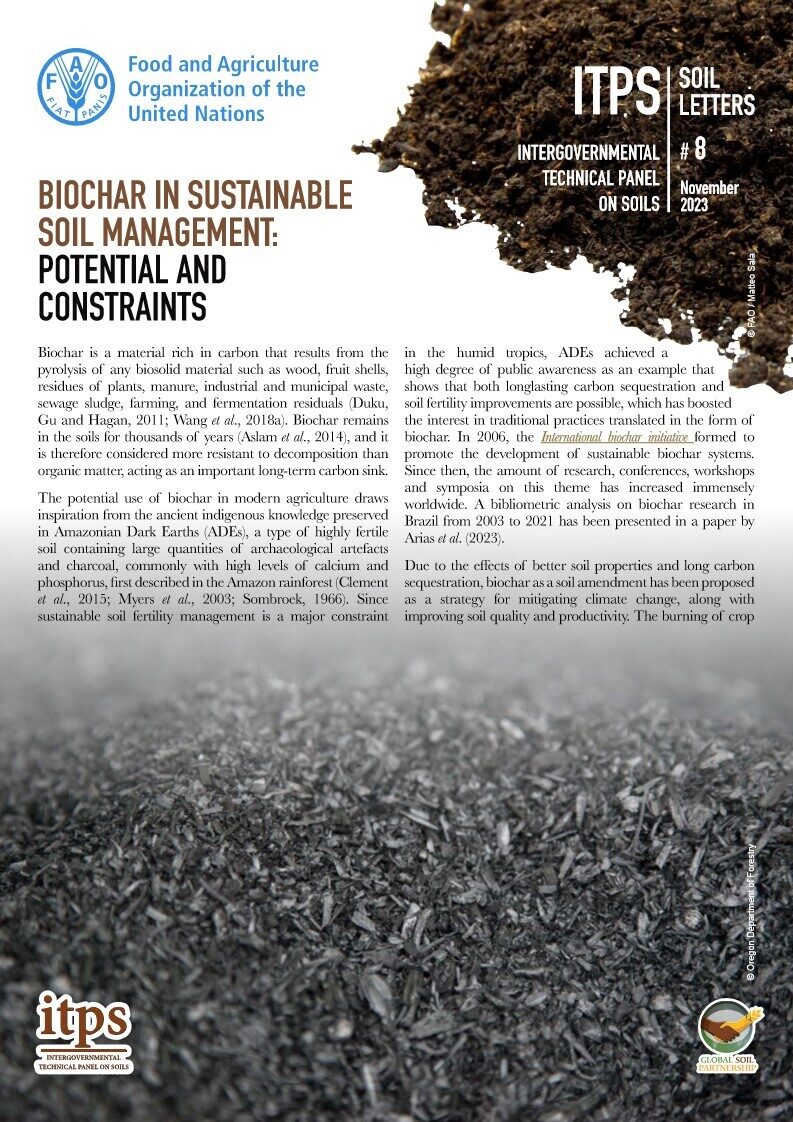
Biochar in sustainable soil management: potential and constraints #8
Year of publication: November, 2023
Place of publication: Rome, Italy
Author: FAO/ Intergovernmental Technical Panel on Soils
Publisher: FAO
Abstract: Biochar, derived from the pyrolysis of organic materials, is a decomposure-resistant soil amendment that enhances fertility, boosts agricultural productivity, and sequesters carbon in the soil for thousands of years. Its positive effects include improved nutrient availability, increased pH, and enhanced water retention capacity. Biochar can reduce nutrient losses, improve soil health, and mitigate greenhouse gas emissions. While its effectiveness may vary, targeted application could be a promising strategy, taking into account factors such as soil type and specific environmental conditions.

Time to address global soil monitoring? ITPS Soil Letters #9
Year of publication: July, 2024
Place of publication: Rome, Italy
Author: FAO/ Intergovernmental Technical Panel on Soils
Publisher: FAO
Abstract: This ITPS soil letter emphasizes the urgent need for a comprehensive global soil monitoring system to address the challenges of increasing food demand due to population growth and soil degradation. With more than 800 million people suffering from malnutrition in 2021, and food production needing to increase significantly by 2050, robust soil monitoring is essential to optimize agricultural productivity and maintain ecosystem services. Soil monitoring involves systematic measurement of soil properties over time and space to gather data crucial for managing food production, reducing greenhouse gas emissions, and protecting water and biodiversity.

Soil pollution on the move – How leaching causes groundwater pollution ITPS Soil Letters #10
Year of publication: February, 2025
Place of publication: Rome, Italy
Author: FAO/ Intergovernmental Technical Panel on Soils
Publisher: FAO
Abstract: The ITPS (Intergovernmental Technical Panel on Soils) is composed of 27 top soil experts representing all the regions of the world. The main function of the ITPS is to provide scientific and technical advice and guidance on global soil issues to the FAO/Global Soil Partnership primarily and to specific requests submitted by global or regional institutions. The overall goal of the ITPS is also to advocate for addressing sustainable soil management in the different sustainable development agendas.