


IPCC Inventory Software User Survey Results

In April and May 2025, FAO conducted a survey among users of the IPCC Inventory Software in order to better understand their capacity building needs; and clarify areas for improvement. The results of the survey are presented below.
About the IPCC Inventory Software
The Paris Agreement’s Enhanced Transparency Framework (ETF) requires countries to submit biennial transparency reports (BTRs) every two years. Under the ETF’s Modalities, Procedures, and Guidelines (MPGs), countries must estimate anthropogenic greenhouse gas (GHG) emissions and removals following the 2006 IPCC Guidelines for National Greenhouse Gas Inventories.
The IPCC Inventory Software was initially developed to help countries prepare these inventories in line with the IPCC guidelines. The software continues to be developed to better respond to ETF requirements. It can be used to implement Tier 1, Tier 2 and Tier 3 methodologies as well as approaches 1, 2 and 3 for land representation.
It can be used for complete inventories; for separate categories or groups of categories; or for tracking specific activities (e.g. mitigation actions) within a national inventory. It can also be used for archiving information; and generating the Common Reporting Tables (CRTs) of the MPGs; or simply as a Quality Control tool to compare estimates produced within the national system with an alternative set.
SURVEY RESPONSES
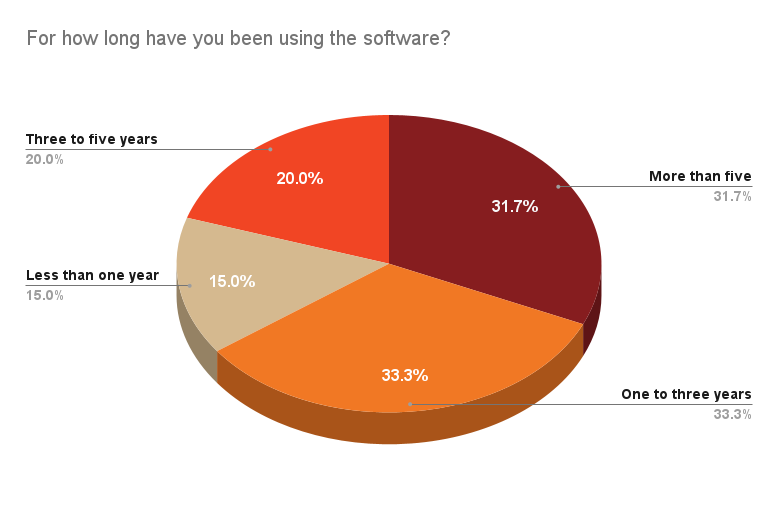
How long have you been using the software?
In the past year, 79% of participants used the IPCC Inventory Software. Of these, 33% have been using the software for one to three years, 31% have been using it for more than five years, 20% for three to five years, and 15% have been using it for less than one year.
In which role have you been using the software?
Users were mainly government officials assigned to compiling the national greenhouse gas inventory (NGHGI) (45%), followed by consultants working for the government (30%), and researchers (12%). The rest were consultants for companies (8%) and other users (5%).
.png?sfvrsn=8cd661ae_1 "In which role have you being using the software")
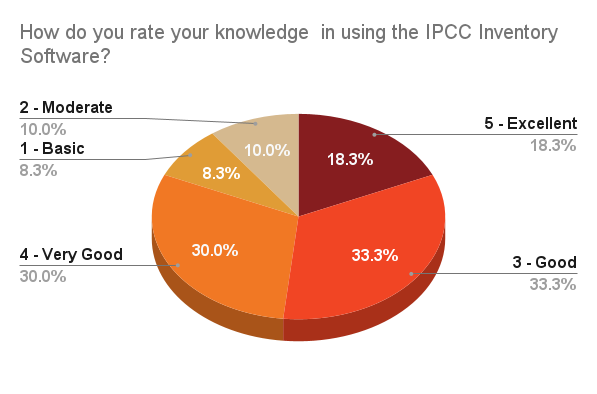
Knowledge of the software
On a scale of 1 (Basic) to 5 (Excellent), most users rated themselves as Good (33%), followed by those rating themselves as Very good (30%), Excellent (18%), Moderate (10%) and Basic (8%)
How is the software being used and in what sectors?
About 92% of respondents have been using the software to estimate emissions and removals for the national GHG inventory. The rest have been using the software for estimating emissions at the project level.
.png?sfvrsn=72ea997d_1 "Have you been using the software for estimating emissions and removals")
In terms of IPCC sectors, participants estimate emissions and removals mainly in the Agriculture sector (29%), followed by the Land Use, Land-Use Change, and Forestry (25%), Energy (19%), Industrial Processes and Product Use (15%) and Waste (12%) sectors.

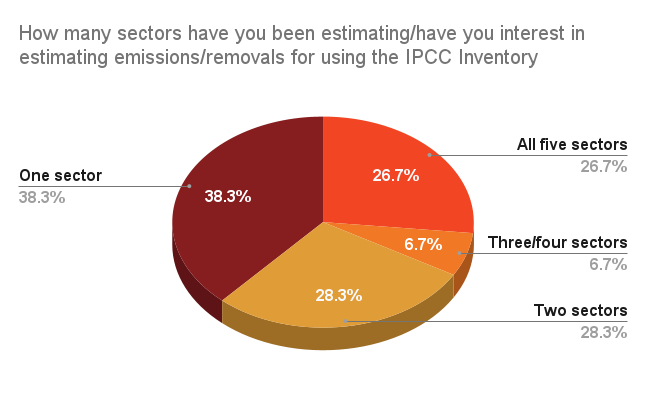
Furthermore, most participants (38%) have been using the software to estimate emissions and removals in only one sector, while 27% have been using it for all five sectors. Other participants used it for two sectors (28%); and for three to four sectors (7%).
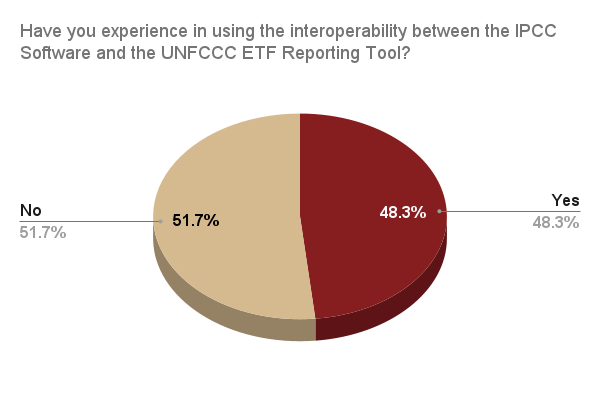
Interoperability function between the IPCC Inventory Software and the UNFCCC ETF Reporting Tool
48% of users had experience in using the interoperability function between the two tools. Several users indicated that further training in the interoperability function between the two software applications is needed urgently.
CAPACITY BUILDING REQUIREMENTS
In terms of improving their knowledge and keeping up to date on new releases and functionalities, users requested in person training (39%) and online training (25%) most frequently. Troubleshooting with an expert was the next most popular choice (21%).

While only 3% expressed interest in being part of a dedicated community, the recently launched IPCC Inventory Software User Community offers a place to ask questions, get help, share experiences, and receive updates about the most recent version of the software. The Community is hosted on Teams and contains several channels which address different objectives.
IMPROVING THE IPCC INVENTORY SOFTWARE
Respondents identified several ways to improve the user experience of the IPCC Inventory Software:
- Better understanding of the different software versions and their compatibility.
- Guidance on moving beyond Tier 1 methods toward more advanced Tier 2 and Tier 3 approaches.
- Clearer explanations of notation keys when exporting in the Common Reporting Table (CRT) format.
- More information on the interoperability between the software and UNFCCC ETF reporting tools.
- Increased knowledge on integrating land-use change data into the software.
- Support on preparing outputs in formats required for national and international reporting.
- Access to hands-on exercises for all sectors, with step-by-step explanations for beginners.
- Availability of case studies across sectors and tiers, including examples from specific regions.
Many of the points raised above are addressed by the IPCC Inventory Software Community. We invite you to join the community, ask questions and share your experiences.
Sign up here: IPCC Inventory Software Community Registration Form
CONCLUSIONS
Many countries chose to use the IPCC Inventory Software in 2024 - the critical year for submitting their first BTRs. This was mainly due to their need for an automated system for compiling the CRTs, made possible through the software’s interoperability function.
To improve their understanding and implementation of this feature, the Technical Support Unit (TSU) of the IPCC Task Force on National Greenhouse Gas Inventories (TFI) released the UNFCCC CRT Export Guide which addresses the most common issues encountered by users.
However, there is an urgent need to strengthen the capacity of national experts using the software—particularly for categories where the interface is less intuitive. To address this, the TSU has developed a series of sectoral user guidebooks that provide more practical, example-based guidance. These cover everything from the description of the complete procedure from activity data organization and input to emission factor selection and input, to GHG estimation and reporting.
Available guidebooks touch upon Energy, IPPU, Land representation for the Land (3.B) IPCC categories, Livestock categories and Waste. These guidebooks are continuously being improved based on user feedback which can be submitted directly to: [email protected].
Updated versions of the guidebooks are available at the IPCC Inventory Software website.
It is important to flag that, despite the efforts of the IPCC TFI TSU and transparency support providers, at country level the reporting process requires a suitable institutional setup with assigned roles and responsibilities. This includes assigning responsibilities for using the software for estimating emissions and removals; and reporting with the UNFCCC ETF reporting tool.
Note: A new version of the IPCC Inventory software v.2.98- was released on June 25 2025.