


Sustainable Forest Management
FAO helps countries manage their forests in a sustainable way
The Organization's approach balances social, economic and environmental objectives so that present generations can reap the benefits of the earth's forest resources while conserving them to meet the needs of future generations. Following this approach, FAO assists countries in their efforts to address policy issues related to forests and climate change by integrating climate change considerations into national forest-related policies and actions.
The importance of forests in helping to achieve global sustainable development has been largely acknowledged by the Sustainable Development Goals (SDGs) and the Paris Agreement. Seeking to enhance forests’ socio-economic and environmental benefits on a worldwide scale, FAO provides countries with the best available data, knowledge and practices to enable sustainable forest management.
Key messages
By halting deforestation, managing forests sustainably, restoring degraded forests and increasing the global forest area, can help avoid potentially damaging consequences for the planet and its people. Governments need to foster holistic and participatory approaches that promote the benefits of forests and trees. Integrating landscape approaches into forest policies and programmes is essential for addressing drivers of deforestation and forest degradation, and to increase the contribution of forests and trees to sustainable productive landscapes.
These benefits include increased food production, employment and income generation, climate change adaptation and mitigation, and enhanced well-being of both urban and rural communities.
Forest governance gains its power from including and maximally engaging all relevant forest stakeholders, such as formal and informal institutions, smallholder and Indigenous organizations, small, medium-sized and large enterprises, and civil society organizations, as well as stakeholders from other relevant sectors. These actors should negotiate, make and enforce decisions about the management, use and conservation of forest resources.
Clear legal frameworks and coherent policy measures that balance stakeholder interests are part of the required enabling environment. Evidence-based forest policy and programmes enhance a balanced delivery of environmental and socioeconomic benefits from forests and trees, and can harness forest contributions to achieve several SDGs, climate change objectives and the Global Forest Goals.
FAO provides active support and guidance to countries’ forest policy development, implementation and review processes at the national and regional levels.
Featured resources

The State of the World’s Forests 2024 - Forest-sector innovations towards a more sustainable future
2024
This report provides highlights on the state of the world’s forests and explores the transformative power of evidence-based innovation in the forest...

A guide to multiple-use forest management planning for small and medium forest enterprises
2023
This guide discusses the concept, evolution, and requirements of forest management planning, focusing on multiple-use forest management and small and...
Sustainable Forest Management (SFM) Toolbox
2021
This module sets out the key elements of public forest policies. It explores how forest managers can assist in developing consensus-based forest policies...
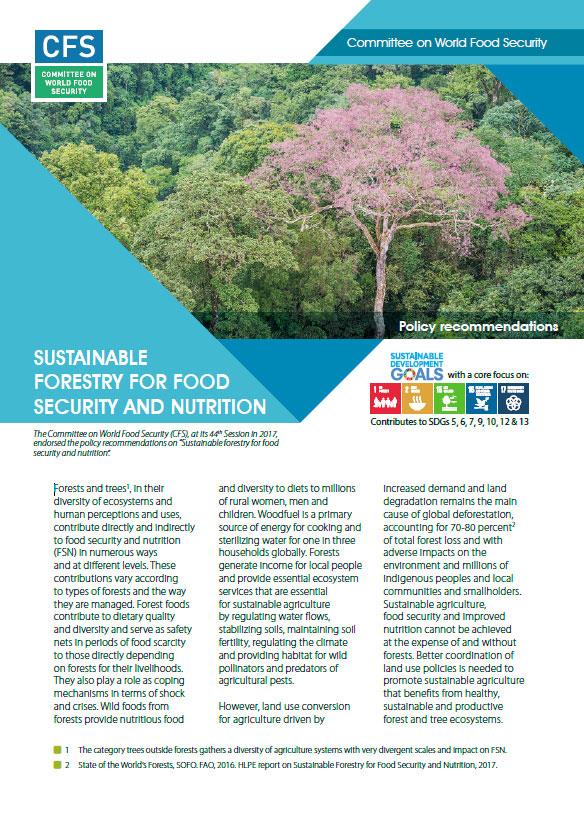
Sustainable forestry for food security and nutrition - CFS policy recommendations
2018
The following recommendations aim to strengthen the contributions of sustainable management of forests and trees to the achievement of food security...
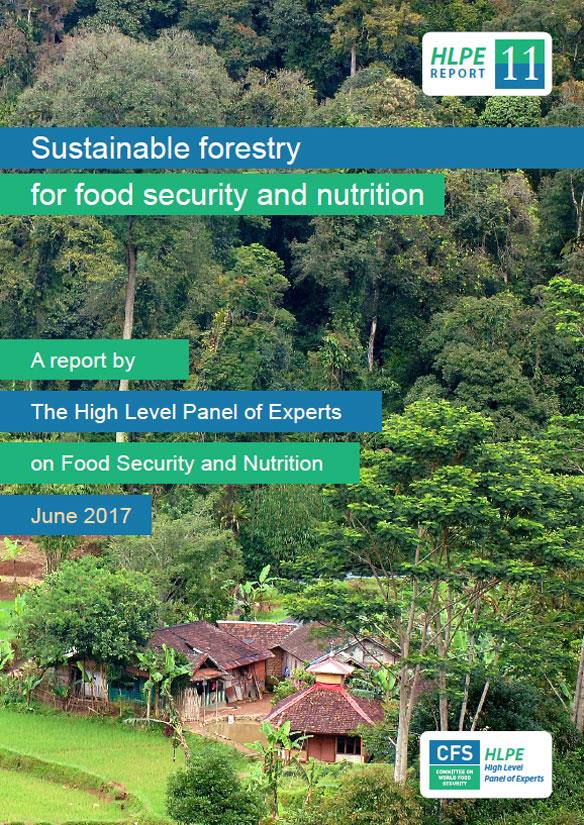
Sustainable Forestry for Food Security and Nutrition. A Report by the High Level Panel of Experts on Food Security and Nutrition. June 2017. HLPE Report 11
2017
Forests and trees contribute to food security and nutrition in multiple ways. They provide wood, energy, foods and other products. They generate...
Sustainable Development Goals
Our work on this theme primarily contributes to:


Find out more
- Sustainable forest management at FAO
- FAO work in forestry
- Sustainable Forest Management (SFM) Toolbox
- Forestry Communication Toolkit
Partner initiatives
- Forest and Farm Facility
- UN Decade on Ecosystem Restoration
- United Nations Collaborative Programme on Reducing Emissions from Deforestation and Forest Degradation in Developing Countries (UN-REDD Programme)
- Sustainable Wood for a Sustainable World (SW4SW)
- Sustainable Wildlife Management (SWM) Programme