


Blog
Gender Equality, food and nutrition security: What can science and innovation contribute?
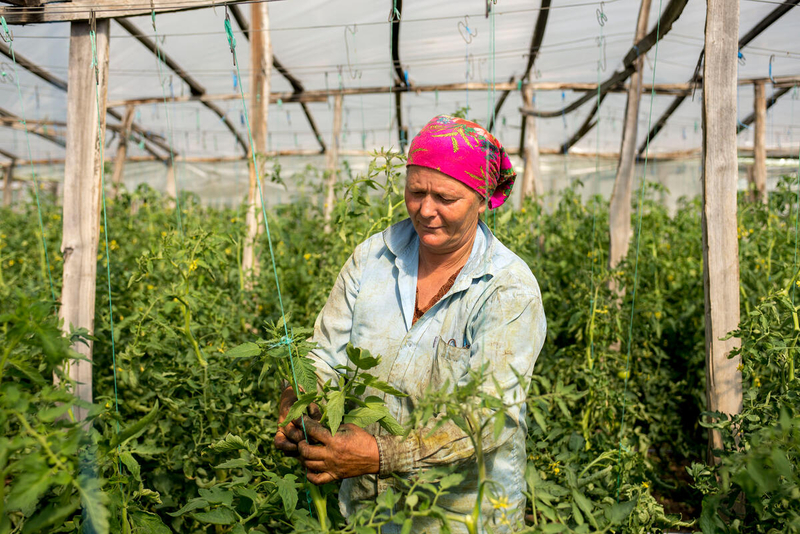
Ungheni, Moldova - Farm worker in tomatoes green house.
©FAO/Dorin Goian
Gender equality and agrifood systems are intertwined, we cannot achieve one without the other. Women need agrifood systems, and agrifood systems need women. Women are agents of change in the agrifood sector. The FAO Report on the Status of Women in Agrifood Systems shows that over 66% of women in sub-Saharan Africa and 71% in Southern Asia are engaged in agrifood systems [1]. And yet despite this engagement, gender inequalities persist in the sector, from lack of rights to the land that women cultivate, to inequalities in access to resources and technologies [2]. And gaps in food insecurity between men and women persist which means that those that produce our food also the most food insecure. In 2023, 26.7% of adult women were moderately or severely food insecure [3]. And while even in times of peace women are more food insecure, during crises it is women who eat least and last.
Gender inequality in agrifood systems is a wicked problem. And wicked problems do not have silver bullet solutions and require multiple innovations. It is important that FAO recognizes gender equality as a guiding principle in their Science and Innovation Strategy. The Strategy recognizes that achieving gender equality and equity between women and men in agrifood systems is critical for the elimination of hunger and poverty and commits to ensure that its interventions respond to the needs of women as well as men, including by promoting women’s inclusion and providing equal decision-making power to shape agrifood systems transformation.
I believe there are four key areas where science and innovation can contribute to the triple win of gender equality, food and nutrition security and the empowerment of women.
The first is in developing innovations that that are inclusive of, and work for, women. Very often, technologies, policies and practices are developed without the involvement of women and do not always reflect their needs and priorities. In many contexts, when people speak of farmers, they do not include women in this definition despite the important roles that women play in production and beyond production. And this has implications for how resources are distributed within the sector as well as how women’s labor is accounted for. And even when technologies and other resources are available, they are often not accessible or affordable to women. These gender inequalities in access and rights to resources are well documented [4]. Women also have unequal rights to productive resources including land. In 2024, women accounted for less than 40% of owners or rights bearers of agricultural land in 32 out of 40 countries with data [5]. Ensuring equal access to, ownership of and control over the resources and technologies that enable women to thrive in agrifood systems is critical. Rights to resources must however go beyond rights to physical resources to include rights to decent pay and living wages, rights to equal pay for work of equal value, rights to dignity within the agrifood system and the right to work in environments free of sexual harassment. For example, women in the agrifood systems sector are paid 82 cents for every dollar paid to men in the sector [6]. Data and innovations around pay transparency including in the informal sector – such as most of the agriculture sector – are needed.
Second is innovations to strengthen the agency, leadership and representation of women across agrifood systems. Women and girls are taking action to address food security, climate, and environment action everywhere, but their participation and leadership is under-supported, under-resourced, under-valued and under-recognized. In 2021 at the UN Food Systems Summit, IFPRI, UN Women and Global Health 50/50 launched the Global Food 5050 Index. The 2023/24 report showed that 71% of CEOs and board chairs in food systems organizations are men and the situation had not changed from 2021[7]. This needs to change. It is not enough for women to just engage in production and processing of food, they need to be leaders in food systems governance and in the policy making process. Collective action approaches that catalyze women’s solidarity and leadership are also needed, and research can play a role in understanding, scaling and evaluating approaches that support women’s individual and collective agency. Tools such as the Women’s Empowerment in Agriculture Index [8] can be critical tools for understanding and identifying entry points for strengthening women’s agency.
Third is addressing harmful and discriminatory social norms and addressing other structural barriers to gender equality. Social and cultural norms shape and reinforce the ways in which women and men can participate in, access, and benefit from opportunities and resources and this important consequences across all aspects of advancing women’s empowerment and gender equality in food systems. For example, norms can hinder women’s ability to access or adopt new agricultural practices, to own certain assets or resources such as land, or to participate in certain activities including agricultural markets or to access important services such as credit. These norms while contextually and culturally specific are strongly linked to women’s empowerment. Innovative gender transformative approaches that shift these norms and develop new understandings and meanings of masculinity have been tested and need to scale. Programs such as the Joint Programme on Rural Women’s Economic Empowerment implemented by FAO, IFAD, WFP and UN Women are important spaces for implementing these approaches at scale and measuring their impacts on gender equality and women’s empowerment.
Fourth is ensuring that there is focus on the multiple needs and priorities of women in the agrifood sector by understanding and implementing policy, institutional and technological innovations that lead to systems change. These include innovations in social protection systems that reach the more than 700 million women who are in the informal sector including in agriculture [9], addressing women’s unpaid care and domestic work through the recognition, reduction and redistribution of care work including investments on infrastructure and labor-saving technologies, and addressing women’s experiences of sexual and gender-based violence including in the world of work. We need to connect the dots between policies to address these issues if we are to ensure gender equality and the rights of women and girls working in the agrifood sector. Science and innovation offer indispensable tools and approaches to do so, but only if the rights of women and girls are placed at the center.
[1] FAO. 2023. The status of women in agrifood systems. Rome.
[2] Njuki J, Eissler S, Malapit H, et al. A Review of Evidence on Gender Equality, Women’s Empowerment, and Food Systems. 2023 Jan 2. In: von Braun J, Afsana K, Fresco LO, et al., editors. Science and Innovations for Food Systems Transformation. Cham (CH): Springer; 2023.
[3] FAO, IFAD, UNICEF, WFP and WHO. 2023. The State of Food Security and Nutrition in the World 2023. Urbanization, agrifood systems transformation and healthy diets across the rural–urban continuum. Rome, FAO.
[4] Njuki, Jemimah, et al. " A review of evidence on gender equality, women’s empowerment, and food systems." Science and innovations for food systems transformation 165 (2023).
[5] UN-Women and DESA. 2024. Progress on the Sustainable Development Goals: The Gender Snapshot 2024. New York: UN-Women and DESA
[6] FAO. 2023. The status of women in agrifood systems. Rome.
[7] Global Health 50/50, the International Food Policy Research Institute, UN Women, ‘ The Global Food 50/50 Report 2023/2024,’ Washington, DC: 2024.
[8] Sabina Alkire, Ruth Meinzen-Dick, Amber Peterman, Agnes Quisumbing, Greg Seymour, Ana Vaz, (2013) The Women’s Empowerment in Agriculture Index. World Development, Volume 52,
[9] Staab, S., L. Williams, C. Tabbush and L. Turquet. 2024. “Harnessing Social Protection for Gender Equality, Resilience and Transformation”. World Survey on the Role of Women in Development. New York: UN-Women
 Dr. Jemimah Njuki is the Chief of the Economic Empowerment section at UN Women, where she leads work on women’s economic justice and rights. Her work is focused on decent jobs and entrepreneurship for women, gender responsive climate action and food systems, transforming care systems, gender responsive macro-economic as well as financing for gender equality. She is a recognized leader on gender equality and women's empowerment, having directed global initiatives promoting women's economic empowerment and women’s leadership. She has served in multiple roles including as the lead for gender and women’s empowerment for the UN Food Systems Summit, Director for Africa at the International Food Policy Research Institute, Coordinator of the Growth and Economic Opportunities program at Canada’s International development Research Centre, Program Lead for Care USA’s Women in Agriculture programme, and in different CGIAR Centers working on research at the intersection of gender and food systems. She has published widely on gender equality and women’s empowerment and in 2021, was named one of the top 100 gender and policy experts.
