


Publications
Highlights

Action Plan 2026–2029 for the implementation of the FAO Science and Innovation Strategy
01/2026
The Action Plan 2026-2029 for the implementation of the FAO Science and Innovation Strategy guides the implementation of the FAO Science and Innovation Strategy. It provides a common framework for FAO action at the country, sub-regional, regional and global levels.

FAO Science and Innovation Strategy
10/2022
The Strategy aims to strengthen FAO’s work on science and innovation by providing Organization-wide guidance, coherence and alignment on science and innovation. Science and innovation serve as a foundation for the FAO Strategic Framework 2022–31 and have cross-sectoral relevance across the Organization’s programme of work.
-
SHARP+ resilience assessment in Somalia in the districts of Jowhar and Balcad
Feb 27, 2025, 10:39 AM -
Resilience and behaviour change assessment in Malawi in the districts of Mangochi, Ntcheu and Balaka
Feb 27, 2025, 10:27 AM -
Self-evaluation and Holistic Assessment of Climate Resilience of Farmers and Pastoralist (Sharp+)
Feb 21, 2025, 10:36 AM -
Agro-industry versus agroecology? Two macroeconomic scenarios for 2050 in Andhra Pradesh, India
Feb 21, 2025, 10:27 AM -
Guide for strengthening functional capacities in agricultural innovation
Feb 21, 2025, 10:18 AM -
Curriculum for training of Multi-actors Agricultural Innovation Platform facilitators
Feb 21, 2025, 10:01 AM -
Leveraging space technology for agricultural development and food security
Feb 17, 2025, 10:23 AM -
Sustainable nitrogen management in agrifood systems
Jan 20, 2025, 14:48 PM -
Agrifood Systems Technologies and Innovations Outlook: Concept Note
Jan 5, 2025, 16:03 PM -
Case studies of agrifood systems technologies and innovations for climate action at country level
Dec 30, 2024, 10:19 AM -
Climate technologies for agrifood systems transformation
Dec 12, 2024, 09:34 AM -
Guidance on strengthening national science–policy interfaces for agrifood systems
Nov 29, 2024, 14:41 PM -
The State of Food and Agriculture 2024
Nov 8, 2024, 15:59 PM -
Mapping affordable and transferrable climate-smart technologies for smallholder farmers
Nov 4, 2024, 09:16 AM -
Shaping sustainable agrifood futures: pre-emerging and emerging technologies and innovations for impact - An extended global foresight report with regional and stakeholders' insights
Oct 21, 2024, 07:25 AM -
Digital technologies for multidimensional youth engagement in agrifood systems transformation
Oct 17, 2024, 10:04 AM -
Connected farmers
Jul 24, 2024, 13:41 PM -
The State of Food Security and Nutrition in the World 2024
Jul 24, 2024, 13:33 PM -
The State of World Fisheries and Aquaculture 2024
Jun 12, 2024, 09:08 AM -
Hunger Hotspots
Jun 10, 2024, 08:27 AM
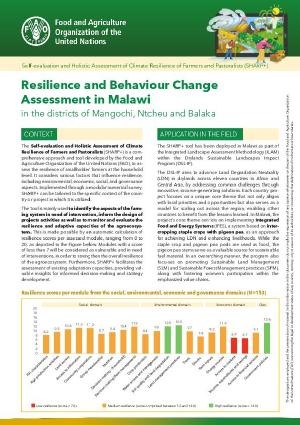
Resilience and behaviour change assessment in Malawi in the districts of Mangochi, Ntcheu and Balaka
01/2025
This factsheet presents key findings from surveys conducted in Mangochi, Ntcheu, and Balaka between November and December 2023, using the Self-evaluation and Holistic Assessment of Climate Resilience of Farmers and Pastoralists (SHARP+) methodology—a tool developed by the Food and Agriculture Organization (FAO) to assess the resilience of smallholder farmers at the household level.

Curriculum for training of Multi-actors Agricultural Innovation Platform facilitators
01/2025
Multi-actors Agricultural Innovation Platform (MAIP) is established in rural communities where farmers and key value chain actors become empowered through participatory action research, knowledge co-creation and application, market linkages and so on.

Self-evaluation and Holistic Assessment of Climate Resilience of Farmers and Pastoralist (Sharp+)
01/2025
The SHARP+ In-Brief presents the mains uses and implementation of the tool

Agrifood Systems Technologies and Innovations Outlook: Concept Note
12/2024
The Agrifood Systems Technologies and Innovations Outlook (ATIO) initiative, launching in 2025, aims to enhance understanding of technology and innovation uptake and factors shaping the technology frontier in agrifood systems. It will be the most comprehensive global source of information on innovative solutions for Agrifood Systems Transformation.

Case studies of agrifood systems technologies and innovations for climate action at country level
12/2024
Climate change is having a devastating effect on many of the world’s agrifood systems and the communities that rely on them for their livelihoods. This compendium contains summaries of forty case studies, from a total of over two hundred submitted to FAO for the Science and Innovation Forum 2023, that describe innovative efforts that have been made to address some of the challenges arising from climate change.

SHARP+ resilience assessment in Somalia in the districts of Jowhar and Balcad
12/2024
The SHARP+ resilience assessment in Somalia factsheet presents key findings from surveys conducted in the districts of Jowhar and Balcad in September 2024, as part of the multi-actor programme Jowhar Off-stream Storage Programme (JOSP).

Agro-industry versus agroecology? Two macroeconomic scenarios for 2050 in Andhra Pradesh, India
12/2024
This book presents the first macroeconomic scenario of a full transition to agroecology in 2050. It is for Andhra Pradesh, a state in southern India with 53 million inhabitants and 9.3 million farmers in 2020.
Guide for strengthening functional capacities in agricultural innovation
12/2024
The purpose of this guide is to contribute to the development of functional capabilities among individuals and organizations that support innovation in Latin America. The guide uses the common framework for capacity development promoted by the Tropical Agriculture Platform (TAP) to identify and strengthen key functional capacities in organizations and individuals.

Climate technologies for agrifood systems transformation Placing food security, climate change and poverty reduction at the forefront
12/2024
The report highlights the needs for robust technology assessments to underpin climate technology identification for agrifood systems transformation that addresses all stages of agrifood value chains. This needs to be supported by capacity-building programmes, targeted financing and fed into the ongoing climate policy process.

SHARP+ resilience assessment in the United Republic of Tanzania in the districts of Kaliua, Mlele, Sikonge and Urambo
11/2024
The SHARP+ resilience assessment in Tanzania factsheet presents key findings from surveys conducted in the districts of Kaliua, Mlele, Sikonge, and Urambo in September 2024, as part of the Drylands Sustainable Landscapes Impact Program (DSL-IP).

The State of Food and Agriculture 2024: Value-driven transformation of agrifood systems
11/2024
Uncovering the true cost of food is the first step in making agrifood systems more inclusive, resilient and sustainable. As The State of Food and Agriculture 2023 revealed, agrifood systems activities generate significant benefits for society, but also have negative impacts on economic, social and environmental sustainability.

Mapping affordable and transferrable climate-smart technologies for smallholder farmers
11/2024
In response to the pressing need for innovative solutions to address food security challenges, a Tripartite Cooperation Agreement between FAO Regional Office for the Near East and North Africa region, the International Fund for Agricultural Development (IFAD), and the Islamic Development Bank (IsDB) initiated a comprehensive “Mapping exercise of affordable and transferrable food security-related technologies”.
Digital technologies for multidimensional youth engagement in agrifood systems transformation
10/2024
The Young Scientists Group (YSG) conducted a comprehensive literature review which highlights various relevant case studies, together with a survey capturing the perspectives and experiences of youth. The results show that, for agrifood systems transformation initiatives, digital technologies provide youth with benefits such as being able to conduct tasks more efficiently, reach wider audiences and form collaborations.


A casebook of good practices and inspiring stories from Europe and Central Asia
07/2024
Amidst the challenges confronting agriculture in Europe and Central Asia, this casebook unfolds the stories of 25 farmers and agripreneurs who have successfully embraced digital technologies. The accounts presented here reveal that, despite the effects of climate change, the consequences of the war in Ukraine and the enduring impact of COVID-19, opportunities for innovation and resilience can still be found.

Financing to end hunger, food insecurity and malnutrition in all its forms
07/2024
Six years from 2030, hunger and food insecurity trends are not yet moving in the right direction to end hunger and food insecurity (SDG Target 2.1) by 2030. The indicators of progress towards global nutrition targets similarly show that the world is not on track to eliminate all forms of malnutrition (SDG Target 2.2).

Blue Transformation in action
06/2024
The 2024 edition of The State of World Fisheries and Aquaculture features the Blue Transformation in action, illustrated by activities and initiatives, led by FAO in collaboration with Members, partners and key stakeholders, to integrate aquatic foods into global food security and sustainability, enhance policy advocacy, scientific research and capacity building, disseminate sustainable practices and technological innovations, and support community involvement.

FAO–WFP early warnings on acute food insecurity: June to October 2024 outlook
06/2024
In the current edition of a regular joint bi-yearly report, the Food and Agriculture Organization of the United Nations (FAO) and the World Food Programme (WFP)warn that acute food insecurity is likely to deteriorate further in 18 hunger hotspots, including a total of 17 countries or territories and one regional cluster which comprises 4 countries, during the outlook period from June to October 2024.
Towards digital inclusion in rural transformation
05/2024
The rapid and ongoing digital transformation of government, economic, and social sectors holds immense potential to improve outcomes across the SDGs for smallholder farmers and rural communities more generally. However, it is also widely recognized that digitalization alone does not guarantee inclusion. Rural residents and marginalized groups have the most to gain from digitalization but are also the most at risk of falling further behind due to digital divides.

Global Report on Food Crises 2024
04/2024
The Global Report on Food Crises 2024 provides analysis and evidence on acute food insecurity and malnutrition in countries/territories identified as being in food crisis in 2023. It is a document of reference that consolidates data from various sources using rigorous methodologies and a transparent and consultative multi-agency process.