


TCP as a Catalyst
By design, TCP projects are meant to complement ongoing programmes/activities. Given its scope, standalone use would unlikely be sustainable or effective. Emphasis is on complementing ongoing high priority Government initiatives, fostering coherence and the potential for systemic outcomes. Policies and procedures applied to the selection/approval of TCP projects prevent the support of fragmented interventions lacking clear pathways to scaling up or achieving systemic impact. As such, standalone initiatives for normative, training and piloting work are not in line with the approval criteria and catalytic role expected from projects.
The TCP criteria approved by FAO Governing Bodies require that “assistance should result in clearly defined outputs and outcomes leading to large-scale impacts. It should have catalytic or multiplier effects such as increased mobilization of government, donor or investment funds.”
TCP projects are considered to have a catalytic outcome when they produce one or more of the following results:
- Follow-up funding from the government, bilateral or multilateral sources, leveraged financing or investments, south-south cooperation or in-kind support to upscale activities.
- Improvements in agri-food systems that lead to their wider diffusion and adoption.
- Improved and strengthened institutional capacities that are applied over time.
- Timeliness in bridging a critical gap, e.g. emergency response, mitigation, preparedness or formulation projects.
- Policy, legal and regulatory changes that facilitate the development of the broader agricultural and related sectors.
- Improved forms of collaboration at the regional and international levels with clear benefits and value at individual country level.
Annual Reports of FAO Representatives have been re-designed to allow for the systematic documentation of catalytic effects achieved with TCP funding. Explore findings below:


Typically, given their scope, TCP projects can only deliver outputs, while outcomes can only be achieved if the assistance is embedded in well-resourced priority initiatives/programmes. Examples for a programmatic use of TCP are:
- Filling critical technical gaps in ongoing initiatives that are part of the Country Priority Framework/UN Sustainable Development Cooperation Framework (CPF/UNSDCF) and are essential to the success of the overall programme.
- Formulation support to programme/project development (e.g. bilateral donors, GEF, GCF), even if the resulting funding is not channelled through FAO.
- As co-funding were required by donors (e.g. European Union)
In all cases, this entails the provision of expertise, mostly consultants, to complement FAO technical capacities. Focus is on filling technical, rather than financial gaps.
As the portfolio approach is developed and piloted in FAO, and related programme and project cycle workflows updated, the catalytic and technical support role the TCP can play will be highlighted and related capacities for its strategic and flexible use strengthened.
Examples of Catalytic TCP Projects
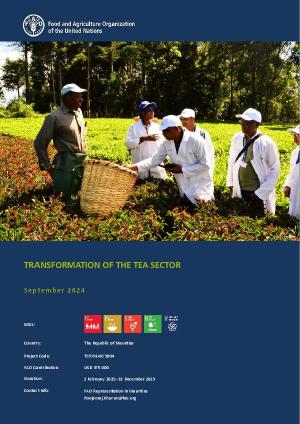
Transformation of the Tea Sector
06/07/2026
The tea sector faces numerous challenges including low productivity, aging tea bushes, high production costs, aging growers, labour shortages, and low-quality tea. Since the mid-1990s, declining global tea prices and rising production costs, particularly for labour and energy, have led to the abandonment of about 86 percent of tea gardens.

Support E-Agriculture Strategy Implementation of Mongolia
06/07/2026
The food and agricultural sector in Mongolia is confronted with many challenges posed by the impact of climate change, increased frequency of natural disasters, loss of biodiversity, erosion of the natural resource base, increasing food price volatility, inefficient supply chains and other challenges.

Sudanese Soil Information System and Digital Soil Mapping
06/07/2026
Although knowledge on soils in Sudan was plentiful, it needed to be harmonized and made accessible to a broadrange of users and stakeholders. The country had nonational soil information system that could describethe status and potential of agricultural soils, as well as individual soil properties that are essential for mapping agricultural areas for investment potential and environmental management in general.
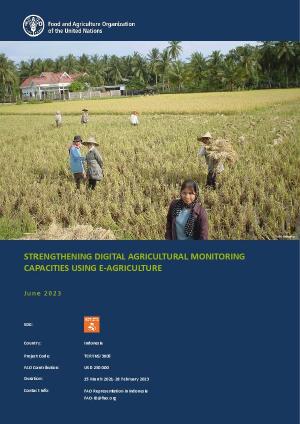
Strengthening Digital Agricultural Monitoring Capacities Using E-Agriculture
06/07/2026
Indonesia is a major producer of agricultural products, although agriculture remains a highly labour-intensive sector and the cost of agricultural inputs is high. Strategies on e-agriculture have been developed in several countries to rationalize resources (financial, human, infrastructure, natural) and address national priorities holistically.
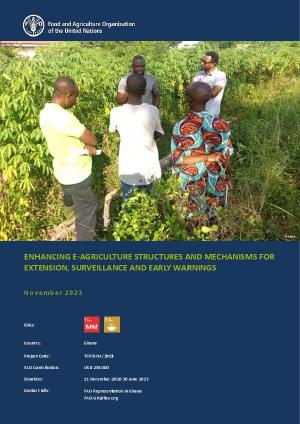
Enhancing E-Agriculture Structures and Mechanisms for Extension, Surveillance and Early Warnings
06/07/2026
Over the years, Ghana has implemented many broad agricultural and subsector-specific policies and programmes, including the Food and Agricultural Sector Development Policy (FASDEP I and II) and Investing for Food and Jobs (IFJ), purposely to promote and enhance a sustainable agricultural sector.
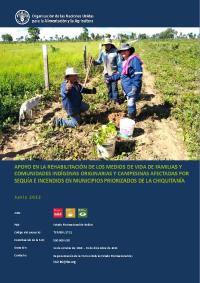
Apoyo en la rehabilitación de los medios de vida de familias y comunidades indígenas originarias y campesinas afectadas por sequía e incendios en municipios priorizados de la Chiquitanía
06/07/2026
El ecosistema Chiquitano representa al bosque tropical seco más grande del mundo, ubicado en una de las últimas regiones forestales tropicales secas no sólo de Bolivia, sino de toda Sudamérica El bosque Chiquitano es valioso por su ecología única y por su importancia histórica y cultural ...
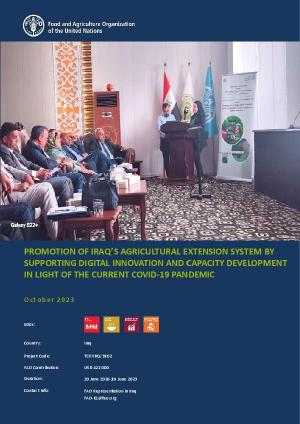
Promotion of Iraq’s Agricultural Extension System by Supporting Digital Innovation and Capacity Development in Light of the Current COVID-19 Pandemic
06/07/2026
The project provided improved extension services to promote information and knowledge sharing, as well as the adoption of improved agricultural practices and measures. Farmers downloaded the digital extension services platform, which included a farmer-to-farmer extension forum.
The 2020 TCP Evaluation collected and categorized 272 examples for TCP projects having achieved a variety of catalytic effects. Explore the report from this link.