
Mobilizing the Private Sector: Asia-Pacific workshop advances the fight against Antimicrobial resistance (AMR)
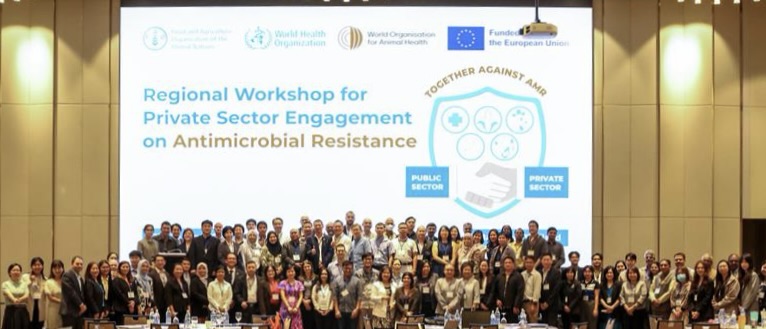
In a decisive step toward curbing the growing threat of antimicrobial resistance (AMR), the Food and Agriculture Organization of the United Nations (FAO) Regional Office for Asia and the Pacific (RAP), convened a regional workshop in Bangkok, Thailand from 23 to 24 June 2025. This workshop was organized in the context of the Regional Tripartite AMR Project “Working Together to Fight AMR in Asia” funded by the European Union.
Bringing together over 120 participants, 94 in person and 30 online from across the public and private sectors, the workshop marked a significant step forward in advancing cross-sectoral collaboration to address AMR in the region. Participants included representatives from animal food and feed industries, food safety and veterinary health agencies, and technical experts from the Tripartite Plus organizations, FAO, the World Health Organization (WHO) and the World Organization for Animal Health (WOAH).
A platform for public–private collaboration
Over the course of two days, participants from eight countries, China, India, Indonesia, Malaysia, the Philippines, the Republic of Korea, Thailand, and Viet Nam, gathered in Bangkok, including representatives from animal food and feed production, food safety authorities, and veterinary health agencies, joining experts from FAO, WHO, and WOAH to explore innovative, cross-sectoral approaches to AMR mitigation.
The workshop served as a platform for exchanging best practices, showcasing success stories, and identifying regulatory and communication strategies to enhance private sector engagement.
The opening day emphasized the critical role of building partnerships. A summary was presented of the identified private sector engagement areas and opportunities for public and private partnerships in project countries to combat AMR. A panel of experts from government, academia, and industry leaders discussed the evolving role of the private sector in reducing antimicrobial use and promoting alternatives. Presentations highlighted recent developments in veterinary and food production, while a dedicated session on communication strategies emphasized the importance of tailored messaging to reach farmers, producers, and consumers alike.
From dialogue to action
The second day focused on regulatory frameworks and strategic planning. Private sector companies such as Betagro (Thailand), Vista Processed Foods Pvt. Ltd. (India), Bounty Plus, Inc. (Philippines), Feedmix Specialist Inc. (Philippines), PT Suri Tani Pemuka (Indonesia), China Association for the Promotion of International Agricultural Cooperation (China), Malaysian Veterinary Medical Association (Malaysia), and Charoen Pokphand Group Co. Ltd. (Thailand), shared practical approaches to AMR stewardship, best practice and responsible antimicrobial use across food value chains.
Interactive sessions enabled participants to map out legal reform priorities and identify new opportunities for collaboration in compliance and data sharing.
Regional synergy moving forward
The workshop concluded with the presentation of a portfolio of joint public–private partnership initiatives, designed to be integrated into future regional AMR project proposals. These initiatives underscore a shared commitment to sustainable food systems and recognize that inclusive, cross-sectoral collaboration, particularly with private sector partners, is essential for long-term AMR resilience.
As the Regional Tripartite continues to advance its AMR agenda, the momentum and insights generated in Bangkok will help chart the next phase of regional collaboration. With innovation, investment, and partnership at the forefront, the path toward a more AMR-resilient Asia is becoming clearer, and more robust.
Strengthening collaborative engagements with the private sector
One key element for a truly action-oriented strategy for private sector engagement is to explore new and effective models for collaboration or collaborative engagements.
These engagements may include a wide range of instruments such as specialized dialogues; knowledge-sharing platforms; and scalable and replicable mechanisms that facilitate proven solutions such as incubators, accelerators, start-up promotion schemes, brown-bag lunches, innovation hubs, and other informal collaboration spaces.
The collaborative engagements are aimed at advancing shared objectives through mutual learning, co-creation, and trust-building and are guided by common principles, aligned goals, and mutual accountability. This workshop serves as a good example of collaborative engagement with the private sector, to advance common goals of tackling AMR resistance in the region, through technical dialogue, sharing of best practices, and knowledge exchange.