
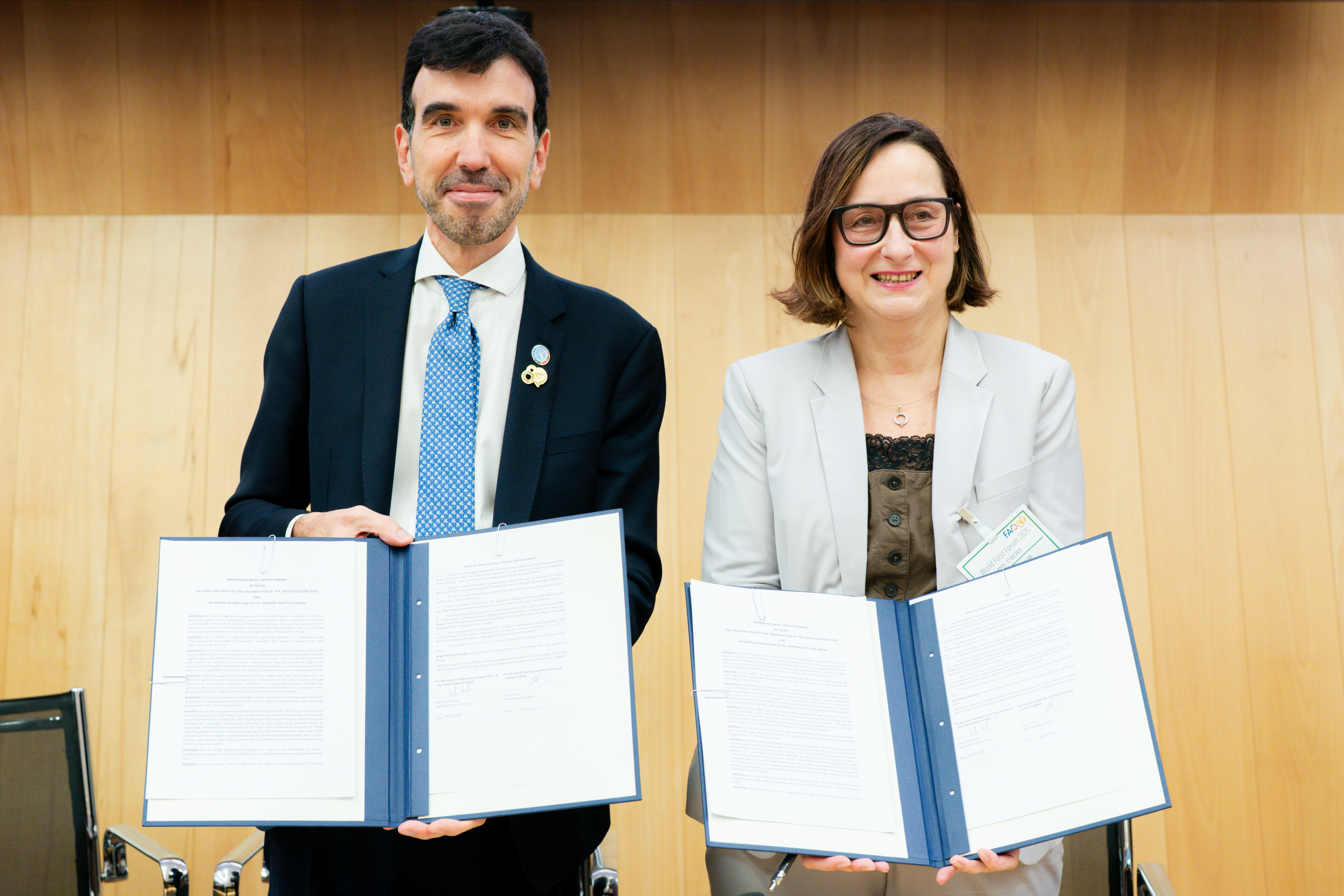
FAO and WSBI join forces to advance inclusive climate finance for agrifood systems
During the 2025 World Food Forum, FAO launched a new partnership with the World Savings and Retail Banking Institute (WSBI), marking a milestone in efforts to mobilize inclusive climate finance and strengthening resilience across agri-food systems. The collaboration, formalized through a Memorandum of Understanding (MoU), coincides with FAO’s 80th anniversary and reaffirms the Organization’s commitment to building stronger public-private partnerships for impact.
The partnership between FAO and WSBI aims to strengthen agrifood systems by expanding access to financial services for those most vulnerable to climate change and shocks. It focuses on the following areas of cooperation:
- Leveraging data and tools for investment design;
- Strengthening public-private dialogue and advocacy;
- Promoting financial innovation and inclusion; and
- Enhancing capacity and knowledge exchange.
Opening the ceremony, Carlos Watson, Chief of the Private Sector Engagement Unit, at the Partnerships and UN collaboration Division (PSU), welcomed the agreement "as an exciting step forward" in connecting FAO’s technical expertise with WSBI’s vast network of community-based banks worldwide.
Deputy Director-General Maurizio Martina highlighted that the forthcoming Private Sector Engagement Strategy (2026-2030) focuses on moving "from dialogue to delivery, with greater impact, efficiency, and agility. Finance must work for farmers, for rural women, for youth, and for small and medium enterprises that are too often left behind,” he said, describing the MoU as a launchpad for joint innovation and inclusion.
Driving local solutions
In a video message, Peter Simon, WSBI Chief Executive Officer, commended the partnership as an opportunity to turn global ambition into local, climate-responsive finance. Raschad Al-Khafaji, Director of FAO’s Liaison Office with the EU and Belgium (LOB), emphasized that the partnership reflects FAO’s commitment to turning knowledge, innovation and collaboration into tangible solutions for people and the planet, while reinforcing public-private dialogue across agri-food value chains. Minà Dowlatchahi, Director of the Project Support Division (PSS), underlined that access to finance for smallholders is a key driver of transformation when guided by equity, innovation and inclusion. Martial Bernoux, Senior Natural Resources Officer from the Office of Climate Change, Biodiversity and Environment (OCB), noted the urgency of scaling up climate finance for agrifood systems, as current investment falls short of global needs.
Panel session: Turning inclusive climate finance into action
A panel discussion moderated by Nadine Valat, Lead of FAO’s Green Climate Fund team at OCB, explored practical ways to make climate finance more inclusive and accessible. Weselina Angelow, Programme Director at WSBI, highlighted that smallholders produce 80 per cent of the world’s food, but only 10 percent have access to formal credit. Lilian Ehigiamusoe of Nigeria’s LAPO Microfinance Bank showcased climate-smart lending products empowering women and youth entrepreneurs, while Austin Chijikwa of the Zambia National Commercial Bank (ZANACO) underscored the importance of blended finance and capacity development to manage risk.
Simon Addison, Senior Economist at the Rural Transformation and Gender Equality Division (ESP), called for quality finance that is inclusive and tailored to the needs of the most vulnerable.
Closing the session, Nadine Valat reaffirmed the shared vision of the FAO-WSBI partnership, to make climate finance more accessible and impactful, helping countries meet their climate commitments while empowering local institutions to deliver solutions where they are needed most.