


Success stories
FAO’s Farmer Field Schools using behavioural science to address antimicrobial resistance in Tanzania
21/11/2024
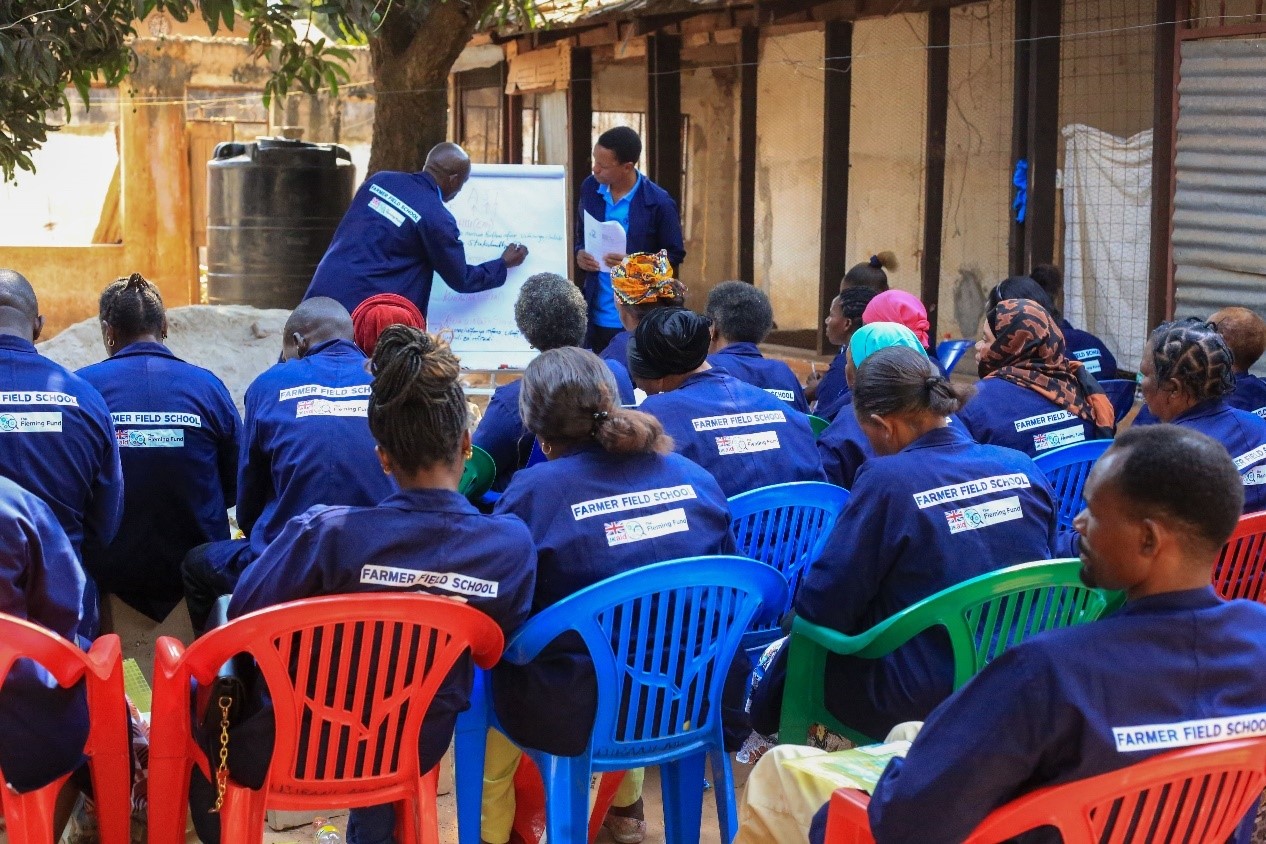
Farmer field schools facilitators conduct a COM-B analysis to promote good record-keeping on farms
©Eric Mgabe
Antimicrobial resistance (AMR) is a growing threat to animal health and productivity, leading to downstream impacts on public health and livelihoods. In Tanzania’s livestock sector, a recent study highlighted a troubling scenario: 100 percent of E. coli isolates from broiler and layer chickens showed resistance to at least one antimicrobial agent. These elevated levels of resistance is often linked to on-farm practices throughout the production cycle. These practices include the early administration of antimicrobials to the day-old chicks, limited investment in farm biosecurity, and the non-adherence to antimicrobial withdrawal periods during sale of broiler chickens.
Importantly, previous work by the Food and Agriculture Organization of the United Nations (FAO), through its Emergency Centre for Transboundary Animal Diseases (ECTAD), has demonstrated that such practices are often not due to a lack of knowledge . Indeed, many farmers recognize the importance of proper biosecurity and the dangers of misusing antimicrobials in poultry production.
To address this “knowledge-practice” gap and promote good practices across the broiler production cycle, FAO, with support of the Fleming Fund from the United Kingdom Agency for International Development (UK AID), is integrating behavioural science techniques into the Farmer Field School (FFS) approach. These methodologies help identify behavioural barriers to the adoption of recommended practices for good husbandry and prudent antimicrobial use across the production cycles, enabling farmers to collaboratively design and test localized solutions to address the identified barriers.
In a recent mission to Tanzania, behavioural scientists from FAO headquarters and FAO Kenya country office joined FAO Tanzania to visit six FFSs focused on broiler production. During the mission, FFS facilitators were provided additional training on the use of the Capacity, Opportunity, and Motivation (COM-B) model for behaviour change. This model suggests that for behaviours to change effectively, individuals need the appropriate capacity, opportunity, and motivation. COM-B sessions were held with FFS participants to examine the barriers hindering record-keeping- important for monitoring profits and making informed production decisions- and enhancing biosecurity practices, including the use and proper maintenance of footbaths. During these discussions, participants explored barriers related to the constructs of COM-B and proposed solutions to overcome these challenges.
In discussing her experience in leading COM-B sessions, Ms. Evelyn Maige, an FFS facilitator in Kigamboni Municipality, Dar es Salaam, shared her insights: “After learning about the COM-B model of behaviour change, I was able to help farmers shift from old practices and adopt practices they had previously overlooked, bringing positive changes to their farming. The COM-B model has made my role as a facilitator much easier by providing clear principles that simplify the process. This success has come from not only identifying the problems but also understanding their root causes. Additionally, I have gained insights into the psychological and emotional barriers that may have prevented farmers from adopting new practices. Without COM-B, this progress would have been challenging, as it was the case previously, everything was theoretical. Now it’s more accessible and understandable for the farmers”.
One positive change from these behavioral science sessions has been the uptake and improvement in biosecurity practices on the farm. As Mariam Alexander, a poultry farmer in Dar es Salaam stated: “We learned about the importance of footbaths, which has been invaluable for us since we used to enter the poultry house without observing them. Footbaths offer many benefits: they prevent diseases from entering the pens and help avoid losses from chicken deaths and so use of antibiotics”.
In summarizing the impacts of behavioral science methodologies on the FFS, Elibariki Mwakapeje, National AMR Coordinator of FAO ECTAD Tanzania, commented: “The integration of behavioral science methods into our Farmer Field Schools has helped our facilitators to identify challenges limiting good husbandry practices and then work with FFS participants to design local solutions. In the future, we hope these local solutions can be scaled up across Tanzania to improve the health of the birds and so to the health of the Tanzanian people”.
Tanzania is one of six African countries, including Ethiopia, Ghana, Kenya, Zambia and Zimbabwe, where FAO is integrating behavioural science methods into the FFS approach to tackle AMR and improve farm profits. Across these countries, over 50 FFSs have been launched with the participation of over 1 500 broiler farmers in 2024. Supported by the Fleming Fund project, FAO will evaluate whether the integration of behavioural sciences into the FFS approach promotes better biosecurity and more prudent antimicrobial use practices — key to curbing AMR. Additionally, the project will assess the impact of FFS participation on farm profits, key for the approach’s sustainability and scalability.
The FAO’s FFS approach, through its focus on production-long learning is well suited to addressing the many behaviours that pattern AMR in Tanzania and beyond. Furthermore, the integration of behavioural science within the FFS approach promises to overcome the knowledge-action gap, which has constrained progress in mitigating AMR.
Continued implementation and scaling up of the FFS approach in Tanzania and throughout the region will likely be key in tackling AMR within Africa and ultimately leading to healthier and more productive livestock, safer food, and healthier agri-food systems.