
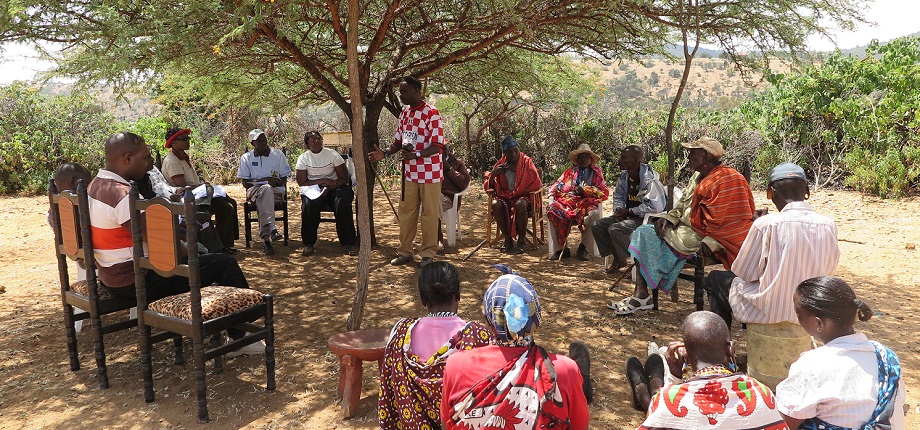
Since 2012, FFF support has enabled FFPOs to achieve significant results in gaining access to markets and better prices, leveraging financial resources, policy changes and tenure security, and improving livelihoods.
Area of support
Collectively, forest and farm producers have the transformative potential to achieve sustainable development and respond to climate change at landscape scales. Empowering FFPOs will be critical to delivering on the Sustainable Development Goals (SDGs) and Nationally Determined Contributions (NDCs) for fighting climate change as part of the Paris Agreement.
FFF provides direct support to FFPOs representing millions of rural people and increase links to complementary development programmes, fostering partnerships and leveraging financial resources. FFF supports the formation and strengthen the capacity of FFPOs through direct financial support and technical assistance, paying special attention to gender equality, youth engagement and indigenous peoples’ rights, working closely with governments.
FFF offers a range of services to FFPOs including advocacy, sharing information, training in market analyses and development, incubating and supporting business, providing financial access and social programmes for their members. Through learning and exchange visits and links to regional and international federations, FFF also strengthens smallholder organization and capacity at national and global levels.
FFF outcomes
1. More inclusive governance and cross-sectorial processes leading to enabling policies (SDGs 16, 17).
2. Increased entrepreneurship, access to markets and finance through an equitable value chain and business development services within FFPOs (SDGs 1, 5, 8, 12).
3. Improved delivery of landscape-scale mitigation, adaptation and resilience for climate change through improved environmental technical knowledge, direct engagement of FFPOs and integration with inclusive livelihood approaches (SDGs 2, 13, 15).
4. Improved and equitable access to social and cultural services (SDGs 3,10). A comprehensive participatory monitoring and learning system will provide continuous feedback and generate adaptive responses.

Monitoring and Learning System
Learning and improving – a shared responsibility
Key to the success of the FFF programme is measuring progress and taking timely action to make improvements. FFF’s monitoring and learning (M&L) system is a shared process which actively involves FAO headquarters, the local country teams and the forest and farm producer organizations. Through a cycle of planning, implementation, monitoring, reflection and response, the system promotes continuous learning and improvement across countries and regions.
Driving better results through the FFF app
Over the years, FFF has transformed its monitoring processes by building a digital infrastructure that connects data collection, risk management, reporting and learning. A key innovation has been the development of an app which brings technical deliverables, administrative monitoring, financial updates and risk tracking into a single integrated system. The app supports consistent reporting, transparent contract management and timely decision-making, making it the backbone of the FFF M&L system.
Monitoring risks and managing performance
The updated system allows risks and performance to be tracked and analyzed more efficiently. Information gathered through field missions, site visits and regular reporting is consolidated into real-time dashboards and analytical products. This enables local country teams and FAO headquarters to visualize progress, compliance and performance at any moment, and ensures any corrective action required is both timely and evidence-based.
Regular data validation processes with country teams and FFF partners, combined with cross-checks against FAO corporate systems, have also improved the reliability of programme information and strengthened accountability across all levels of implementation.
Added value of the FFF
FFF’s lessons learned will be widely shared to provide inputs into large initiatives like REDD+, FLEGT, the Forest Investment Programme, Landscape restoration programmes and the implementation of the Non-legally Binding Forest Instrument. Indeed, the FFF’s focus on forest and farm producer organizations as the primary actors (the “largest rural private sector”) in broader rural transformation, intentionally stresses linkages between forestry and other major sectors within forest based landscapes. The FFF proposes a focused and practical approach to working within the current global agenda: the growing global interest in forests within landscapes, the role of forests for food security, the emphasis on a “green economy”, the role of the small and medium scale private sector and a new sustainable development framework. Furthermore FFF is attracting significant interest from other sectors within the international development community and in governments, including the agricultural sector, rural development and livelihoods funders – thereby raising the profile of forestry.
Management
The FFF is a partnership launched in September 2012 between FAO, IIED and IUCN, and AgriCord. Its Steering Committee is formed by members affiliated with forest producer, community forestry, indigenous peoples’ organizations, international research community, business development service provider organization, private sector, government, and donors.