


FAO and Malawi kick-start climate action with $53 million Green Climate Fund project

©Steven Katete
A $53.2 million project to help Malawi’s farmers adapt to the impacts of climate change has been successfully launched in the capital city, Lilongwe.
The ‘Ecosystems-based Adaptation for Resilient Watersheds and Communities in Malawi (EbAM)’ project, being implemented by FAO and the Government of Malawi, will improve food security, protect biodiversity, and enhance the climate resilience of more than half a million people.
The initiative is the largest of its kind to be led by FAO in Malawi, where 70 percent of the country lives below the international poverty line.
Farmers in Malawi depend mostly on rainfed agriculture for their livelihoods and food security. Yet, rising temperatures, unpredictable rainfall, and other climate change-related phenomena threaten food production, and the natural resources people rely on for their well-being.
One of the ways the EbAM project will bring solutions to these challenges is by restoring 83 000 hectares of degraded communal plots and farmland for improved water, food, and nutrition security.
Shared vision
Over 140 representatives from Government Ministries, districts, development partners, NGOs and more gathered at the inception workshop, held from 5-6 December, to discuss their shared vision of collective and inclusive action for effective project implementation.
The event, co-hosted by the Government of Malawi, represented an important milestone in the EbAM project’s six-year lifespan.
“We look forward to working with our partners to scale up the implementation and uptake of climate smart agrifood systems solutions that rural Malawian’s need for a better life,” said Kaveh Zahedi, Director of the Office of Climate Change, Biodiversity and Environment at FAO.
Ted Sitimawina, Principal Secretary for Economic Affairs in the Ministry of Finance and Economic Affairs in Malawi, underscored the country’s strong sense of ownership and commitment to working with FAO and partners on this ambitious project.
Sitimawina noted how cross-sectoral collaboration on activities will support Malawi’s vision for an “inclusively wealthy and self-reliant nation,” known as Malawi 2063.
In his keynote Speech, Yusuf Mkungula, Principal Secretary for the Ministry of Natural Resources and Climate Change in Malawi, underscored the importance of Ecosystem-based Adaptation (EbA) in preserving the country’s cultural heritage and ensuring food security so that all people benefit from thriving ecosystems and secure livelihoods.
Collaboration for impact
Collaboration was the leitmotif of the workshop, which engaged participants in discussions on how to create synergies with other ongoing initiatives for maximum impact.
Donald Manda, Portfolio Lead for the International Fund for Agricultural Development (IFAD) in the country, praised the fruitful collaboration between the two UN agencies, which secured co-financing for the project from the Ministry of Finance and Economic Affairs through the IFAD-funded Financial Access for Rural Markets, Smallholders and Enterprise (FARMSE) Programme.
Zhijun Chen, FAO Representative in Malawi, commended the momentum participants created around a unified approach to project implementation. “Thanks to your collaborative efforts, we now have a clear roadmap to the EbAM project’s implementation and success,” he enthused.
Deepening understanding
Stakeholders gained a deep understanding of the initiative’s goals, objectives, and scope, including its strategic alignment with national climate planning processes and strategies.
During interactive breakout sessions, participants explored the EbAM project’s governance structures, Environmental and Social Safeguards (ESS), gender approaches, Monitoring and Evaluation (M&E) framework as well as finance management.
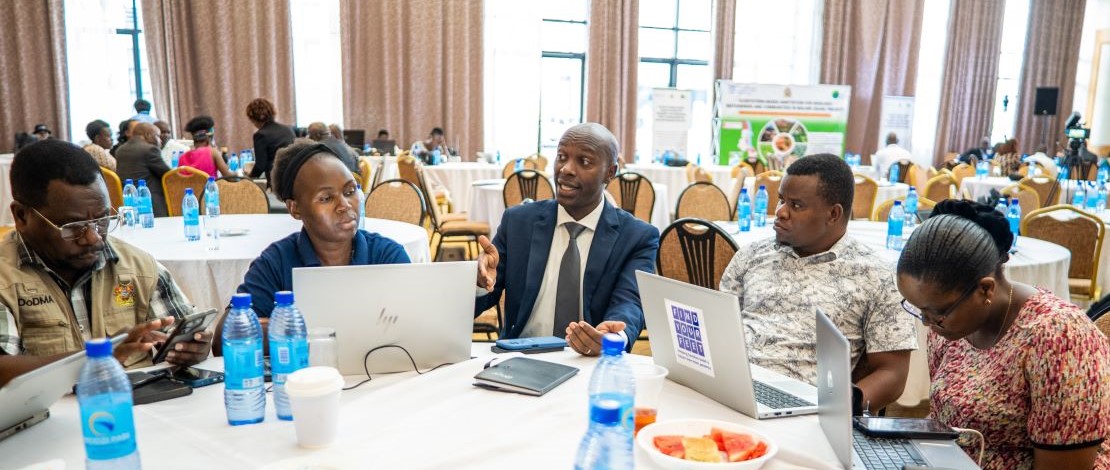
Breakout session on monitoring and evaluation systems. © FAO/Steven Katete
Geoffrey Mamba, Principal Secretary in Malawi’s Ministry of Agriculture, stressed the importance of sharing lessons learned and building on good practices for effective implementation.
Climate action in Africa
The EbAM project is one of seven initiatives in FAO’s portfolio of high-impact projects in Africa.
These projects in Benin, Congo, Côte d'Ivoire, the Gambia, Malawi, Somalia and Sudan – amounting to USD 276 million in GCF grants and co-financing – are critical to enhancing food security and ensuring finance effectively reaches agricultural communities, leaving no one behind.