


A shared commitment to institutionalizing robust national forest monitoring systems
Nearly 3 000 professionals join FAO’s online facilitated course

Marking the start of a collaborative journey to strengthen national forest monitoring systems, nearly 3 000 professionals from around the world will engage in the “Institutionalization of Forest Data” online facilitated course, which officially begins today. The four-week course, developed by the Food and Agriculture Organization of the United Nations (FAO), underscores the critical role that robust and transparent national forest monitoring systems (NFMS) play in supporting forest-based climate actions.
Building on the success of previous forest monitoring e-learning courses, this course has drawn a diverse group of participants – including forest practitioners, policymakers, academics and civil society representatives.
“Whether to advance professional goals, improve technical expertise or support national policies, participants are united by one goal: building strong, institutionalized national forest monitoring systems that deliver real impact,” said Rocío Condor, Forestry Officer at FAO. “This course explores how to embed forest monitoring in national structures to ensure transparency, long-term sustainability and open data sharing.”
Why are participants enrolling?
When registering, participants were asked to clarify their motivations. The results are clear: forest data matters now more than ever.
The infographic below illustrates the main motivations for joining the course.
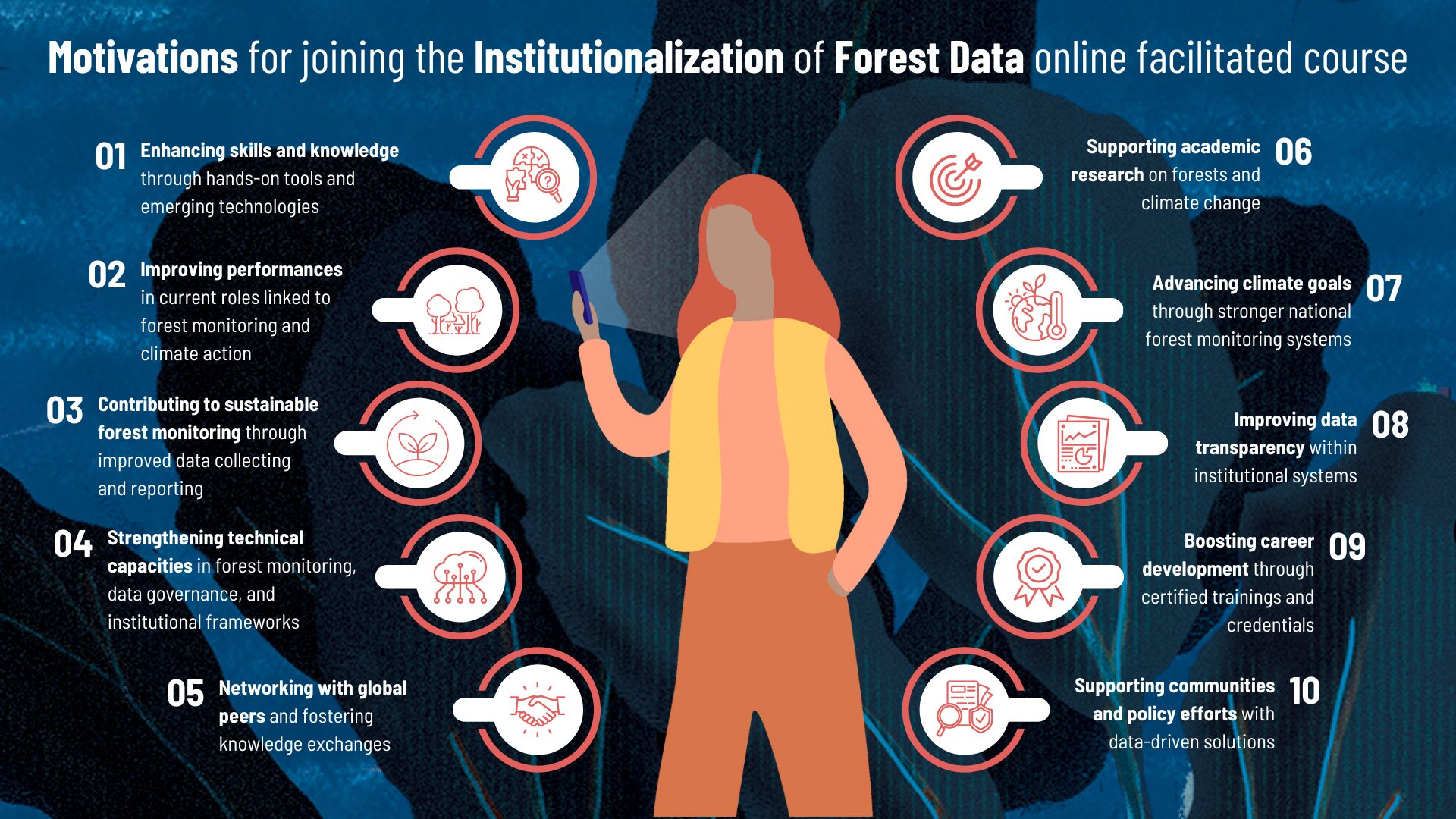
These motivations reflect a collective drive to strengthen the foundations of forest monitoring worldwide. By participating in this course, participants are not only looking to enhance their own capacities and professional growth but also contributing to a broader movement toward institutionalizing forest monitoring systems that are more transparent, inclusive and responsive to national and global priorities.
Who is participating?
A total of 2 927 participants from 125 countries will participate. According to the registration survey:
- 1 754 (60 percent) will follow the course in French;
- 673 (23 percent) will follow in English; and
- 500 (17 percent) will follow in Spanish.
Notably:
- 909 (31 percent) are women;
- 1 720 (59 percent) are young professionals (ages 18–35); and
- 1 062 (36 percent) self-identify as Indigenous Peoples.
The top countries represented by the participants include (in order of prevalence): Senegal, Madagascar, Benin, Cameroon, Côte d’Ivoire, the Democratic Republic of the Congo, Togo, Burkina Faso, Colombia and Kenya.
By region, the highest share of participants comes from Africa (72 percent), followed by Latin America and the Caribbean (20 percent), with the remaining 8 percent coming from Asia, Europe, North America or Oceania.

Participants represent a diverse mix of organizations, including universities and research centres, government institutions, civil society, international organizations (including United Nations bodies), and the private sector. Additionally, many are working in areas directly related to forestry, such as forest protection, restoration, economics, harvesting and the sustainable management of forest ecosystems.
Building long-term capacity for forest monitoring
The “Institutionalization of Forest Data” course offers practical guidance on embedding forest monitoring into national systems and policy frameworks. Through a mix of learning activities such as case studies, interactive discussions, videos, reading materials, quizzes, discussion forums and live expert sessions, participants will gain the skills needed to institutionalize NFMS with transparency and consistency for long-term impact.
Running from today, 7 May to 6 June 2025, the course is delivered in English, French and Spanish simultaneously. It features three sequential modules focused on the NFMS:
- Module 1: Overview
- Module 2: Institutionalization
- Module 3: Strategy and Planning
This course builds on the ideas introduced in FAO’s Voluntary Guidelines on National Forest Monitoring as agreed by FAO member countries.
Upon completion, participants will receive a digital certification badge recognizing their newly acquired competencies.
This growing community reflects a global shift: forest monitoring is no longer the task of a few – it is a collective responsibility. With every new learner, FAO helps to advance the use of transparent forest data to benefit people, protect the planet and support global climate action.
This course is offered by FAO’s Forest Monitoring and Data Platforms team in collaboration with the FAO eLearning Academy, and with the financial support of the AIM4Forests programme and the CBIT-Forest initiative.
Looking for a different learning path on forest monitoring?
Explore the “National Forest Inventory” Learning Journey to uncover the essentials of effective implementation, available in English, French and Spanish.
Take the “Forest and land monitoring for climate action – SEPAL” facilitated course to improve your GIS and remote sensing skills, available in English, French and Spanish.