


The approach
SCOPE follows a three-level analytical approach. Each level builds on the previous one, moving from a broad system overview to more targeted analysis and concrete actions. This structure ensures that support is systematic, scalable, and responsive to country needs, while enabling governments and partners to work from a shared evidence base.
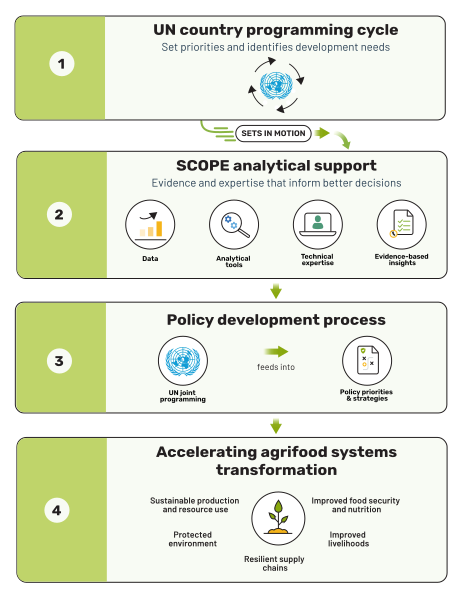
SCOPE delivers transformative, evidence-driven results in agrifood systems by:
 | Leveraging state-of-the-art tools, data platforms and analytical knowledge to tackle current challenges and generate robust diagnostics and insights tailored to each country’s development needs and potential, in line with national priorities and strategies. |
| Translating these insights into actionable, timely and evidence-based recommendations for effective programmes and policies that address key trade-offs in agrifood systems transformation, ensuring cost-efficiency and long-term impacts. |
| Building consensus on country-level priority actions through a holistic agrifood systrems approach and shared evidence frameworks that foster collaboration, align with the 2030 Agenda, and drive greater efficiency across the United Nations system – unlocking deeper inter-agency cooperation. |
The three-level approach

Level 1 — Status of the national agrifood system
The first level provides a comprehensive snapshot of the national agrifood system. Using data from FAO’s State of the Agrifood System Data Platform and other sources, it identifies major trends, structural bottlenecks, and systemic challenges affecting progress toward the Sustainable Development Goals.
What this provides
- A clear, evidence-based overview of the agrifood system
- Identification of key development challenges and opportunities
- A shared analytical baseline for government and partners

Level 2 — Exploring systemic challenges
The second level explores why these challenges persist. It examines the underlying drivers of agrifood system constraints and identifies the key leverage points for change.
This analysis helps clarify how different policies, institutions, and investments interact across the system, highlighting potential synergies and trade-offs.
What this provides
- A deeper understanding of the root causes behind slow progress
- Identification of priority areas for policy reform and investment
- A shared diagnosis across ministries and development partners

Level 3 — Deep-dive on actions
The third level focuses on practical solutions and implementation pathways. It provides targeted analysis of specific interventions with strong potential to accelerate agrifood systems transformation.
This level is deployed when there is clear demand for policy guidance or investment planning.
What this provides
- Identification of a small number of high-impact, game-changing solutions.
- Clear options for sustainable, resilient, and inclusive agrifood systems transformation.
- Practical inputs to guide policy decisions, programmes, and investments.
Frequently asked questions (FAQs)
The Analytical Support Mechanism for Agrifood System Country Programming and Evidence (SCOPE) helps countries turn data, analysis and specialized expertise into better-informed agrifood policy, programming and investment decisions. Through decentralized regional teams, it bridges country-level needs with FAO’s wider knowledge and technical, policy and investment expertise, global public goods, normative guidance and convening power.
Agrifood systems transformation is essential to address hunger, climate change, biodiversity loss and economic inequality. It is the basis of the Strategic Narrative of the FAO Strategic Framework 2022–31 and is recognized as one of the United Nations’ six critical transitions for achieving the Sustainable Development Goals.
Because agrifood systems are interconnected, decisions in one area can create benefits, costs and trade-offs elsewhere. Integrated analysis can help countries understand these connections and identify who may gain or lose from different policy and investment choices.
SCOPE supports priorities identified by FAO Members and national partners by bringing timely, multidisciplinary evidence into national, FAO and UN programming processes, and other critical windows where coordinated analytical support is needed. This can include the Common Country Analysis, the United Nations Sustainable Development Cooperation Framework and FAO Country Programming Framework processes, as relevant to the country programming cycle. It can also include acute needs or opportunities to provide robust evidence and analysis due to crisis or major policy formulation processes.
In doing so, SCOPE contributes to the objectives of UN development system reform: moving beyond fragmented, project-based support towards more strategic policy engagement, while improving coherence and collaboration across the UN system via the Resident Coordinator Office, in line with the “One UN” approach.
SCOPE brings to bear a coherent analytical framework and a cost-effective regional delivery model designed around country demand, linking analytical support more holistically and systematically to inform and enrich country and UN programming processes.
Its regional delivery model decentralizes specialized technical capacity, bringing expertise closer to where national decisions are made. Six regional teams connect national stakeholders with wider pools of FAO expertise at all levels of the Organization and mobilize support according to the country question, institutional context, available data and decision timeline. By sharing scarce analytical capacity across countries rather than duplicating it in each location, SCOPE makes specialized support more accessible and cost-effective.
SCOPE also connects three types of analysis within one coherent framework: understanding how the agrifood system is performing, investigating the causes of priority problems, and appraising possible policy and investment responses.
Agrifood systems are complex, interconnected and dynamic. Outcomes related to food production, markets, nutrition, the environment and the wider economy influence one another. SCOPE therefore looks beyond individual problems to examine their underlying drivers, relationships, synergies and trade-offs.
It puts this systems perspective into practice through a three-level analytical framework. The framework moves from assessing how an agrifood system is performing, to investigating priority constraints and leverage points identified for deeper analysis, and then to appraising context-specific policy and investment options. These levels organize the analysis; they do not imply that agrifood systems transformation follows a fixed or linear path.
According to FAO's Systems approach to food and agriculture (FAO, 2026), SCOPE strengthens:
systems knowledge, through data and analysis that reveal interactions across the agrifood system;
systems thinking, by examining problems and possible responses across interconnected areas; and
systems doing, via evidence-informed decision-making, by connecting country-led analysis with policy dialogue and investment planning.
By bringing analysis into national planning and programming processes, SCOPE can help countries move from broad diagnosis towards more targeted, coherent and evidence-informed action. This evidence complements the political leadership, institutional coordination, stakeholder engagement, investment and implementation capacity required for lasting transformation.
Also see the FAQ on agrifood systems transformation.
In one SCOPE-supported country, an initial assessment identified high levels of informal employment in the agrifood system. More detailed analysis then showed how the problem varied by farm size and value chain. Accordingly, alternative formalization policies were simulated. The analysis helped identify where resistance could arise, what complementary measures might be needed and why a differentiated, phased approach would be most effective, helping inform policy design and implementation.
In another country, poor nutrition indicators led to closer analysis of the foods available for human consumption, including gaps and surpluses. Based on the findings, possible fiscal instruments (e.g. taxes and subsidies) and trade options were assessed alongside stakeholder interests and political feasibility.
Both cases illustrate the benefit of SCOPE’s approach of moving from a broad diagnosis to a specific country question and then to policy options grounded in the national context.
Initiated through country and UN programming processes, each analysis responds to country demand and is developed in consultation with national stakeholders, whose priorities and input shape the questions examined, the methods used and the policy options assessed.
SCOPE support responds to country demand and is developed in coordination with FAO country and regional teams and relevant national stakeholders. It can be mobilized to provide support when governments and the United Nations set joint programming priorities, or when particularly acute needs or opportunities, such as crises or major policy processes, create an urgent need for evidence.
The type and depth of support depend on the country question, existing evidence, national priorities and the decisions that the analysis is intended to inform.