


Resilience in Protracted Crises
Protracted crises are contexts in which a significant proportion of the population is acutely vulnerable to hunger, disease and disruptions to livelihoods over prolonged periods. In these situations, undernourishment is severe, long-standing and almost three times more frequent than in other developing contexts. According to the 2024 Global Report on Food Crises (GRFC), 36 countries faced protracted food crises in 2023.
Strengthening livelihoods in protracted crises through policy guidance
Among the 36 cases mentioned above, 19 are protracted major food crises and accounted for up to 80 percent of the total population facing high levels of acute food insecurity across food-crisis countries/territories each year.
FAO provides policy guidance, builds partnerships, and supports in-country programmes to strengthen conflict-sensitive livelihoods and food systems in protracted crisis situations. These help support vulnerable communities and households, improving their food and nutrition status, whilst building resilience to future shocks and stressors.
Key messages
The figure represents a worldwide increase of 24 million from the previous year. This rise was due to the report’s increased coverage of food crisis contexts as well as a sharp deterioration in food security, especially in the Gaza Strip and the Sudan. Children and women are at the forefront of these hunger crises, with over 36 million children under 5 years of age acutely malnourished across 32 countries. Acute malnutrition worsened in 2023, particularly among people displaced because of conflict and disasters.
These interlinked drivers are exacerbating agrifood systems fragility, rural marginalization, poor governance, and inequality, and lead to massive displacement of populations globally. The protection situation of the displaced population is additionally impacted by food insecurity.
The GNAFC also aims at mitigating their impacts, and boosting resilient and sustainable post-crisis recovery and rehabilitation for transforming agriculture and food systems. It involves working at the global, regional and national levels to support partnerships within existing structures and to improve advocacy, decision-making, policy and programming through shared analysis and knowledge, strengthened coordination in evidence-based responses and collective efforts across the Humanitarian, Development and Peace (HDP) nexus.
Such policies should look to the future through linkages across the humanitarian, development and peace nexus to increase community, household, food systems and ecosystem resilience.
Examples of these drivers are conflict and insecurity, climate change, environmental degradation, and demographic change.
This must be done with great care and with respect for informal and traditional institutions and based on a good understanding of natural resource management (such as land and water), which can often be the basis of local tensions and disputes. FAO supports transparent and inclusive governance practices that involve civil society and indigenous/local populations, which are adapted to their contextual realities.
Featured resources

Assessing decent employment situation and perspectives in the Gaza Strip and the West Bank - Briefing note on the Occupied Palestinian Territory
2024
The employment situation in the Occupied Palestinian Territory (OPT) has been critically impacted by the conflict triggered by the attack on 7 October...

Understanding the status of land rights for sustainable reconstruction of the Gaza Strip and the West Bank - Briefing note on the Occupied Palestinian Territory
2024
The legal framework and effective land rights in the Occupied Palestinian Territories (OPT) are highly unstable. Recent hostilities, displacements,...

Protecting the right to adequate food and saving lives in the Gaza Strip - Briefing note on the Occupied Palestinian Territory
2024
The note outlines the obligations of States to safeguard food as a human right. It explores how the right to food is applied in armed conflict and occupation...

Agricultural producer organizations in the West Bank and Gaza Strip - An assessment of their agribusiness capacities and institutional environment
2024
This study comprises an assessment of a selected number of producer organizations in the West Bank and Gaza Strip with regards to their agribusiness...

Agricultural producer organizations in the West Bank and Gaza Strip – An assessment of their agribusiness capacities and institutional environment
2024
Strengthening agricultural producer organizations (POs) and cooperatives has been recognized as a key way forward to support farmers in the West Bank...
Global Report on Food Crises 2022
2022
The 2022 Global Report on Food Crises (GRFC 2022) highlights the remarkably high severity and numbers of people in Crisis or worse (IPC/CH Phase 3 or...

How to feed the world in times of pandemics and climate change? Opportunities for innovation in livestock systems
2021
Progress towards Zero Hunger must be protected from the dual challenges of pandemics and climate change. The frequency of infectious disease outbreaks...

Desert locust upsurge. Progress report on the response in Southwest Asia, May–December 2020
2021
This progress report details the work carried out by FAO across the Southwest Asia to combat the unprecedented threat to food security and livelihoods...
The Federal Republic of Nigeria Resilience Strategy 2021–2023. Increasing the resilience of agriculture-based livelihood – The pathway to humanitarian–development–peace nexus
2021
The Food and Agriculture Organization of the United Nations (FAO) has developed this three-year strategy to strengthen resilience of agriculture-based...
Burkina Faso – Analysis of conflicts over the exploitation of natural resources
2021
In Burkina Faso, the exacerbation of conflicts over natural resources and the rapid development of insecurity are sources of major concern for both...
Mali – Analysis of conflicts over natural resources
2021
Due to the economic dominance of the agriculture sector, Mali is extremely dependent on natural resources and also vulnerable to the adverse effects...
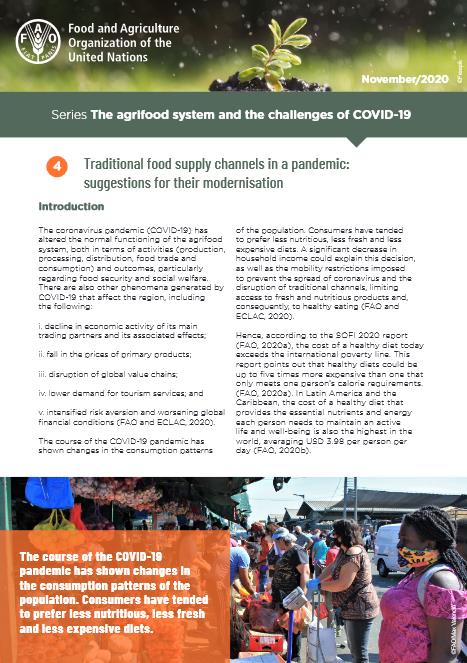
Series: The agrifood system and the challenges of COVID-19. Traditional food supply channels in a pandemic: suggestions for their modernisation
2020
The text provides a description, analysis and perspectives of the traditional supply and marketing channels in the face of the pandemic. It identifies...

Jordan food security update. Implications of COVID-19, May – June 2020
2020
With the COVID-19 in Jordan under control, the government of Jordan has managed the response proactively and to mitigate potential immediate impacts...
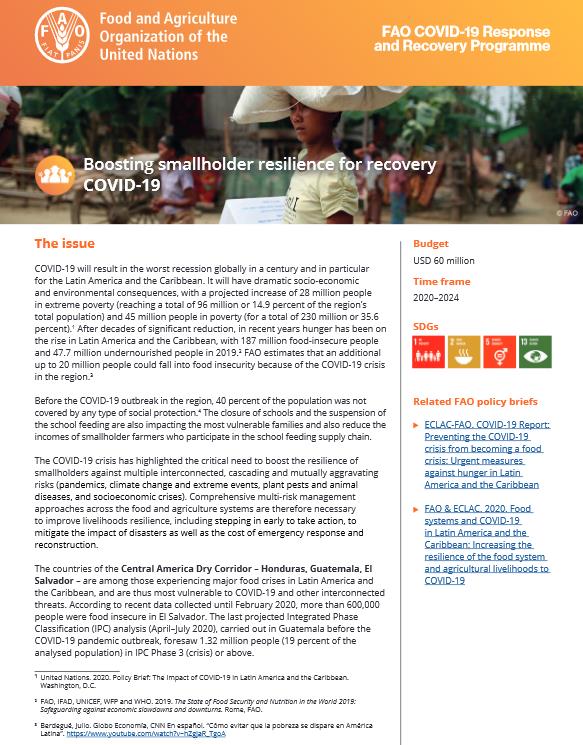
Boosting smallholder resilience for recovery. Boosting the resilience of smallholders for COVID-19 recovery
2020
This action sheet is part of a series of action sheets developed under the seven key priority areas of the FAO COVID-19 Response and Recovery programme,...

Protecting agricultural workers through remote COVID-19 awareness campaigns in Pakistan. Using digital media and distanced messaging to promote virus mitigation and combat misinformation
2020
The continuing COVID-19 pandemic—and related lockdowns—triggered a massive cash crisis around the world for families who depend on informal earnings,...

Key success factors and obstacles for FAO energy projects in humanitarian settings. An evaluation of FAO’s energy-in-emergency portfolio to inform future programming in three Eastern African Countries
2020
Under the Safe Access to Fuel and Energy (SAFE) programme, FAO has contributed to improving resilience and livelihoods for refugees and internally displaced...

Exposure of humans or animals to SARS-CoV-2 from wild, livestock, companion and aquatic animals. Qualitative exposure assessment – Summary
2020
SARS-CoV-2 is an emerging virus currently causing a large epidemic of COVID-19. Countries have asked FAO to provide guidance on how to investigate the...

Observations on the impact of the COVID-19 outbreak on farmers. Case of Italy
2020
As countries report mounting cases of the COVID-19, the outbreak presents them and the global community with unprecedented challenges in recent times....

Assistance in chronic conflict areas: evidence from South Sudan. FAO Agricultural Development Economics Working Paper 20-01
2020
People living in context prone to or affected by conflict suffer from many forms of deprivation. The international community plays a crucial role in...

Exposure of humans or animals to SARS-CoV-2 from wild, livestock, companion and aquatic animals
2020
Understanding the risk of exposure of humans or animals to SARS-CoV-2 from animals and their products is essential for containing virus spread, prioritizing...
Sustainable Development Goals
Our work on this theme primarily contributes to:


Find out more
- Global Report on Food Crises
- Committee on World Food Security (CFS)
- Food Security Information Network (FSIN)
- FAO's work on emergencies and resilience