

Inspiration, inclusion and innovation: FAO–China South–South Cooperation Programme (2009-2019)
25/11/2019
The People’s Republic of China (China) has been one of FAO’s main partners in the promotion of South-South and triangular cooperation. In terms of cooperation among developing countries, China upholds the principles of equality and mutual trust, building equal partnerships with parity of ownership and responsibility, mutual benefit and win–win cooperation, which are highly valued by FAO. The brochure is also available here.

South-South and triangular cooperation - Gateway
30/10/2019
As of 2019, FAO has approximately 40 South-South and Triangular Cooperation (SSTC) projects in more than 90 host countries. Moreover, different Trust Funds (TFs) have been established, partnering with countries such as Brazil, the People’s Democratic Republic of China, Japan, Mexico, Morocco and the Republic of Korea.
FAO’s SSTC Gateway is a platform designed to facilitate knowledge and partnership brokering for SSTC in the agriculture and rural development sector. The platform comprises good practices, technical guidance documents, videos from the agriculture and agri-food sector, a SSTC expertise database and allows users to submit SSTC-related inquiries.
This scale-up note is part of a series of SSTC scale-up notes, which provide insight into FAO's role in SSTC.
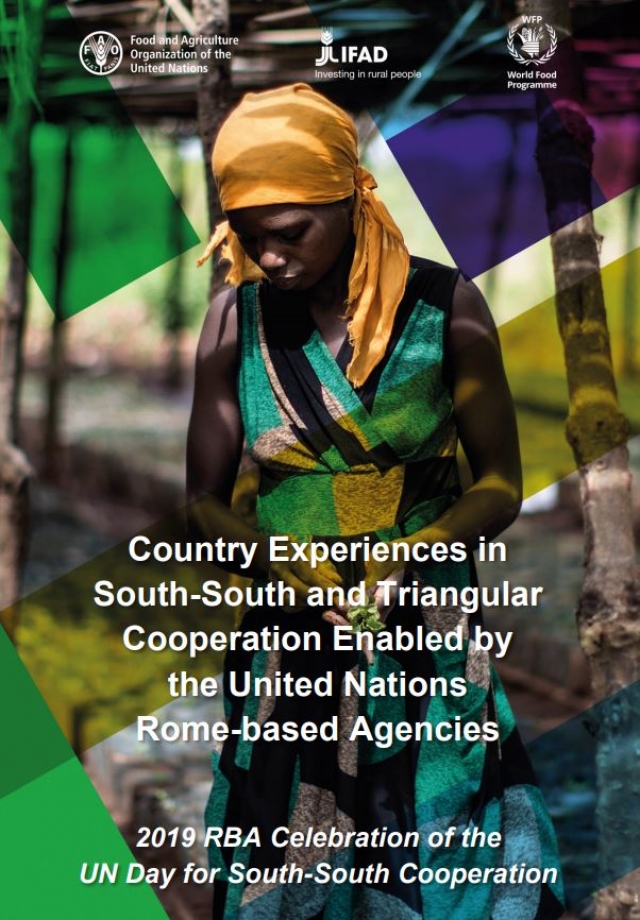
Country Experiences in South-South and Triangular Cooperation Enabled by the United Nations Rome-based Agencies
11/09/2019
This brochure has been jointly developed to showcase concrete examples of how the RBAs promote South-South initiatives at the country level. Focusing on the theme of the joint celebration of the 2019 UN Day for South-South Cooperation, leaving no one behind in achieving SDG 2, the cases highlight opportunities to enhance collaboration in the fight against hunger and malnutrition to realize Zero Hunger by 2030.

South-South and Triangular Cooperation in FAO
26/04/2019
Sustainable Development calls for strengthened partnerships in the implementation of the 17 Sustainable Development Goals (SDGs), including North–South, South–South, and triangular partnerships. The report South–South and Triangular Cooperation in FAO: Strengthening Partnerships to Achieve Sustainable Development Goals illustrates how South–South and triangular cooperation (SSTC) can be leveraged to enhance agricultural productivity and improve food security and nutrition in the developing world. It aims to deepen the understanding of the role and contribution of SSTC to agricultural development, food security, and nutrition. The report also offers practical lessons on how SSTC could be further strengthened and scaled-up in the implementation of the 2030 Agenda with the support of the United Nations system, multilateral organizations and other development partners.

Knowledge exchange on the promotion of efficient rice farming practices and value chains in Sub-Sahara Africa through South-South Cooperation
14/09/2018
The Regional Knowledge Exchange on the promotion of efficient rice farming practices and value chains in sub-Saharan Africa took place from 7 to 11 August 2017 in Elmina, Ghana. The workshop brought together over 40 participants from ten countries and technical partner institutions involved in the implementation of the regional project “Partnership for Sustainable Rice Systems Development in Sub-Saharan Africa’’ (GCP/RAF/489/VEN). The key objectives of the workshop were primarily (1) to discuss priorities and plans for continued project implementation at country and at regional level, and (2) to facilitate the regional exchange of knowledge and experiences on sustainable rice production intensification and rice value chain.

FAO’s South South and Triangular Cooperation to achieve the Sustainable Development Goals
14/09/2018
South-South and Triangular Cooperation (SSTC) is rapidly gaining ground as a powerful delivery mechanism in the development cooperation landscape. It has been recognized as a key means of implementing the 2030 Agenda for Sustainable Development, with particular reference to UN Sustainable Development Goal (SDG) 17: Strengthen the means of implementation and revitalize the global partnership for sustainable development.
SSTC initiatives, facilitated by the Food and Agriculture Organization of the United Nations (FAO), may involve two or more countries of the global South, sometimes in collaboration with a third party. By sharing innovative development solutions, such as knowledge, policies, technologies and resources, countries are able to overcome challenges that once seemed insurmountable.
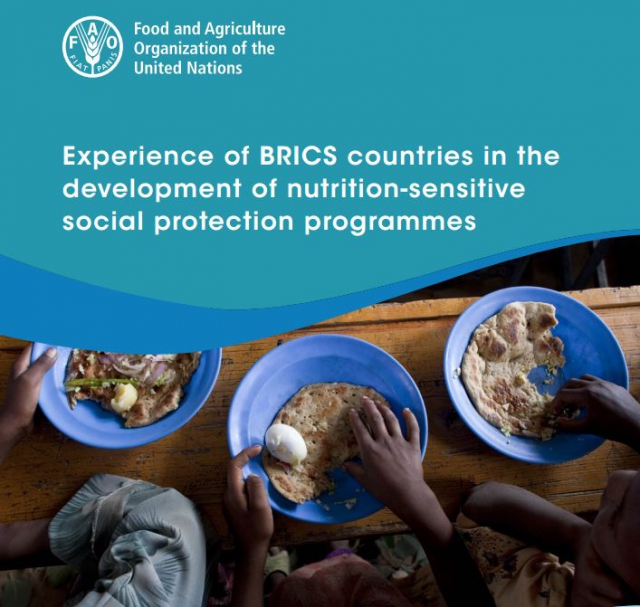
Experience of BRICS countries in the development of nutrition-sensitive social protection programmes
14/03/2017
BRICS countries (Brazil, Russian Federation, India, China and South Africa) have taken the lead in recent global policy dialogues on economic, social and environmental issues. They are home to 3.1 billion people, representing 42 percent of the world’s population. Combined, BRICS have achieved the Millennium Development Goal of halving the prevalence of undernourishment by 2015. Building on their experience in reducing hunger, BRICS countries have also been instrumental in initiating mechanisms of South-South cooperation by supporting and promoting the establishment of nutrition-sensitive social protection systems in other developing countries.

FAO's South-South and Triangular Cooperation Strategy in Action
09/03/2017
South-South Cooperation (SSC) is playing a greater role than ever before in the development cooperation landscape. Innovation in the global South is generating new tools and partnerships for tackling issues of food insecurity, poverty reduction and sustainable agriculture. The South offers wide-ranging development solutions – knowledge, experiences and good practices, innovative policies, technology, know-how, and resources – that have proven costeffective and have huge potential to be shared, adapted and adopted.

How to engage in South-South and Triangular Cooperation
08/03/2016
South-South Cooperation (SSC) is a cost-effective mechanism for sharing knowledge, resources and developing capacities among countries of the global South. Global demand for successful SSC and Triangular Cooperation is at an all-time high and FAO’s Corporate SSC Strategy aims to facilitate SSC development solutions to achieve food security, poverty reduction and sustainable agriculture.

FAO's Quick Guide to South-South Cooperation
11/11/2015
The Guide takes readers through a step by step process on how to engage in South-South Cooperation as a complementary instrument to North-South Cooperation, as a means to deliver on FAO’s mandate and achieving the Sustainable Development Goals. It also provides the tools required to raise the profile of countries engaged in South-South Cooperation, as well as encourage others that have something to offer.