Carbon and Water Footprint (CWF) Initiative

Example of CWF Tool results table displaying the carbon footprint of a company
The European Union recently approved the Corporate Sustainability Due Diligence Directive (CSDDD) and the draft reporting requirements of the Corporate Sustainability Reporting Directive (CSRD). These regulations will mandate companies operating in Europe to disclose human rights and environmental risks within their value chains, including Scope 3 Greenhouse Gas (GHG) emissions, while similar regulatory frameworks are being developed in other significant markets, such as the United Kingdom of Great Britain and Northern Ireland and China.
In response to these new regulatory requirements, the World Banana Forum (WBF) Secretariat launched the Carbon and Water Footprint (CWF) initiative and developed the most comprehensive and validated environmental assessment tool specifically designed for the banana industry. Since 2017, the WBF has supported over 400 banana producers (approximately 25,000 hectares) across 9 countries in measuring, reporting and reducing their carbon and water footprints.
The WBF’s CWF Tool provides an industry-standard approach to measuring, monitoring, and verifying carbon and water footprints, enabling a high level of precision and comparability across operations. It integrates best-in-class methodologies aligned with internationally recognized protocols, including the GHG Protocol, ISO 14064, and the ISO 14046 standards. With robust data analytics and automated reporting features, the tool ensures transparency and consistency in environmental impact reporting, making it the preferred solution for banana producers and exporters.
Through a harmonized methodology and a validated, user-friendly tool for the banana industry, the WBF and FAO provide an accessible and continuously updated solution that complies with evolving regulatory requirements while advancing environmental sustainability and resource efficiency across global banana supply chains.
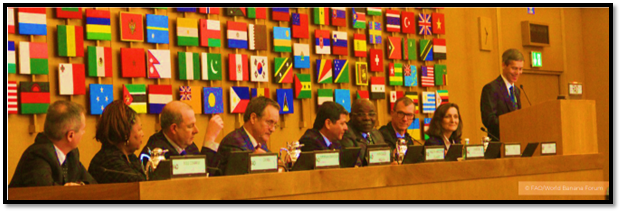
Panel Discussion on Sustainability in the Global Banana Value Chain at the Fourth Global Conference of the World Banana Forum (March 2024)
Xavier Roussel (Dole Food Company), Iris Mungia (COLSIBA), Leonard Mizzi (European Commission – DG INPA), Lieven De La Marche (Permanent Representation of Belgium to FAO, WFP, and IFAD), Ricardo Palacios (Ministry of Agriculture of Ecuador), Médi Moungui (Permanent Representation of Cameroon to FAO, WFP, and IFAD), Patrick Belser (International Labour Organization – ILO), and Marike de Peña (CLAC).
The goal
The goal of the Carbon and Water Footprint (CWF) Initiative is to optimize resource and water use, reduce GHG emissions, and enhance efficiency in the banana industry. By providing a standardized and updated tool for environmental impact assessment, this initiative supports producers in adopting sustainable practice, complying with evolving environmental standards, informing stakeholders on climate action and promoting data-driven decision-making to drive long-term sustainability in global banana supply chains.

Timeline of the CWF Tool Development
Different phases of the Carbon and Water Footprint (CWF) initiative:
PHASE I (2017): Development of a methodological guide to measure and reduce carbon and water footprints, with an initial pilot in Costa Rica. The guide was published in English and Spanish in 2018.
PHASE II (2020): Creation of an automated, cloud-based tool based on the methodological guide, making footprint assessment more accessible. This phase included training and validation sessions in collaboration with producer associations in Ecuador, Colombia, Costa Rica, and Guatemala.
PHASE III (2022): Enhancement of the tool’s scope and robustness, incorporating additional metrics and functionalities. Training and validation sessions were expanded to include producer associations and companies across Colombia, Costa Rica, the Dominican Republic, Ecuador, Guatemala, Panama, and Brazil.
PHASE IV (2024 - 2025): Complete revamp of the software’s architecture with the development of new modules to capture Scope 3 emissions, including input manufacturing, maritime transport, storage and ripening operations, and terrestrial transport in the destination country, marking a shift from an organizational to a partial footprint estimation approach in line with recent global standards and guidelines. Extensive databases of commercial fertilizers, pesticides, and other key inputs were integrated to automatically calculate fabrication emissions, water impacts, and field-level emissions.
The new phase also introduced more intuitive result displays, enhanced report generation, refined water footprinting with blue and green water indicators and much more.
Contributors to the implementation of the initiative
| | |
| | |
| | |
| | |
| | |
| | |
| | |
| |