


FAO at UNOC 2025: QU Dongyu's leadership and engagement
June 2025, Nice, France. FAO Director-General QU Dongyu, delivers his opening remarks in presence of Crown Prince Haakon of Norway during the The Ocean We Depend On: Achieving SDG 14 Through Sustainable Governance event. © FAO/Alessandra Benedetti
Nice (France) – Mr. Qu Dongyu, Director-General of the Food and Agriculture Organization of the United Nations (FAO), was the leading figure representing the Organization at the 2025 United Nations Ocean Conference, where he emphasized the essential role of science, innovation, and international collaboration in promoting sustainable ocean management. The conference was a valuable opportunity to advance FAO’s work in fisheries and aquaculture and to reaffirm the Organization’s role as a leading global authority on sustainable fisheries and aquaculture.


FAO Director-General QU Dongyu, meeting with with the Minister of Ecological Transition, Biodiversity, Forests, Sea and Fisheries of France Agnès Pannier-Runacher.
FAO Director-General QU Dongyu, and FAO ADG Manuel Barange leave the Thalassa Vessel at the end of the From science to platter event (Thalassa Vessel).
© FAO/Alessandra Benedetti
Promoting sustainable fisheries management
Highlighting the critical role of science, innovation, and international cooperation in ensuring that aquatic food systems can feed a growing global population while preserving biodiversity, the Director-General addressed Ocean Action Panel 5, an event focused on achieving sustainable fish stock management.
"Since 1950, FAO has been supporting global efforts to collect and analyze fisheries and aquaculture data, providing direct support to its Members for the conservation and sustainable development of their aquatic food systems," Qu stated in his address, underlining the Organization's long-standing commitment to responsible fisheries practices.
The Director-General also underscored FAO's pivotal role in shaping the global governance framework through the negotiation of key international instruments. Twenty five years ago FAO was the pioneer in these including the FAO Fish Stocks Agreement, the Port State Measures Agreement, and the Voluntary Guidelines for Securing Sustainable Small-Scale Fisheries. His emphasis on these agreements highlights FAO's commitment to combating illegal, unreported, and unregulated (IUU) fishing, which poses a significant threat to marine ecosystems and global food security.
Launching a landmark fisheries report
Director-General Qu also launched the 2025 edition of FAO's Review of the State of World Marine Fishery Resources, the most comprehensive assessment of global marine fisheries to date. Developed with input from over 650 experts across 92 countries, the report covers more than 2,500 marine fish stocks and reveals that over 80 percent of fish stocks in several FAO regions are sustainably exploited.
This report was highly recognized among Members and partners, not only serves as a critical tool for policymakers but also highlights the urgent need for continued investment in scientific research and effective management practices to ensure the long-term sustainability of fish stocks.
Signing of a Memorandum of Understanding
In a significant move to enhance collaboration, Qu signed a Memorandum of Understanding (MoU) between FAO and the International Seabed Authority (ISA). This agreement facilitates closer cooperation on deep-sea ecosystems, biodiversity, capacity development, and responsible resource use, aligning with the Decade of Ocean Science for Sustainable Development.
The MoU emphasizes the importance of knowledge-sharing, marine spatial planning, and technology transfer in addressing global challenges such as pollution, habitat degradation, and unsustainable practices.
The partnership with ISA represents FAO's ongoing commitment to safeguarding marine resources and fostering collaborative efforts that support sustainable ocean governance.
Addressing ocean health and plastic pollution
In a high-level side event “Sustainable Shipping: our ocean – our obligation – our opportunity”, held by the International Maritime Organization (IMO), the Director-General turned the attention to plastic pollution and the health of the oceans.
He highlighted the fruitful collaboration between FAO and IMO to reduce marine litter, which includes partnership projects with Norway, the Republic of Korea, as well as an upcoming project funded by the Global Environment Facility, all focusing on managing marine litter from sea-based sources.
“Reducing ocean litter is not just a matter of environmental responsibility — it is fundamental to ensuring sustainable fisheries, safeguarding marine biodiversity, and supporting the livelihoods of coastal communities,” stated Qu in his address.
Celebrating FAO’s milestones
Additionally, Qu celebrated significant milestones during the conference. He marked World Oceans Day (9 June) at the immersive “La Baleine” pavilion in Nice, where various organizations showcased their initiatives related to ocean conservation and sustainable use.
The Director-General visited the FAO exhibit on Blue Transformation, which focused on transforming aquatic food systems for Better Production, Better Nutrition, a Better Environment, and a Better Life, leaving no one behind.
Furthermore, the Director-General addressed event celebrating FAO’s 80th anniversary, which coincides with the 30th Anniversary of the Code of Conduct for Responsible Fisheries. This event highlighted the importance of youth-led solutions in ocean sustainability and recognized innovative practices that contribute to the responsible development of fisheries and aquaculture.
Engaging youth and fostering dialogue
During the conference, Qu emphasized the significance of intergenerational dialogue by meeting with Crown Prince Haakon of Norway and young representatives from the fisheries and aquaculture sector aboard the Norwegian training vessel, Statsraad Lehmkuhl. This informal exchange underscored the importance of engaging youth in discussions around ocean sustainability and fostering a new generation of leaders in the field.
In addition, Qu participated in the high-level side event “The Ocean We Depend On: Achieving SDG 14 Through Sustainable Governance.” The event marked the 50th anniversary of the FAO–Norway EAF-Nansen Programme and brought together government officials, youth leaders, scientists, and development partners to explore how ocean science and inclusive policies can contribute to enhancing governance. Discussions focused on the role of science-based fisheries management in ensuring food and nutrition security, equitable livelihoods, and healthy marine ecosystems.
“Sustainable aquatic food systems are vital for rural development, economic resilience, equitable growth and for unlocking the global blue economy - we need an aquatic fish culture!” said Qu in his speech at the event.
Symbolic seafood tastings also featured as part of the event, promoting sustainable consumption and the cultural value of aquatic foods. Further highlighting responsible consumption, aboard the French oceanographic research vessel Thalassa, the Director-General met with internationally renowned chefs committed to promoting sustainable seafood.
Engaging in dialogues
Throughout the week, Qu engaged in bilateral meetings and symbolic encounters. In addition to his dialogues with the Crown Prince Haakon of Norway and the UN Secretary-General’s Special Envoy for the Ocean Peter Thomson, Qu had several high-level bilateral meetings.
In meeting with Her Excellency Agnes Pannier-Runacher, Minister for Ecological Transition, Biodiversity, Forests, Sea and Fishing of the Republic of France, the Director General conveyed his appreciation to France for its regular and continued support to FAO and looked forward to France's increased contribution, particularly in support of French-speaking developing countries, in the area of fisheries and aquaculture.
The Director-General also met with The Right Honourable Feleti Teo, Prime Minister of Tuvalu, with H.E. Sun Shuxian, Vice Minister for Natural Resources of the People’s Republic of China and with The Honourable Ahmed Shiyam, Minister for Fisheries and Ocean Resources of the Maldives.
Director-General QU Dongyu's active leadership at the UN Oceans Conference 2025 signifies FAO's unwavering commitment to promoting sustainable ocean governance and addressing urgent challenges facing the world's oceans. Through strategic partnerships, youth engagement, and a focus on scientific innovation, FAO is making meaningful contributions to the sustainability of fisheries and aquaculture and stands as the trusted partner for countries seeking to harness the potential of the ocean while safeguarding its future.
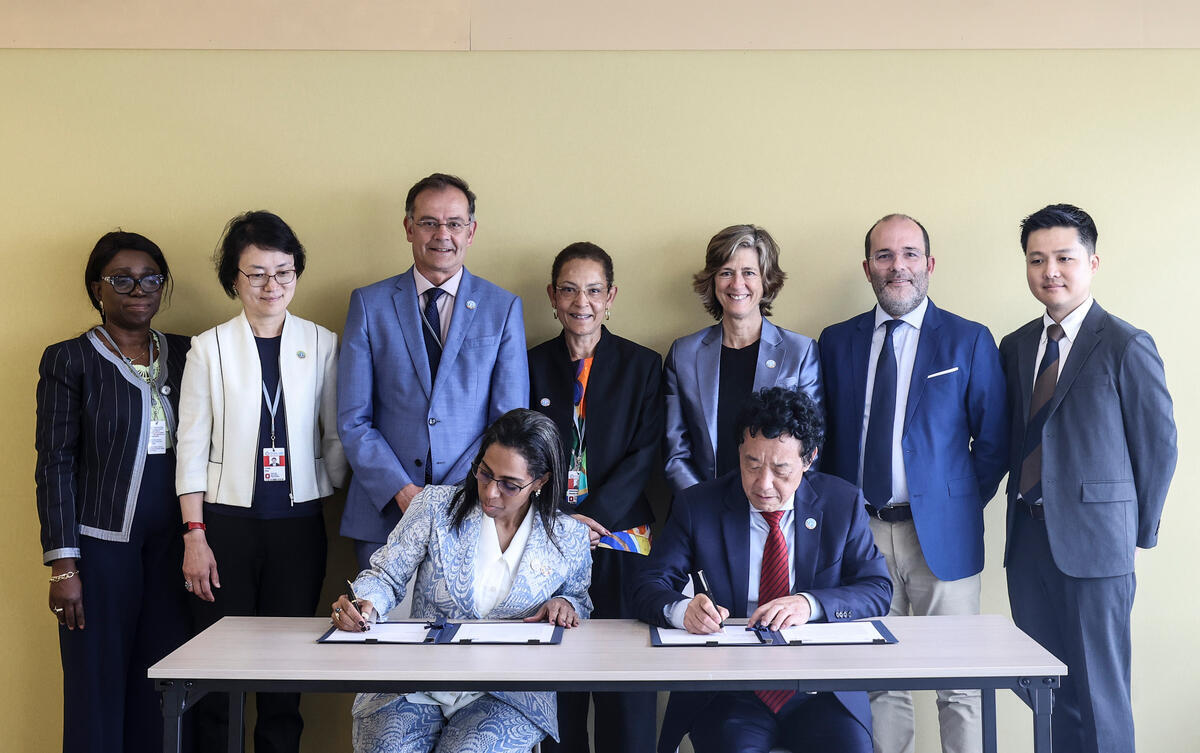
Leticia Reid de Carvalho, ISA Secretary-General (C Left) and FAO Director-General QU Dongyu (C Right) sign a Memorandum of Understanding between FAO and the International Seabed Authority.
© FAO/Alessandra Benedetti