


Global leaders highlight the links between biodiversity and agrifood systems ahead of COP17
At the Leaders for Nature Summit, coinciding with World Food Day, global leaders stressed the importance of biodiversity for food security and resilient agrifood systems.

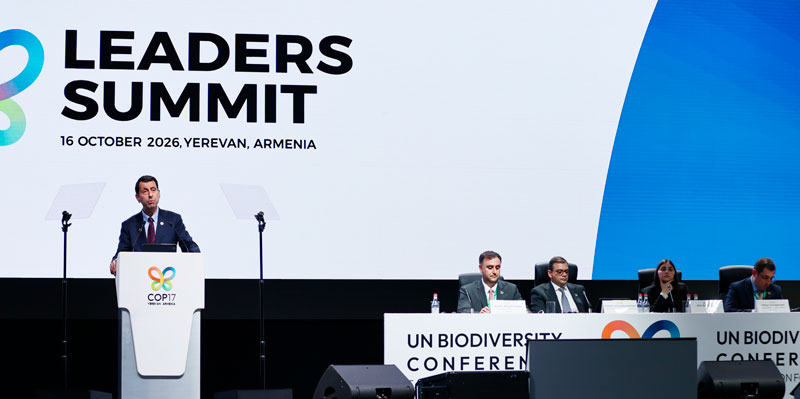
Kaveh Zahedi, Assistant Director-General and Director of the FAO Office of Climate Change, Biodiversity and Environment addressing the Plenary at the Leaders for Nature Summit.
©FAO/Arev Grigoryan
Yerevan – FAO joined leaders from around the world at the Leaders’ Summit on Biodiversity, a high‑level event hosted by the Armenian Presidency of the UN Biodiversity Conference (COP17). Held under the motto “Leaders for Nature”, the Summit brought together Heads of State and Government, leaders of international organizations, Indigenous Peoples and Local Communities, and other key stakeholders to provide strategic direction and demonstrate renewed political commitment to biodiversity ahead of COP17.
Opening the Summit, Nikol Pashinyan, Prime Minister of the Republic of Armenia, and António Guterres, United Nations Secretary-General, emphasized that accelerated action is needed to achieve global biodiversity objectives and that biodiversity loss is closely linked to many of today's global challenges, including food insecurity, climate change, and conflict.
Coinciding with World Food Day and held on the eve of UN Biodiversity COP17, the Summit provided a timely opportunity to reflect on the fundamental role of biodiversity in food security and sustainable agrifood systems, as countries prepare to assess progress and accelerate implementation of the Kunming-Montreal Global Biodiversity Framework (KMGBF).
Guterres also highlighted the links between agrifood systems and biodiversity: "Delivering on the framework will require a massive shift from policies that destroy nature to practices that sustain it.” He pointed to solutions including circular economies and sustainable farming.
Biodiversity, food security and resilience are interconnected
FAO was represented in the high-level discussions, by Kaveh Zahedi, Assistant Director‑General and Director of the FAO Office of Climate Change, Biodiversity and Environment. Speaking during the Leaders' Roundtable on "The Political Imperative: Safeguarding Nature for Peace, Security and Development", Zahedi highlighted the strong interlinkages between these elements:
“There can be no Peace when there is hunger (over 700 million people are living in hunger), no Security without food security and no development without transforming agriculture and food systems to be more resilient, more inclusive and more sustainable,” Zahedi said.
He underscored that COP17 provides an opportunity to recognize that investments in agriculture and food system solutions are essential for advancing the objectives of the KMGBF.
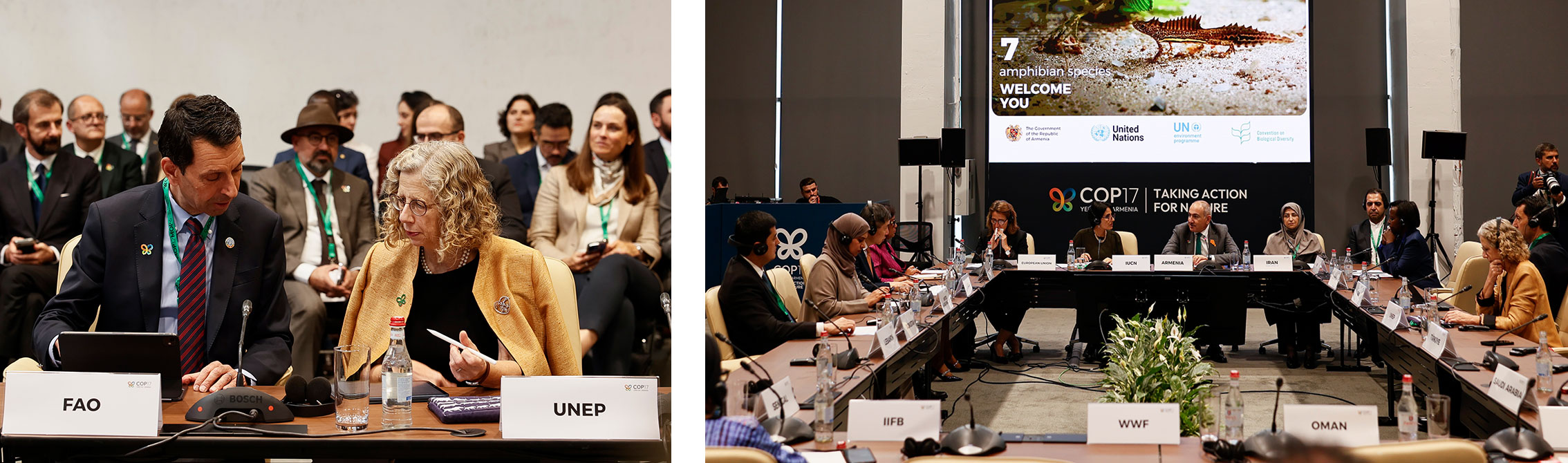
at the Leaders' Roundtable, “The Political Imperative: Safeguarding Nature for Peace, Security and Development.
©FAO/Arev Grigoryan
Agriculture and food systems are central to the global biodiversity agenda
In FAO’s plenary statement, Zahedi stressed that achieving the goals of the KMGBF will depend in large part on how agrifood systems are managed.
“Countries are increasingly recognizing that food and agriculture are powerful solutions to the conservation and sustainable use of biodiversity,” he said.
This is reflected in FAO's global analysis of National Biodiversity Strategies and Action Plans (NBSAPs), published on the same day, which found that more than one-third of national actions relate to agrifood sectors, and that nearly two-thirds of national targets depend on agrifood solutions.
While this demonstrates growing recognition of the role of agriculture and food systems, the real challenge now lies in implementation and monitoring. Countries need stronger monitoring systems to track progress, identify where greater efforts are needed, and turn biodiversity priorities into investment-ready actions. Accelerating implementation on the ground will require both practical action and stronger national systems to sustain progress over the long-term. To help close this gap, FAO is supporting countries through the Agri-NBSAPs Support Initiative, which fosters policy alignment and collaboration between agriculture and environment stakeholders and helps to translate biodiversity commitments into action across agrifood systems.
Noting the need for accelerated action, Zahedi reaffirmed that “FAO stands ready to work with countries and partners to turn the ambition we bring to Yerevan into lasting results.”
Yerevan Declaration sets the tone for COP17
A central outcome of the Summit was the adoption of the Yerevan Declaration: Taking Action for Nature. The Declaration sends a clear message that accelerated implementation of the KMGBF is urgently needed if its global goals and targets are to be met. It reaffirms the central role of biodiversity for food security and calls for stronger biodiversity mainstreaming across public policies and economic sectors, enhanced international cooperation, improved monitoring and reporting systems, greater mobilization of finance, and stronger partnerships.
As COP17 kicks off on 19 October, FAO supports the call to accelerate action and remains committed to helping countries advance biodiversity and agrifood objectives together. In support of these efforts, FAO is partnering with the COP17 Presidency to launch two new initiatives: the Yerevan Tech for Biodiversity Monitoring Hub, which will strengthen countries' access to technical expertise, tools and data for biodiversity monitoring, and the Yerevan Global OECM Action Hub, which will support countries in identifying, recognizing and strengthening effective conservation beyond protected areas, contributing to the achievement of Target 3 of the KMGBF to have 30 % of areas conserved and sustainably managed by 2030. These initiatives aim to strengthen national capacities and accelerate implementation of the Framework on the ground.
Agrifood Systems in National Biodiversity Strategies and Action Plans – Global analysis, Methodology and Policy brief