
G Kruseman
| Organization | CIMMYT |
|---|---|
| Organization type | Research Institution |
| Organization role |
Big data focal point | foresight and ex-ante impact assessment research leader
|
| Country | Mexico |
| Area of Expertise |
socio-economic data
metadata management blockchain |
This member participated in the following Forums
Forum E-consultation on ethical, legal and policy aspects of data sharing affecting farmers
Day 5: Summarize the salient points of this discussion and recommend priority aspects for the f2f consultation
Please read our (Robert hijmans (UC Davis) and mu self) op-ed blog post on ethics, data confidentiality and privacy in relation to using data for smallholder farmers in our target geographies:
http://bigdata.cgiar.org/if-mary-has-a-little-lamb-who-should-be-in-the-...
Day 4: Actions to be taken in 2018-2021 to ensure smallholder farmers benefit from agricultural data in the future
- ILRI animal health experts interacting in a mix of English and Swahili within a Facebook chat group of around 30,000 farmers who share pictures and tips with each other; read more…
- CIMMYT and VIAMO are developing user-centered design approach to develop and deploy interactive voice response (IVR) content in local languages with several types of participants in market systems. Read more...
Finally, there are some early learnings about translating all we at the CGIAR Platform for Big Data in Agriculture have learned and continue to learn about communicating in the cultural context of smallholder farmers. Moving together into the digital realm, in which small holders are participating. Bridging formal and informal knowledge, folksonomies with taxonomies/Ontologies, mediated by digital technology. A couple of good examples come from two of our Inspire awards: read more…
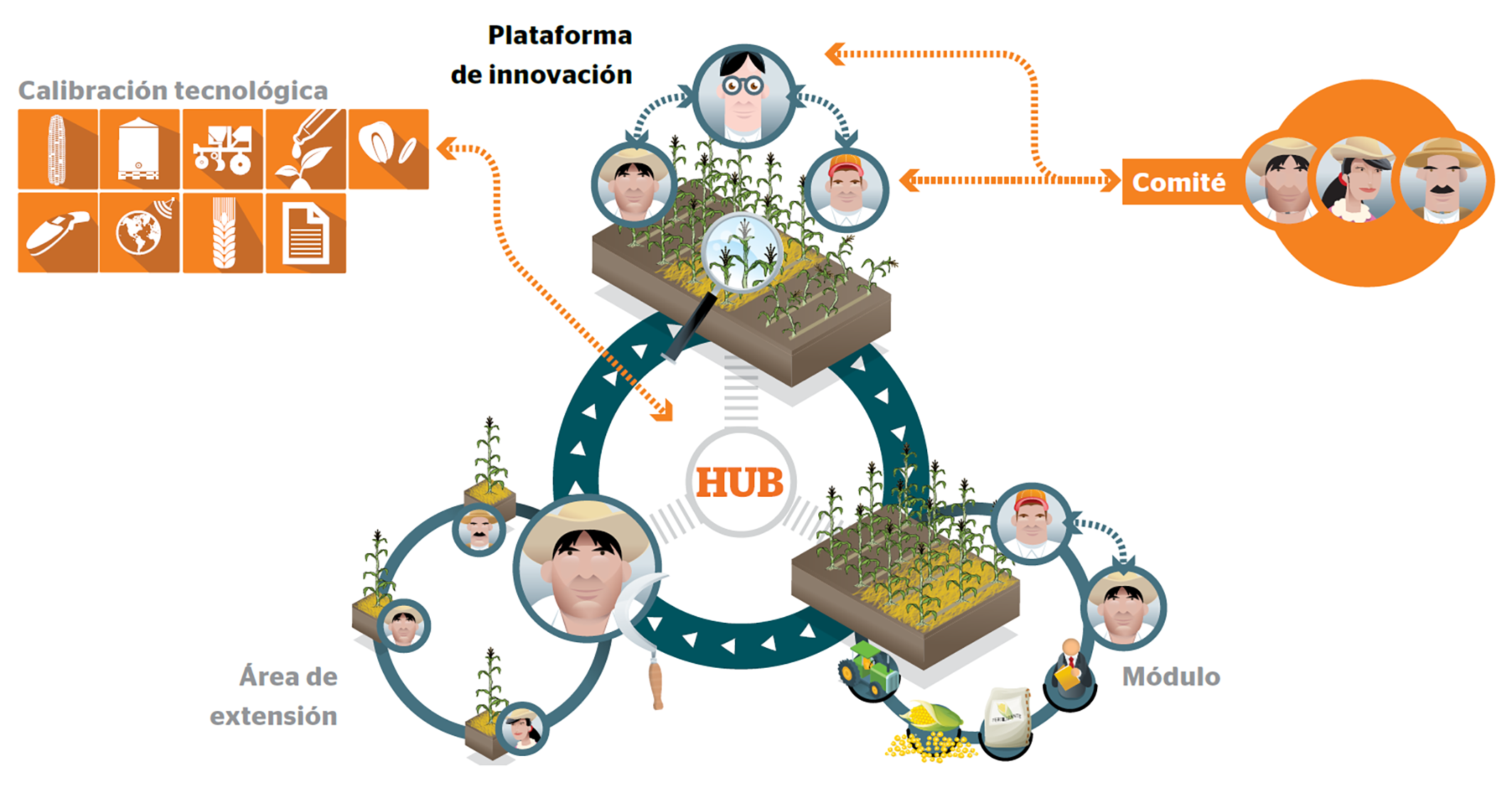
Let me start by pointing to an example in Mexico where the MasAgro project funded by the Mexican government and implemented by CIMMYT is providing online tools to farmers:
http://masagroguanajuato.cimmyt.org/herramientas.html
You won't be able to access most links since it is meant for farmers.
The principle behind the project is to have innovation hubs that link agricultural research, extension agents and farmers. Because a picture says more than a thousand words:
The CGIAR Platform for Big data in Agriculture has a community of practice on data driven agronomy:
http://bigdata.cgiar.org/data-driven-agronomy/
Here we try to harness the capabilities of big data to improve the livelihoods of smallholders in low and middle-income countries. Doing this requires skills that are not always widely available see recent post by the coordinator of the CoP:
https://www.ictworks.org/data-unicorns-agriculture/#.Wxl4Gt-nFPY
Day 3: Long-term ethical, legal and policy changes needed to move from the current scenario to the desired scenarios
On the issue of codifying traditional or indigenous knowledge. Just as with all data that is deemed sensitive, ensure that it is stored on a secure system, put in place clear rules about data sharing and appropriate licensing agreements.
The exact same holds true for farmer level data on how they manage their fields/animals/crops/farms in relation to their individual identifiers. The informed consent realted to the data collection ,should have specified for what purposes the data may be used and often by whom.
The purposes of data use and who uses the data is a key element here.
- digital ag service provision by a service provider (irrespective if it is a public or private entity), usually entails a service agreement and some outline on what data is collected and how it will be used.
- use of data for impact evaluation and policy setting. Here it is development organizations and governments that want to make informed decisions to enhance impacts and achieve societal goals (e.g. SDGs). Here we are dealing with data that can be stripped of personal identifiers, including granular geo-spatial identifiers. The risk to the data subjects is minimal. To reduce risks, some information may need to be masked or aggregated.
- use of data for research purposes, development of products, services and technologies by public and private entities. Here we are dealing with data that can be stripped of personal identifiers, including granular geo-spatial identifiers. The risk to the data subjects is minimal. To reduce risks, some information may need to be masked or aggregated.
Ethics and privacy concerns come into play mostly with data that contains personally identifiable information. Let's not throw away the baby with the bathwater.
Dear all,
Sorry I was not able to participate in the first two days of the consultation due to an overbuderden agenda. I have read the contributions of day 1 and 2 and may in the course of this discussion come back to some of the issues discussed previously. Let me start by stating my interests in this topic:
1. I am big data focal point at CIMMYT
2. I chair our Internal Research Ethics Committee
3. I coordinate the community of practice on socio-economic data, which is part of the CGIAR Platform for Big data in Agriculture
4. I lead the foresight ex-ante impact assessment and targeting research at CIMMYT, hence a keen interest in all things future.
Prior to the 20th century, scientists guarded their findings meticulously and only expanded on them after they were many steps further and considered their previous scientific discoveries less valuable. Today scientists rush to publish their findings to be the first. While till recently research data was guarded by scientists, it is becoming common practice in many settings to share data sooner than later. I don't think anybody has any qualms about bringing their old newspapers to a paper recycler, knowing that the recycler is making some money. So let's not get too hung up on data sharing.
Having said that, data that contains personally identifiable information is a different matter. Its use may pose risk to the subject of that data. It is therefore useful to distinguish between data with and without identifiers. Note that high resolution satellite images fall under the heading of personally identifiable information.
The main question at stake here is farmer level data and how that can benefit those farmers, especially the poor farmers in resource scarce environments who have not been benefiting from global economic development. The promise of data-driven agronomy (not necessarilly precision-ag) holds in store for accelerating productivity for ppor farmers requires some level of data-sharing. GDPR offers some useful pointers in a direction that it may evolve.
- Consent: The data subject should provide unambiguous positive consent regarding the processing of his/her personal data for specific purpose(s).
- Performance of contract: The data in question should be processed in order to allow/facilitate the performance of a contract that the data subject is part of. Data processing can also be a way for the data subject to initiate a contract agreement.
A service contract between a farmer and a service provider, whereby the service provider must guarantee the privacy and data confidentiality. Unless explicit consent is given the service provider cannot (legally) share that data with third parties.
Hyper ledger technology (HLT, better known as blockchain) is one way of dealing with personal data sharing since the authorization granting rights can stay with the original data provider (farmer) if a system is set up that way. Think a few generation further than the current best HLT solutions and don't worry about the current drawbacks of, for example, bitcoin blockchain or Ethereum.
Since technology is still developing and evolving rapidly, any policy such be principle based and not rule based, because rules are likely to be obsolete before they are published.
I'll chip in more later.