


Institutionalization of forest data online facilitated course: Building sustainable and transparent national forest monitoring systems
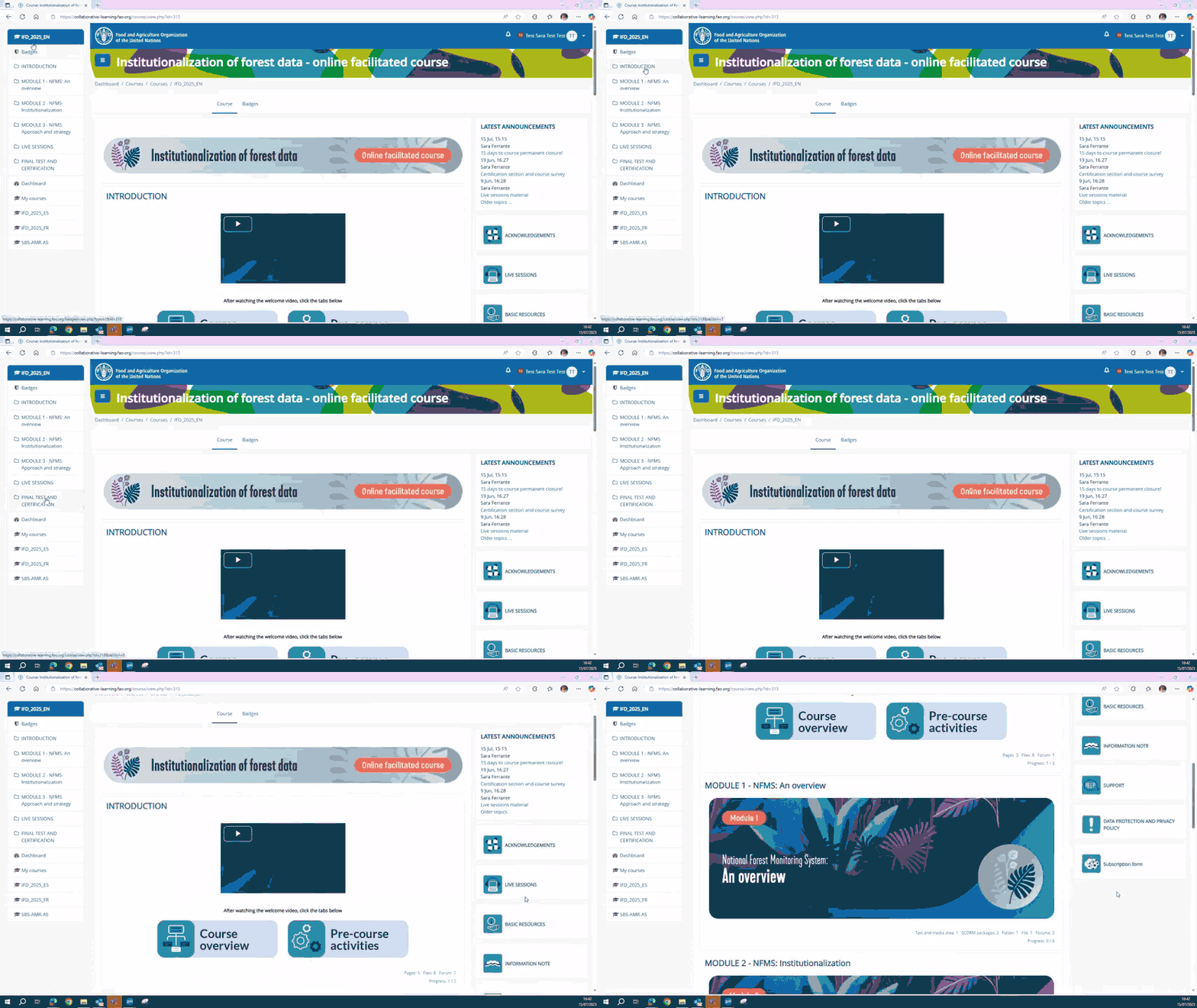
The Institutionalization of Fores Data online facilitated course on the FAO eLearning Academy’s Moodle-based collaborative platform
A strong national forest monitoring system (NFMS) is the foundation for transparent, sustainable and science-based forest management. From 7 May to 6 June 2025, the Forestry Division delivered the Institutionalization of Forest Data online facilitated course in collaboration with the FAO eLearning Academy to provide participants with the knowledge and technical solutions necessary to integrate NFMSs into long-term national frameworks.
Offered in English, French and Spanish, the four-week course combined interactive lessons, discussion forums, quizzes and live sessions. The course attracted a diverse group of stakeholders, including government officials, technical experts, Indigenous Peoples’ representatives, NGOs non-profit governmental organization employees, and private-sector actors, from across the globe to exchange experiences and strengthen their capacity to institutionalize forest data.
This course highlighted the significance of institutionalizing a robust and sustainable NFMS by establishing a legal basis, financial commitments and permanent institutional frameworks to ensure efficient implementation and operation. After completing the course, participants developed a comprehensive understanding and capability to effectively establish, institutionalize and manage an NFMS by strengthening institutional arrangements, applying good practices, addressing data sharing and transparency issues, and leveraging legal and strategic instruments.
The course attracted a diverse group of stakeholders, including government officials, technical experts, Indigenous Peoples’ representatives, non-profit governmental organization employees and private-sector actors. As of 31 July (permanent closure of the platform),1342 participants accessed the platform. A gender balance and strong youth representation were apparent, as 31 percent of the participants were women, while 59 percent of all participants were under 35. A total of 350 digital badges were awarded from this online facilitated course. The great variety of perspectives enriched discussions on how countries can institutionalize their NFMS to improve decision-making, transparency and climate reporting.
Main takeaways from forum discussions
Participants across the three language groups exchanged practical experiences and identified the following common challenges and opportunities:
- Legal frameworks: Strong legislation and institutional mandates are essential for sustainability. Countries such as Costa Rica, Mexico and Brazil have built credibility through robust legal instruments.
- Inclusive participation: Involving Indigenous Peoples, local communities, women and youth improves both governance and data quality. Examples of community monitoring from Mexico and Bolivia were shared.
- Transparency and trust: Open data systems, including Costa Rica’s SIMOCUTE and Uganda’s Microdata Catalogue, were cited as models that enhance credibility and accountability.
- Capacity and innovation: Continuous training in GIS, remote sensing and solutions like SEPAL and Open Foris is vital for long-term sustainability. Some participants also pointed to opportunities with artificial intelligence and mobile-based data collection.
- Importance of institutionalized forest data: A key lesson that emerged from many countries is that investing in forest data collection creates powerful opportunities. It improves the accuracy of greenhouse gas reporting, enables the shift to higher-tier emission factors, and strengthens both national planning and global commitments. A well-designed monitoring system not only engages stakeholders at all levels but also builds trust through transparency and data sharing. Most importantly, participants realize that reliable data opens doors to international partnerships, funding opportunities, and long-term sustainability.
- Financing and coordination: Ensuring NFMS sustainability requires integration into national budgets and exploring diverse funding sources, including climate finance and public-private partnerships. Coordination across institutions and ministries was highlighted as a persistent challenge.
These exchanges emphasized that institutionalization depends on strong governance, inclusiveness, transparency, financial sustainability and innovation.
Satisfaction survey results
The post-course survey confirmed the high value of the learning experience. A total of 305 respondents reported the following:
- overall course satisfaction: 97 percent (62 percent satisfied, 35 percent very satisfied);
- course relevance to participants’ work: 97 percent (70 percent relevant, 27 percent highly relevant);
- satisfaction with the platform: 94 percent (61 percent satisfied, 33 percent very satisfied);
- satisfaction with the facilitation: 89 percent (46 percent satisfied, 43 percent very satisfied);
- satisfaction with the learning materials: 96 percent (61 percent satisfied, 35 percent very satisfied); and
- participants acquiring new knowledge: 98 percent (79 percent agreed, 19 percent strongly agreed).
Participants especially valued the interactive design, expert live sessions and opportunities for peer-to-peer learning across countries.
The FAO eLearning Academy’s Moodle-based collaborative platform offered an interactive space with progress tracking, discussion forums and access to live sessions and recordings. Each learner could monitor progress through modules and, upon final test completion, receive a digital badge to recognize achievements – sharable on professional networks and CVs.
Explore how the course platform worked in practice through this one-minute short tour.
Continuing the learning journey on your own
Institutionalizing forest data is fundamental to ensuring countries can deliver transparent, credible information to support their climate, biodiversity and forest management commitments. By equipping participants with legal, institutional and practical solutions, the Institutionalization of Forest Data course supports countries in strengthening NFMS as a cornerstone of climate action and sustainable forest governance.
For those who could not participate in the online facilitated course, a self-paced version of this learning journey will be available later this year. In the meantime, you can access a wide range of related courses through the FAO eLearning Academy, including the Forest monitoring for climate action series.
You can also explore the Boosting Transparency in forest data web site, particularly the dedicated Institutionalization of forest data course page, for more details as well as testimonials from past participants.
This course was designed and developed by the Food and Agriculture Organization of the United Nations (FAO) with the financial support from the Global Environment Facility (GEF) and Department for Energy Security and Net Zero of the United Kingdom of Great Britain and Northern Ireland.