


What is SCOPE?
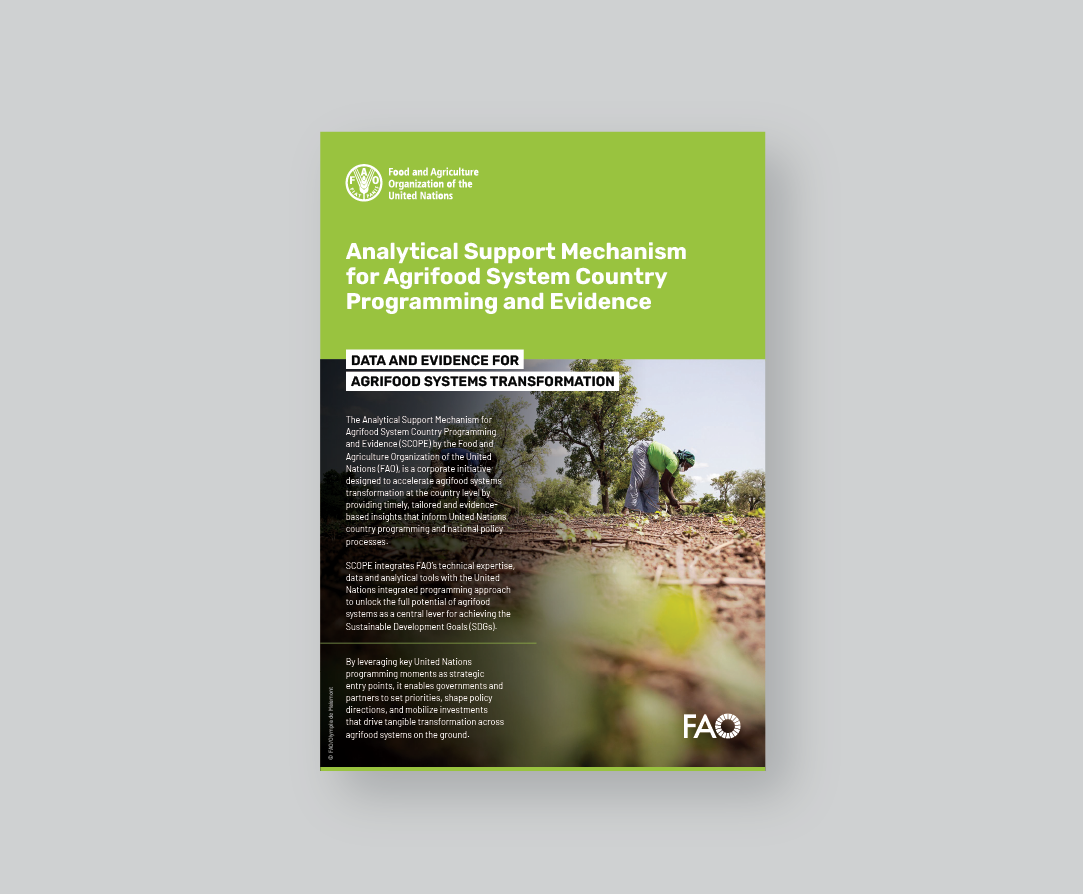
FAO’s Analytical Support Mechanism for Agrifood System Country Programming and Evidence (SCOPE) provides data, evidence-based analysis and expertise on demand to help countries accelerate agrifood system transformation. Its regional delivery model decentralizes specialized technical capacity, bringing expertise closer to where national decisions are made. It operates during the critical window when United Nations programming frameworks are formulated — a moment when data and evidence have the greatest leverage.
By strengthening national planning processes through reliable data and multidisciplinary analytical support, SCOPE helps turn agrifood strategies into effective and coordinated action, reinforcing the analytical foundations that underpin targeted policy advice and catalytic investment. SCOPE delivers this through a three-level analytical approach, moving from system diagnosis to actionable solutions.
The three-level analytical approach

Level 1 — Status of the national agrifood system
The first level provides a comprehensive snapshot of the national agrifood system.


Level 3 — Deep dive on actions
The third level focuses on practical solutions and implementation pathways.
Latest publications

Food supply for healthy diets in Pakistan - Policy brief, September 2026
05/10/2026
This policy brief assesses the gaps and surpluses between Pakistan’s food supply and the quantities required to support healthy diets. It examines ten food groups from 2010 to 2023 against national dietary guidelines. More than 60 percent of Pakistan’s population cannot afford a healthy diet, contributing to persistent malnutrition and a growing burden of non-communicable diseases, while rapid population growth continues to place pressure on the food system.

Status of the national agrifood system in the Maldives - A diagnostic assessment
18/09/2026
This report provides a comprehensive overview of the Maldives' agrifood system and its various dimensions, identifying systemic challenges that hinder the agrifood system from achieving the Sustainable Development Goals (SDGs). It presents the Level 1 analysis of the state of the agrifood system in the Maldives, under the Analytical Support Mechanism for Agrifood System Country Programming and Evidence (SCOPE).

Characteristics and survival of agrifood micro-, small and medium-sized enterprises in the Sudan’s recent conflict - Exploring systemic challenges
11/09/2026
The April 2023 outbreak of violent conflict in Sudan severely disrupted agrifood systems, markets, and livelihoods, with micro-, small and medium-sized enterprises (MSMEs) playing a critical role in sustaining food supply, employment, and economic activity.
Videos
Economic modelling for agrifood systems transformation
04/05/2026
How to weigh trade-offs against synergies when transforming an agrifood system? Economic modelling tools helps us explore the impacts of alternative interventions and how agrifood actors may respond to incentives. This playlist features training videos on economic modelling, presenting quantitative tools and methods to support evidence-based agrifood systems transformation.
Platform

The State of Agrifood Systems Data Platform
The platform supports agrifood systems analysis, helping analysts interpret and apply data for country-level programming and monitoring, with a range of indicators available through interactive visualizations and bulk downloads.
Related links
- Agrifood systems in FAO
- FAO's Strategic Framework
- Food and Agriculture Policy Decisions Analysis (FAPDA)
For more information contact
[email protected]