
Sustainable School Feeding Network participated in a side event in France to discuss global efforts for school feeding
During the side event and the N4G Summit, experts highlighted the role of school feeding as a transformative policy for food security.
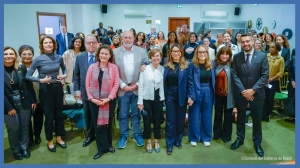
April 1, 2025, Brasília, Brazil – The governments of Brazil and France, with the support of the Sustainable School Feeding Network (RAES), hosted the event "Uniting global efforts to ensure nutritious school feeding programmes for every child" on March 28 at the Embassy of Brazil in Paris. The event aimed to discuss the progress and challenges of school feeding as a key tool for global food and nutrition security. Representatives from the Brazilian government, international organizations, and school feeding experts participated in the discussions.
Held alongside the Nutrition for Growth (N4G) Summit, the event featured the participation of Janja Lula da Silva, First Lady of Brazil and the country’s "ambassador" for school feeding. She emphasized the strategic role of these programmes in the economic and social transformation of women and communities. “Talking about school feeding is talking about the economy. In Brazil, we strengthen the connection between family farming and school feeding, which sets us apart globally,” said the First Lady. The N4G Summit brought together global leaders to align policies and resources for nutrition, placing healthy eating at the center of sustainable development agendas.
During the panel discussion, moderated by Cecília Malaguti, general coordinator for trilateral technical cooperation with international organizations at the Brazilian Cooperation Agency (ABC/MRE), Fernanda Pacobahyba, president of the National Fund for Educational Development (FNDE/MEC), highlighted the evolution of Brazil’s National School Feeding Programme (PNAE). She pointed out the legal framework requiring at least 30% of the programme’s food purchases to come from family farming, as well as advances such as the restriction of ultra-processed foods, reducing their share to 15%. “Brazil has a solid track record in building public policies that ensure not only school feeding but also human and social development,” she stated.
Najla Veloso, Senior School Feeding Specialist at the Food and Agriculture Organization of the United Nations (FAO) and RAES executive secretary, emphasized the importance of the RAES Network as a reference in Latin America and the Caribbean. She noted that Brazil does not seek to be a model, but rather a partner in the collective construction of solutions. Veloso also underscored the FAO’s role in the region and its ability to support various countries. “This support is crucial to strengthening school feeding,” she said.
The RAES Network is jointly implemented by FNDE, ABC, and FAO and has the formal participation of 18 countries. Its presence at this event is part of a broader strategy to enhance its global standing, showcasing the work carried out since 2009 in the region, as well as advancements in school feeding policies.
Debates and reflections on school feeding
Donald Bundy, Director of the Research Consortium for School Health and Nutrition, highlighted the importance of regional and sub-regional networks in developing global tools and solutions. “RAES is an example of how regional networks can influence policies and practices on a global scale through the exchange of experiences,” he said.
Meanwhile, Saulo Ceolin highlighted the synergy between the Global Alliance Against Hunger and Poverty, launched during Brazil’s G20 presidency, and school feeding programmes, which are among the main initiatives suggested in the policy package established by the Alliance. “For every dollar invested, we see at least a tenfold return in terms of economy, health, and quality of life”, he said.
For Émilie Sidaner, speaking on behalf of the School Meals Coalition, nutrition and healthy diets are now at the core of global discussions. “These global coalitions are essential to strengthening countries’ commitments.” During the event, the Brazilian government reaffirmed its commitment to international cooperation as a key mechanism to ensure that every student has access to healthy and high-quality school meals.