


Supporting livelihoods, resilience and climate adaptation in Yemen


©FAO/Yemen
17/11/2025
Years of conflict have left Yemen’s agricultural landscape to face severe degradation and human hardship. Farmlands suffer from soil depletion, recurrent droughts, and loss of productive assets, leaving rural households struggling to meet daily food needs. Yet, agriculture offers a powerful opportunity to restore food security and income. To support this, the Food and Agriculture Organization of the United Nations (FAO), with funding from the European Union and Sweden, and in partnership with the Ministry of Agriculture and Irrigation and other partners, launched the Supporting Resilient Livelihoods, Food Security, and Climate Adaptation in Yemen project to rebuild agricultural systems, boost productivity, and strengthen resilience among vulnerable communities.
Reviving livestock health and services
One of the project’s first interventions improved livestock health and veterinary access by training Community Animal Health Workers (CAHWs). These locally based professionals received training in animal husbandry, nutrition, disease prevention, and vaccination. Soon after, they were treating animals, curbing disease outbreaks, and rebuilding trust between rural communities and animal health systems. CAHWs provided ethical, reliable services that protected animal welfare and public health while earning income through veterinary and related activities. Feedback from farmers and veterinary officers reflected strong satisfaction and clear improvements in livestock health, productivity, and the sustainability of local animal health services.
Seeds of recovery: sorghum and millet
The project revived staple cereal production by providing high-quality sorghum and millet seeds to 9 000 farmers across Yemen, cultivating 9 000 ha (8 150 with sorghum and 850 with millet) to boost household food production and seed security.
To sustain these gains, four Community Seed Banks were established in Bani Awam (Hajjah), Bajil district (Hodeida), Al-Tawilaa (Al-Mahweet), and Khanfar district (Abyan). They were equipped to process, sort, and store climate-resilient seeds for future seasons. Each bank is equipped to process, sort, and store climate-resilient seeds and is managed by a 10-member local committee. They are supported by 100 climate-smart seed producer groups, organized into five groups of 20 farmers. These producers received training in soil and water management, seed selection, intercropping, and post-harvest storage, along with tools and machinery for processing high-quality seeds adapted to local conditions.

©FAO/Yemen
Boosting tomato production and value addition
Tomatoes are a key cash crop in Yemen, but production has been limited by drought, erratic rainfall, and poor irrigation. To address these challenges, a comprehensive tomato value chain initiative supported 3 500 beneficiaries across six governorates: Lahj, Abyan, Taiz, Hajjah, Hodeidah, and Al-Mahweet. Farmers received improved seeds, fertilizers, and training in water conservation and pest management, resulting in 975 ha cultivated using better practices. To strengthen resilience, the project introduced solar-powered pumps and drip irrigation, enabling 106 households to irrigate 98.8 ha while reducing groundwater use.
Among the beneficiaries was Salem, a farmer from Ahwar District in Abyan Governorate, who had struggled with high fuel costs for water pumps. After receiving a solar-powered irrigation system, his fields began to flourish. “My land has come back to life thanks to this system. We were on the verge of losing everything, but now we can plant, produce, and provide food for our families.” Solar energy, abundant in Yemen, now supports year-round production and improved farmer incomes.
Empowering women through agro-processing
Women’s participation was a major element of the project. 47 women’s agro-processing groups were established, reaching 470 women across six governorates. These groups received training and equipment to process and market tomatoes and other fruits such as mangoes, dates, and bananas. Supported by five agro-processing and marketing centres, women learned food safety, packaging, branding, and cooperative management.
Complementary training by the International Labour Organization (ILO) strengthened women’s entrepreneurial skills in bookkeeping, cost analysis, and market access. The women-led centres, equipped with solar power, refrigeration, and storage, now produce tomato paste, ketchup, jams, and pickles, transforming perishable crops into profitable goods while reducing post-harvest losses.

©FAO/Yemen
Rebuilding livestock assets and feed systems
To restore lost livestock assets, 1 000 vulnerable households in Haydan district (Saada governorate) received restocking kits with four sheep and 100 kg of feed concentrate. This raised household livestock holdings from two to six animals on average, tripling household asset values from around USD 200 to USD 600–800. With Haydan’s population at roughly 10 000 households, the support reached about 10 percent of all families and helped women and youth, who traditionally manage small livestock, regain productive assets.
To address persistent feed scarcity, emergency feed support reached 6 000 livestock farmers across seven governorates, distributing 960 metric tons (MT) of wheat bran, 192 MT of feed blocks and 150 MT of molasses. To ensure sustainability, 350 fodder production groups (50 per governorate) were formed and equipped with tools such as choppers, balers, and feed pelletizers, and trained to produce and store fodder using drought-tolerant pastures and crop residues.
Strengthening the dairy and coffee value chains
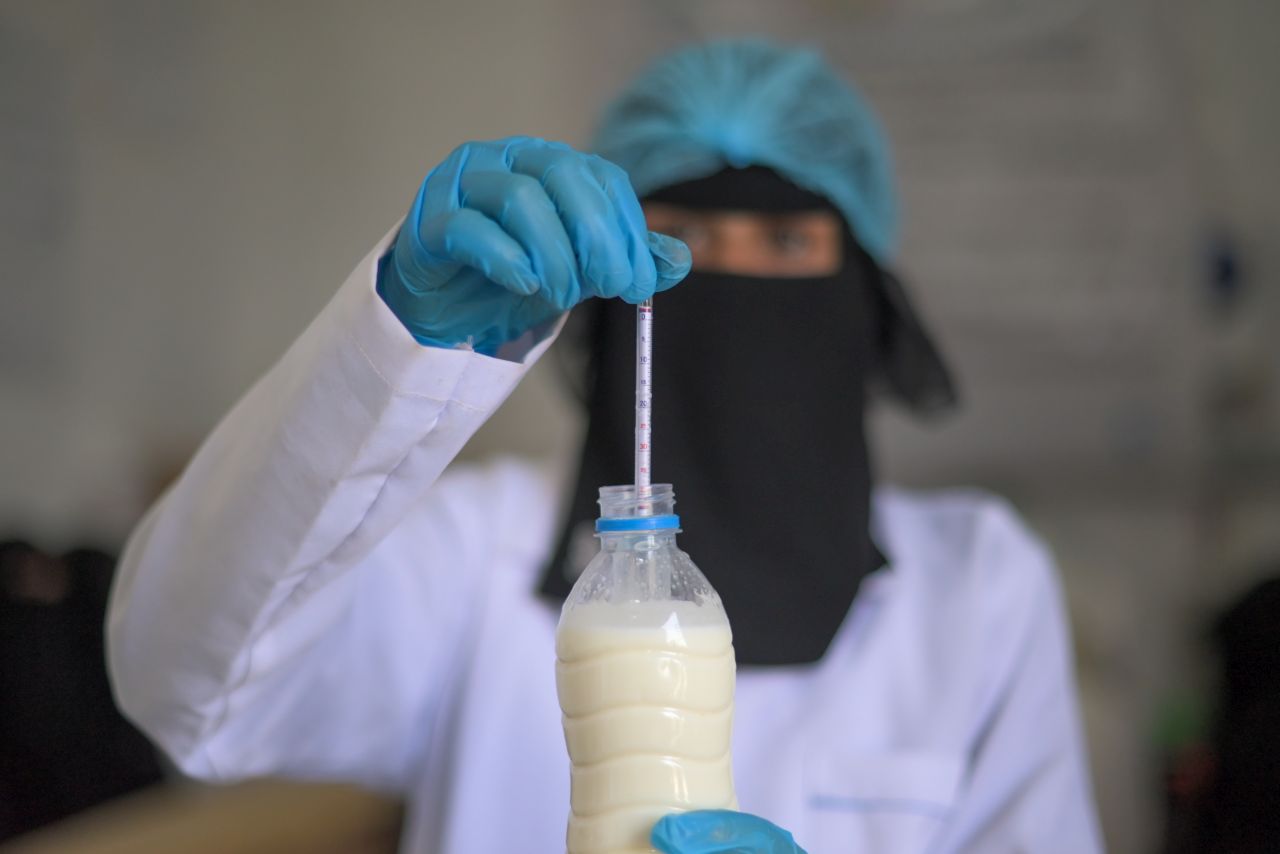
The project supported 3 539 women in Yemen’s dairy sector across seven governorates with feed, training, and equipment to produce yoghurt, cheese, labneh, and butter. Six dairy processing and three marketing centres were established with production lines, cold chains, and solar-powered refrigeration, while two centres were rehabilitated to improve milk hygiene and market access.
Additionally, 500 coffee farmers in Hajjah and Saada received training in improved harvesting, drying, and processing, along with 250 coffee dryers. Two modern coffee processing and marketing centres were set up in Bani Al-Awam with roasting, grinding, and packaging equipment, enhancing product quality, value addition, and smallholder incomes.
Building knowledge and capacity for the future
The project has reached 25 420 beneficiaries through 800 training and awareness sessions on sustainable farming practices. Fifty ministry specialists received advanced training to strengthen local extension services, supported by thousands of booklets and guides. From revitalized seed systems to solar-powered irrigation and community processing centres, the initiative shows how locally driven, climate-smart agriculture can build skills, enhance resilience, and restore hope across Yemen’s fragile agricultural landscapes.