


Publications
The State of the World
FAO’s State of the World collection comprises the Organization’s flagship reports. Published annually or biennially, these are data-rich and analytically complex publications: they provide a global snapshot of topics associated with food and agriculture.
The collection is increasingly structured to gauge progress towards the goals and targets of the 2030 Agenda for Sustainable Development. It is aimed at policymakers; donors; international organizations; academia; and journalists and researchers specializing in food security, agrifood systems, the environment and international development.

The State of Food and Agriculture
Addressing land degradation across landholding scales
.png?sfvrsn=33a708d1_2)
The State of Food Security and Nutrition in the World
Understanding and addressing the high cost of a healthy diet

The State of the World’s Land and Water Resources for Food and Agriculture
The potential to produce more and better

The State of Agricultural Commodity Markets
Trade, resilience and food security: Global food markets under stress

The State of the World’s Forests 2026
Restoring forests and landscapes: the way forward for a sustainable future

The State of Fisheries and Aquaculture
Blue Transformation in action
Recent Publications

Food safety aspects of cell-based food
04/2023
The Food and Agriculture Organization of the United Nations (FAO), in collaboration with the World Health Organization (WHO), has developed this document to engage with respective Members and relevant stakeholders by proactively sharing the current knowledge to identify concrete ways to inform consumers and all other stakeholders about the food safety considerations for cell-based food products.

Gene editing and agrifood systems
01/2023
Gene-editing technologies represent a promising new tool for plant and animal breeding in low- and middle-income countries. They enhance precision and efficiency over current breeding methods and could lead to rapid development of improved plant varieties and animal breeds.

The future of food and agriculture – Drivers and triggers for transformation
12/2022
This report aims at inspiring strategic thinking and actions to transform agrifood systems towards a sustainable, resilient and inclusive future, by building on both previous reports in the same series as well as on a comprehensive corporate strategic foresight exercise that also nurtured FAO Strategic Framework 2022–31. It analyses major drivers of agrifood systems and explores how their trends could determine alternative futures of agrifood, socioeconomic and environmental systems. The fundamental message of this...

Agrifood Systems Technologies and Innovations Outlook (ATIO)
11/2022
Agrifood system transformation to achieve the Sustainable Development Goals requires increased attention to developing, adapting and diffusing impactful science, technology and innovation (STI). Current levels and patterns of STI uptake are inadequate to facilitate needed agrifood system transformations, especially in today's low- and middle-income countries. Moreover, the descriptive and evaluative evidence on current and emergent STI is also insufficiently well understood to permit intentional management of STI to meet the multiple objectives of future...

The State of Food and Agriculture 2022
11/2022
The State of Food and Agriculture 2022 looks into the drivers of agricultural automation, including the more recent digital technologies. Based on 27 case studies, the report analyses the business case for adoption of digital automation technologies in different agricultural production systems across the world. It identifies several barriers preventing inclusive adoption of these technologies, particularly by small-scale producers. Key barriers are low digital literacy and lack of an enabling infrastructure, such as connectivity and...

State of Agricultural Commodity Markets (SOCO) 2022
06/2022
This edition of The State of Agricultural Commodity Markets (SOCO) discusses how trade policies, based on both multilateral and regional approaches, can address today’s challenges for sustainable development. Trade policies in food and agriculture should aim to safeguard global food security, address the trade-offs between economic and environmental objectives, and strengthen the resilience of the global agrifood system to shocks, such as conflicts, pandemics and extreme weather.
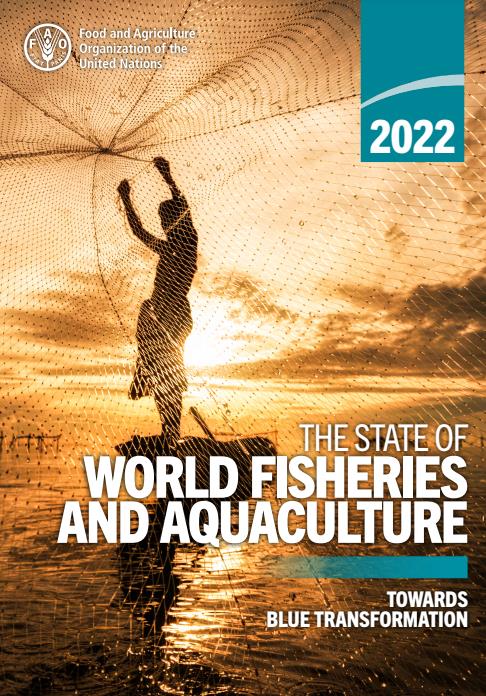
State of World Fisheries and Aquaculture 2022
06/2022
The 2022 edition of The State of World Fisheries and Aquaculture coincides with the launch of the Decade of Action to deliver the Global Goals, the United Nations Decade of Ocean Science for Sustainable Development and the United Nations Decade on Ecosystem Restoration. It presents how these and other equally important United Nations events, such as the International Year of Artisanal Fisheries and Aquaculture (IYAFA 2022), are being integrated and supported through Blue Transformation,...

Global Report on Food Crises 2022
05/2022
Globally, levels of hunger remain alarmingly high. In 2021, close to 193 million people were acutely food insecure and in need of urgent assistance across 53 countries/territories, according to the findings of the 2022 Global Report on Food Crises (GRFC 2022). This represents an increase of nearly 40 million people compared to the previous high reached in 2020 (reported in the GRFC 2021). The sixth edition of the Global Report on Food Crises is...

State of the World’s Forests 2022
05/2022
Against the backdrop of the Glasgow Leaders’ Declaration on Forests and Land Use and the pledge of 140 countries to eliminate forest loss by 2030 and to support restoration and sustainable forestry, the 2022 edition of The State of the World’s Forests (SOFO) explores the potential of three forest pathways for achieving green recovery and tackling multidimensional planetary crises, including climate change and biodiversity loss.
Print Send Ukraine: Note on the impact of the war on food security in Ukraine
03/2022
FAO is deeply concerned about the food security situation in Ukraine. The war that began on 24 February 2022 has caused extensive damage and loss of life in key population centres, spread across rural areas, and sparked massive displacement. It is clear that the war has resulted in a massive, and deteriorating, food security challenge. It has already significantly disrupted livelihoods during the agricultural growing season, through physical access constraints and damage to homes,...

The FAO Action Plan on Antimicrobial Resistance 2021–2025
12/2021
This document outlines the FAO Action Plan on Antimicrobial Resistance 2021–2025 which serves as a roadmap for focusing global efforts to address AMR in the food and agriculture sectors. The aim of this plan is to help accelerate progress in developing and implementing multi-sectoral National Action Plans to tackle AMR by calling attention to strategic priorities and areas of expertise for FAO support.

State of the World’s Land & Water Resources for Food and Agriculture
12/2021
“The state of the world’s land and water resources for food and agriculture: Systems at breaking point (SOLAW 2021)” Synthesis Report comes at a time when human pressures on the systems of land, soils and fresh water are intensifying, just when they are being pushed to their productive limits. The impacts of climate change are already constraining rainfed and irrigated production over and above the environmental consequences resulting from decades of unsustainable use.

The State of Food and Agriculture 2021
11/2021
The State of Food and Agriculture 2021 presents country-level indicators of the resilience of agrifood systems. The indicators measure the robustness of primary production and food availability, as well as physical and economic access to food. They can thus help assess the capacity of national agrifood systems to absorb shocks and stresses, a key aspect of resilience.

Hunger Hotspots FAO-WFP
07/2021
Efforts to fight a global surge in acute food insecurity are being stymied in several countries by fighting and blockades that cut off life-saving aid to families on the brink of famine, warn the UN's Food and Agriculture Organization (FAO) and World Food Programme (WFP) Hunger Hotspots FAO-WFP early warnings on acute food insecurity August to November 2021 Outlook.

State of Food Security and Nutrition in the World 2021
07/2021
In recent years, several major drivers have put the world off track to ending world hunger and malnutrition in all its forms by 2030. The challenges have grown with the COVID-19 pandemic and related containment measures. This report presents the first global assessment of food insecurity and malnutrition for 2020 and offers some indication of what hunger might look like by 2030 in a scenario further complicated by the enduring effects of the COVID-19...

OECD-FAO Agricultural Outlook 2021–2030
07/2021
The OECD-FAO Agricultural Outlook provides an assessment of the prospects of national, regional and global agricultural commodity markets over the coming decade. The baseline projections for production, consumption, stocks, trade and prices for cereals, oilseeds and oilseed products, roots & tubers, pulses, sugar, meat, dairy products, fish, cotton, biofuels and tropical fruits cover the years 2021 to 2030.

Indigenous Peoples’ food systems
06/2021
This publication provides an overview of the common and unique sustainability elements of Indigenous Peoples' food systems, in terms of natural resource management, access to the market, diet diversity, indigenous peoples’ governance systems, and links to traditional knowledge and indigenous languages. While enhancing the learning on Indigenous Peoples food systems, it will raise awareness on the need to enhance the protection of Indigenous Peoples' food systems as a source of livelihood for the 476...

Global assessment of soil pollution
06/2021
Soil pollution is invisible to the human eye, but it compromises the quality of the food we eat, the water we drink, and the air we breathe and puts human and environmental health at risk. Most contaminants originate from human activities such as industrial processes and mining, poor waste management, unsustainable farming practices, accidents ranging from small chemical spills to accidents at nuclear power plants, and the many effects of armed conflicts.

The White/Wiphala Paper on Indigenous Peoples’ food systems
06/2021
This White/Wiphala Paper offers a constructive, evidence-based contribution to the 2021 UN Food Systems Summit. The contributors and co-authors of the paper look to the leadership of the UN Food Systems Summit to incorporate the principles and values of Indigenous Peoples’ food systems in the Summit’s agenda, and in the policy discussions and programmes beyond the Summit.

Global Report on Food Crises - 2021
05/2021
The 2021 Global Report on Food Crises (GRFC 2021) highlights the remarkably high severity and numbers of people in Crisis or worse (IPC/CH Phase 3 or above) or equivalent in 55 countries/territories, driven by persistent conflict, pre-existing and COVID-19-related economic shocks, and weather extremes. The number identified in the 2021 edition is the highest in the report’s five-year existence. The report is produced by the Global Network against Food Crises (which includes WFP), an...