


Publications
The State of the World
FAO’s State of the World collection comprises the Organization’s flagship reports. Published annually or biennially, these are data-rich and analytically complex publications: they provide a global snapshot of topics associated with food and agriculture.
The collection is increasingly structured to gauge progress towards the goals and targets of the 2030 Agenda for Sustainable Development. It is aimed at policymakers; donors; international organizations; academia; and journalists and researchers specializing in food security, agrifood systems, the environment and international development.

The State of Food and Agriculture
Addressing land degradation across landholding scales
.png?sfvrsn=33a708d1_2)
The State of Food Security and Nutrition in the World
Understanding and addressing the high cost of a healthy diet

The State of the World’s Land and Water Resources for Food and Agriculture
The potential to produce more and better

The State of Agricultural Commodity Markets
Trade, resilience and food security: Global food markets under stress

The State of the World’s Forests 2026
Restoring forests and landscapes: the way forward for a sustainable future

The State of Fisheries and Aquaculture
Blue Transformation in action
Recent Publications

The State of Agricultural Commodity Markets 2018
09/2018
This edition of The State of Agricultural Commodity Markets focuses on the complex and underexplored intersection between agricultural trade, climate change and food security. The report makes an important contribution to the policy debates on climate change adaptation and mitigation under the Paris Agreement and the multilateral agricultural trade rules. The report discusses policies – both domestic support and trade measures – that can promote food security, adaptation and mitigation, and improve the livelihoods...

The State of Food Security and Nutrition in the World 2018
09/2018
Building climate resilience for food security and nutrition New evidence in SOFI 2018 confirms a rise in world hunger: the number of people who suffer from hunger has been growing over the past three years, returning to levels from almost a decade ago. Multiple forms of malnutrition are evident in many countries: adult obesity is growing even as forms of undernutrition persist. The report says that climate variability and extremes are key drivers behind this rise,...

Emerging Opportunities forthe Application of Blockchainin the Agri-food Industry
08/2018
Distributed ledger technologies (DLTs) and smart contracts provide a unique opportunity to bring greater efficiency, transparency and traceability to the exchange of value and information in the agriculture sector. By utilising digital records, cryptography and the disintermediation of transaction processing and data storage, DLTs can improve both agricultural supply chains and rural development interventions in a number of ways. The technology has the potential to simplify and integrate agricultural supply chains, enhance food safety,...

Impacts of climate change on fisheries and aquaculture
07/2018
This report provides the most up-to-date information on the disaggregated impacts of climate change for marine and inland fisheries, and aquaculture, in the context of poverty alleviation and the differential dependency of countries on fish and fishery resources. The work is based on model projections, data analyses, as well as national, regional and basin-scale expert assessments. The results indicate that climate change will lead to significant changes in the availability and trade of fish...

Food security and nutrition: Challenges for agriculture and the hidden potential of soil
07/2018
This report, prepared by FAO and the OECD with inputs from IFPRI, IFAD, the World Bank and WTO, was submitted to the G20 Argentinian Presidency in response to the Presidency’s request for information on future trends and challenges faced by global agriculture.
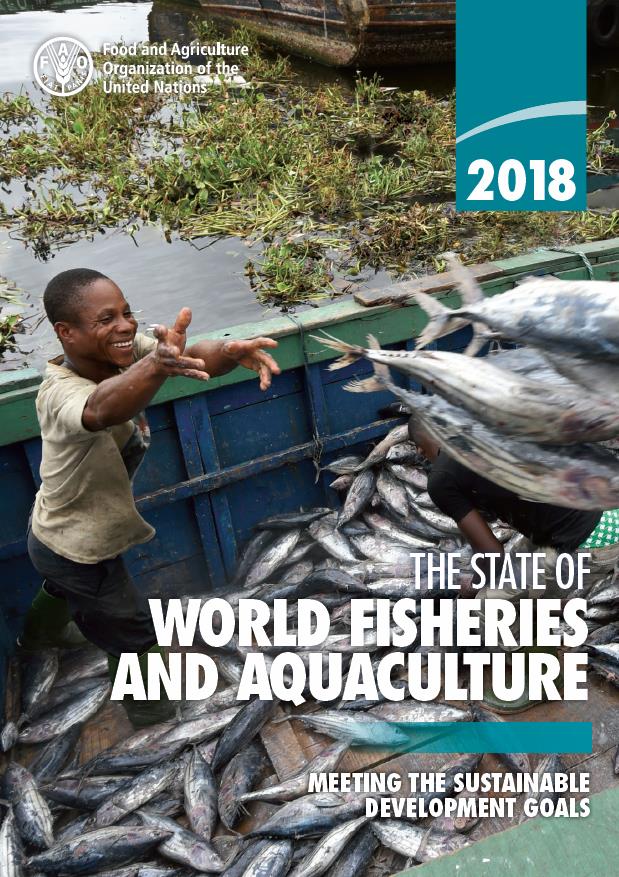
The State of World Fisheries and Aquaculture 2018
07/2018
The 2018 edition of The State of World Fisheries and Aquaculture emphasizes the sector’s role in achieving the 2030 Agenda for Sustainable Development and the Sustainable Development Goals, and measurement of progress towards these goals. It notes the particular contributions of inland and small-scale fisheries, and highlights the importance of rights-based governance for equitable and inclusive development.

The State of the World's Forests 2018
07/2018
Forest Pathways to Sustainable Development Nearly three years ago, world leaders agreed to the United Nations 2030 Agenda for Sustainable Development and its 17 Sustainable Development Goals (SDGs) – the central framework for guiding development policies throughout the world. This edition of The State of the World’s Forests is aimed at enhancing our understanding of how forests and their sustainable management contribute to achieving several of the SDGs. Time is running out for the world’s forests:...

OECD‑FAO Agricultural Outlook 2018‑2027
07/2018
The fourteenth joint edition of the OECD-FAO Agricultural Outlook provides market projections for major agricultural commodities, biofuels and fish. The 2018 report contains a special feature on the prospects for, and challenges facing, the Middle East and North Africa.

Biodiversity matters
05/2018
Biodiversity is the sum of all terrestrial, marine and other aquatic ecosystems, species and genetic diversity. It includes the variability within and among living organisms and the ecological complexes of which they are part. FAO recognizes biodiversity as being integral to agriculture, and is committed to working with governments and other key actors to mainstream biodiversity as a vital element of sustainable agriculture. Here are some FAO titles on this theme that might inspire...

Bees Matter: The importance of bees and other pollinators for food and agriculture
05/2018
Launched on the occasion of the first observance of World Bee Day, this brochure aims to raise awareness on the role of bees and other pollinators in increasing food security and fighting hunger as well as in providing key ecosystem services for agriculture.

Improving diets in an era of food market transformation
05/2018
The policy brief recommends ways in which governments can encourage food industry partners to provide consumers with better access to healthier diets. Read press release.

The Benefits and Risks of Solar-Powered Irrigation-A Global Overview
05/2018
Solar powered irrigation systems are now an affordable and climate-friendly technology for both large and small-scale farmers in developing countries, however they need to be adequately managed and regulated to avoid the risk of unsustainable water use, stresses the report.

Making forest concessions in the tropics work to achieve the 2030 Agenda: Voluntary Guidelines
05/2018
Released during the United Nations Forum on Forests (New York, 7−11 May), the Voluntary Guidelines show how to make forest concessions an effective economic instrument capable of delivering sustainable forest management and generate socio-economic benefits to relevant stakeholders, thereby contributing to Agenda 2030.

Soil Pollution: A Hidden Reality
05/2018
Launched during the Global Symposium on Soil Pollution (Rome, 2−4 May), this report on soil pollution explains how to manage and remediate polluted soils. It includes risk assessment approaches and suggests changes to agronomic practices.

Strengthening sustainable food systems through geographical indications
04/2018
From Moroccan saffron to Cameroonian pepper, a new study called Strengthening sustainable food systems through geographical indications, produced by FAO and the European Bank for Reconstruction and Development (EBRD), highlights the multiple benefits of geographical indication labelling. The study analyzes the economic impact of geographic indications through nine case studies, ranging from Darjeeling tea (India) to Kona coffee (United States). Press release

Safeguarding Our Water
04/2018
Water is essential for every form of life. It is also an integral part of every aspect of FAO’s work: from agriculture to forests and fisheries; from climate change to crises caused by conflict. In a context of growing populations and food demands, increasing pressure from agricultural production and changing weather patterns, there is a widening gap in water quality and availability among regions. On the occasion of World Water Day 2018 on 22...

Understanding Agroecology
04/2018
Although not a new concept, agroecology is gaining momentum worldwide as an effective approach to tackle climate change and the interconnected challenges facing food security and nutrition. On the occasion of the 2nd International Symposium on Agroecology (3‒5 April 2018, Rome), have a look at FAO’s work in this area and a selection of publications offering guidance, tools and analysis.

The impact of disasters and crises on agriculture and food security 2017
04/2018
This second edition of FAO's report on the Impact of Disasters and Crises on Agriculture and Food Security provides the latest data on the impact of disasters and crises on agriculture sectors, combined with sound analysis of remaining gaps and challenges. It is not limited to natural disasters alone, but includes the first-ever analysis of the effect on agriculture of conflict and food chain crises. The 2017 report considers how the entire sector is...

Global Report on Food Crises
03/2018
The latest Global Report on Food Crises sounds alarm on surging levels of acute hunger. Around 124 million people in 51 countries were affected by acute food insecurity during 2017 — 11 million more people than the year before. Acute food insecurity is severe hunger that poses an immediate threat to lives and livelihoods.

Forests and Sustainable Cities
03/2018
Recognizing the importance of the services provided by forests and trees to urban dwellers, the Collaborative Partnership on Forests proposed that the theme for the 2018 International Day of Forests would be “Forests and Sustainable Cities”. To mark this occasion and promote the widespread adoption of “green” strategies for dealing with urban challenges, FAO invited the mayors of 15 different sized cities from various regions around the world to present their experiences with trees...