


Blog
The Relationship Between the Right to Food and Science and Innovation
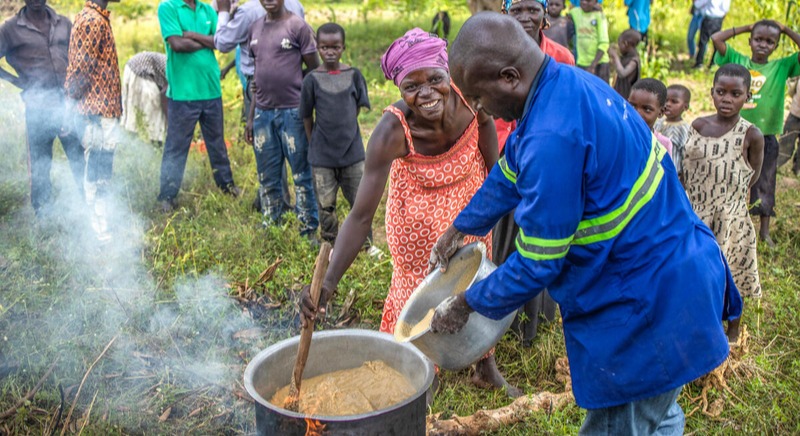
©FAO/Stuart Tibaweswa
The FAO Science and Innovation Strategy recognizes that science and evidence are essential for sound decision-making while not necessarily providing a singular course of action. To better connect science and innovation to decision-making and guide the FAO’s work, the Strategy identifies the first guiding principle to be a rights-based and people-centered focus, namely using the right to food. This is encouraging because the right to food provides a framework based on people’s entitlements and government obligations, thereby acting as the connective tissue that turns knowledge into action.
To understand the link between the right to food and science and innovation it is first important to understand that human rights are about the relationship between governments and people. The other relationship that is central to defining human rights is people’s relationship to the environment. This is because people are only as strong as the biosphere. So things like biodiversity, agroecology, and resilience matter as a human rights concern. The purpose of human rights is therefore to ensure that every aspect of society and every sector of the economy work to serve and empower those relationships, the Government and the People, the People and the Environment.
The key to human rights, and the right to food specifically, is that people are at the center of it all, not profits or geopolitics. People – both consumers and producers – must have as much power as possible in their own food system, gaining more control over their own destiny. Moreover, food is not just about power, but is also principal way in which communities define who they are in cultural and social terms. In turn, governments are obliged to create the conditions for all people to be able to access good, nutritious, affordable food with dignity, now and in the future.
Drawing from the Right to Food Guidelines, taking a people-centered approach to science and innovation means that the first place to always start is to ask people and communities, especially those in which the existing food system marginalizes and harms the most, what they want and how they frame the problem. As simple as this may sound, too often policymakers usually start with asking professional experts to determine what is the problem and provide solutions. Or policymakers are superficial in their popular engagement.
The UN Declaration on the Right of Peasants and Other People Working in Rural Areas provides an understanding that can apply to all cases: participation must be active, free, effective, meaningful, and informed. For Indigenous Peoples, as a matter of international law reflected in the UN Declaration on the Rights of Indigenous Peoples, experts and policy-makers must obtain their free and informed consent prior to the approval of any project affecting their lands or territories. The FAO can therefore work with regional, national, and local governments to operate within existing frameworks or develop processes in which different communities can express their needs and set their own policy-agenda.
Second, the right to food means that traditional and Indigenous knowledge must be prioritized. If the scientific method emphasizes experimental knowledge and often focuses on isolating processes and elements, traditional and Indigenous knowledge is experiential knowledge inherently tied to a particular people and their territory.
Traditional and Indigenous knowledge has not been sufficiently included or prioritized in the development of international food systems. Technical and scientific knowledge, taken in cultural and territorial isolation, has proved limited in its uptake and application. Moreover, good nutrition should be understood within appropriate cultural contexts and broader dynamics of public and environmental health. Technical and scientific knowledge must therefore be embedded within traditional and Indigenous knowledge systems to enable a comprehensive understanding of the full range of environmental, health, and nutritional elements of food.
Looking at seeds as an example – throughout humanity’s 10,000-year-old domestic relationship with plants, farmers have co-evolved and adapted genetic resources resulting in increased agricultural biodiversity. Farmers have driven innovation and agricultural biodiversity by selecting which seeds to save, grow and distribute within and among communities through gifting, exchange, or sale. Plant breeders and intellectual property rights holders rely on naturally occurring biodiversity for the raw material to innovate from. But they also rely on seed systems that depend on farmers’ and Indigenous peoples’ rights to freely save, use, exchange and sell seeds; seed systems based on farmers’ and Indigenous peoples’ rights significantly enhance global biodiversity and are responsive to climate change in real time.
Based on my recent country visit, I saw that Venezuela provides some good examples (report forthcoming). Moreover, in 2015, the Venezuelan government passed the Seed Law, after a three-year process of broad and inclusive public consultations. The purpose of the Seed Law is to “preserve, protect, guarantee the production, multiplication, conservation, free circulation and use of seeds, as well as the promotion, research, innovation, distribution and exchange of seeds”, giving priority to national seed production. Particularly commendable are the principles and values on which the Seed Law is based, including, the struggle for food security and sovereignty; the struggle against poverty; equity, inclusion, emancipation, participation, gender equality and social justice, among other things. What makes this t Seed Law a human rights example is not only the process but also the fact that it protects farmers’ rights as per the International Treaty on Plant Genetic Resources for Food and Agriculture, Indigenous Peoples rights, and others communities rights due to its explicit focus on, and recognition of, the knowledge, practices and beliefs of local peasants, Indigenous Peoples and Afro-descendants.
The FAO Science and Innovation Strategy is concerned with the limited uptake of science by local communities and global digital divides. By starting with the right to food, however, the FAO would first prioritize engaging with and understanding what communities want. Communities are the best experts to determine what are the core problems that need to be prioritized. Otherwise – as colonial legacy and contemporary experience has shown – science and innovation will shift power in food systems into the hands of scientists, policy-makers and businesses. All while also dispossessing Indigenous peoples and local communities from of their territories, wealth, knowledge, and livelihoods.
 Mr. Fakhri is a professor at the University of Oregon School of Law where he teaches courses on human rights, food law, development, and commercial law. He is also the director of the Food Resiliency Project in the Environmental and Natural Resources Law Center. He was appointed Special Rapporteur on the right to food by the Human Rights Council in March 2020 and assumed his functions on 1 May 2020.
