


Highlights
FAO Statistics and Publications: impossible to not be enthralled
Blog | 2025 World Statistics Day
©FAO/Giulio Napolitano
by Patrizia Varone, journalist at Corriere della Sera.
Journalism is founded on the principle of making information accessible to all.
Informing implies responsibility, as it requires following certain rules dictated by the Code of Ethics for Journalists, which are essentially inspired by ethics.
Therefore, informing everyone involves not only gathering news and publishing it, but also taking into account ethical issues and appropriate processing rules to provide good, respectful, information that is clear, fluent, concrete, reliable, high-quality, and explained in an accessible manner.
But how can we find news that will provide a good service to the public? Where can we find reliable, high-quality data and information?
In journalism, it is essential to have reliable, trustworthy sources you can rely on. This is precisely because of that sense of responsibility toward the community that also determines a relationship of trust. Therefore, obtaining news and data from credible sources becomes essential.
Another issue is communicating it to the public through the production of clear articles. Here, it's certainly crucial to not only have retrieved reliable, quality information from reliable sources, but also to have understood its meaning and conveyed it in a concise, fluid, and readable text that avoids confusion, accompanied by data and numbers that facilitate a clear understanding.
Once it's established that an article which is intended to provide information must be prepared with reliable data and news, it needs to be sourced.
Writing articles, therefore, is no simple task and requires, as a first step, collecting and reading documents and scientific or certified evidence, understanding them, and communicating them. This becomes crucial when the topics covered are sensitive and innovative, such as the climate, the environment, and ongoing transformations, where, in terms of widespread knowledge, there is still much to learn, understand, and disseminate.
But, in these areas, what sources can be considered high-quality?
And what are the most interesting topics to discuss and highlight, including through numbers, the important issues related to the environment, climate, and human interaction with them?
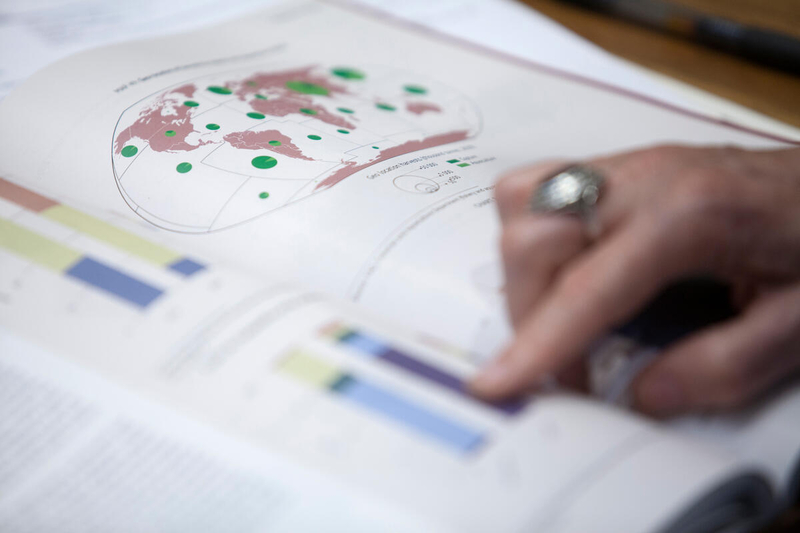
Some of the most reliable sources are the United Nations agencies, of which the United Nations Food and Agriculture Organization (FAO) is an integral part. These international organizations publish reports and facilitate access to statistics that are the fruit of many years of field observation and collaboration between countries, scientists, organizations and institutions, and civil society. They are, therefore, the product of broad, shared, and interconnected visions that allow for a broad-spectrum approach to issues related to the climate, the environment, and human relationships with the planet and our communities. These reports, accompanied by data and statistics, help to visually understand the scale of a phenomenon. Therefore, they are essential for quantifying it instantly.
This information is necessary, reliable, and of high quality.
In 2015, the United Nations developed a program of action for people, planet, and prosperity, called the 2030 Agenda for Sustainable Development, signed by 193 member countries. The agenda, or rather, this broad program of action divided into 17 Sustainable Development Goals (SDGs), was launched in 2016, and the signatory countries have committed to achieving them by 2030, under the guidance of the United Nations.
FAO, in particular, has objectives that encompass a range of challenges, including feeding populations and helping them escape poverty, addressing and adapting to extreme climate conditions and limited resources, taking into account evolving dietary needs and population growth, and adopting methods that preserve the planet for future generations. FAO, as a key agent of transformation, encourages younger generations to increase food production, replace the aging workforce, adapt to increasingly frequent exceptional climate events, and develops programs to provide universal access to education and markets.
For journalists who wish to report on and communicate the implementation of the 2030 Agenda and its 17 SDGs, the publications, statistics, and reports produced by FAO represent an essential reference point for global information and a reliable tool to guide and support understanding of these topics.
These are fundamental issues that concern everyone, worldwide. It is therefore crucial to disseminate them through FAO initiatives, publications, and data. FAO has undertaken actions to achieve the Zero Hunger goal through methods that make agri-food systems sustainable, with programs that are inspired and implemented by United Nations member countries. Indeed, the availability of timely and reliable FAO statistics facilitates knowledge and offers a broad range of useful information for decision-makers and investors in the field of agri-food systems and, consequently, in the sustainable use of resources and in ways of adapting to climate change. FAO statistics therefore support effective research and learning on global progress towards the SDGs, enabling adequate and reliable information for all. They offer a clear and quantifiable, up-to-date, and accessible view of the dynamics unfolding on Earth.
Thanks to FAO publications and statistics, the dissemination of information and the transmission of reliable, essential, and accurate news fosters concrete awareness and expertise, enabling quantitatively measurable, high-quality, and reliable information.
Fascinating!
7101908fcef84e90b61727fc1611fdb0.png?sfvrsn=98f9deaf_1 "Publication - no white footer - EN (1)")
Ms. Patrizia Varone is a professional journalist. For Corriere della Sera's Pianeta 2030, she writes about clime, habitat, ongoing transformations and the United Nations programs on 2030 Agenda. Interested in the environment, history, photographic research, cultures, art and human evolution, she has conducted multidisciplinary essays on the Euro-Mediterranean region. Since January 2025, she has been a member of the Disciplinary Council of the Campania Order of Journalists.