
Other articles
ICARRD+20: putting women’s land rights back on the agrarian reform agenda?
International year of rangelands and pastoralists 2026
Working together for responsible and inclusive land governance
Strengthening partnerships to promote inclusive land reforms
Local multi-stakeholder platforms drive inclusive land governance
Development Program in Sierra Leone
La réforme foncière en République centrafricaine et la voix des peuples autochtones
Chad |Champions for responsible land governance in Chad
Niger and Chad | Land observatories in support of inclusive land reforms
Mauritania | Concrete solutions for improving youth’s access to land
Reflections on the Role of Multi-Stakeholder Platforms in Land Governance
Advancing land tenure security through global dialogue
Gaining positive momentum at the World Bank Land Conference 2025
Cameroon launches its multi-stakeholder platform for inclusive land reform
Cameroon launches its national roadmap towards a national land policy
Promoting responsible and inclusive land governance through MSP in Sierra Leone
Sierra Leone embraces a Human Rights Based approach to land governance assessment
FAO and Partners advancing Inclusive Land reforms at the 2023 African Land Policy Conference
FAO supported the National Forum on Land Tenure in Cotonou
FAO supports the launch of the Pacific Land Network (PLaNet)
Chad validates its National Land Policy
Towards an inclusive land reform in Mauritania
More secure land tenure in Senegal lays the groundwork for agroecology and women empowerment
FAO supports a historic land tenure forum in Guinea
Land Tenure and Sustainable Agri-Food Systems
Open Tenure Trainings with UN-REDD in RDC and Colombia
Geospatial Information for Digital Transformation conference, 27-29 October, Oslo
Land tenure continues to be major objective of development agenda
Mainstreaming VGGT in revision of 2013 Land Law in Viet Nam for more responsible tenure governance
Passage of long-awaited tenure reform in Niger
Sharing land law knowledge in Southeast Asia
What COVID movement restriction means for nomadic pastoralists in the Sahel
Chinese investments in agricultural land in Africa
Land governance in Colombia's protected areas
ECOWAS embraces the Voluntary Guidelines
ICARRD+20 Declaration reinforces global commitment to equitable land governance
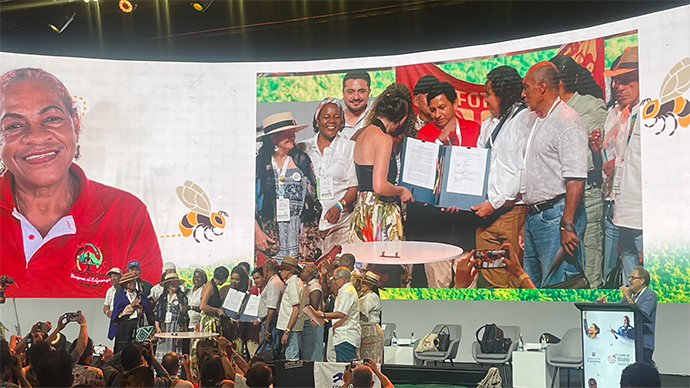
- Second International Conference on Agrarian Reform and Rural Development (ICARRD+20) final Declaration, Colombia, Cartagena de Indias.
The Second International Conference on Agrarian Reform and Rural Development (ICARRD+20) and its Final Declaration marked a significant aggiornamento of the international and multi stakeholder debate on the relation between agrarian reform and rural development, twenty years after the realization of ICARRD 2006 in Brazil.
Yet the long period trat stretched between the two conferences was not wasted, much the opposite, as ICAARD 2006 paved the way for the discussion ad approval of a huge set of international guidance such as the Committee on World Food Security's (CFS) Voluntary Guidelines on the Responsible Governance of Tenure of Land, Fisheries and Forests in the context of National Food Security (VGGT), the CFS Principles for Responsible Investment in Agriculture and Food Systems, Voluntary Guidelines for Securing Sustainable Small-Scale Fisheries in the Context of Food Security and Poverty Eradication (SSF), and the Voluntary Guidelines on Gender Equality and Women’s and Girls’ Empowerment within policies and legislative frameworks on agrarian reform, sustainable rural development, and land tenure governance.
ICARRD+20 was built upon this legacy in a time when climate change, population pressures and competing claims over land are shaping patterns of land tenure, distribution and use in ways that are often not conducive to inclusive and resilient rural transformation.In four days of debate – preceded by both an academic and civil society conference – ICARRD+20 gathered fifty-two national delegations and a vast representation of rural peoples and communities to identify challenges, discuss policy pathways and shape consensus and political commitment.
Yet significant gender gaps in land tenure persist. Women continue to face barriers to owning, inheriting and controlling land due to discriminatory social norms, unequal power relations within households and communities, gaps in legal protections and weak implementation of existing laws. Access to justice and land administration systems also remains limited for many rural women. These challenges are often compounded for women experiencing intersecting forms of marginalization and discrimination, including Indigenous women, Afro-descendant women, migrant and displaced women, widows, elderly women, young women and women with disabilities. The explicit recognition of these intersecting inequalities in the ICARRD+20 declaration represents an important step forward.
ICARRD+20 culminated in the adoption by non-objection of a forward-looking Declaration. The commitment to the VGGT was reaffirmed, but the emphasis is now clearly on implementation and monitoring to deliver real change on the ground. Addressing extreme and growing inequalities, poverty, and hunger stands at the heart of the Declaration. Strong cross-sectoral alignment was underscored, including coherence with the Rio Conventions, sustainable water management, and the promotion of inclusive and sustainable land-use and farm models, alongside respect for traditional knowledge and collective and customary land rights.
These points resonated within a general sense of urgency for the affirmation of multilateralism and international cooperation. States, academics and civil society organizations called upon FAO and the other relevant agencies of the United Nations system to carry forward the outcomes of ICARRD+20 in their governance bodies, promote the exchange of experiences and good practices. The CFS, notably, was demanded to report periodically on the status of implementation and progress of the VGGT, as well as on the outcomes and recommendations of ICARRD+20, with the support of the Global Land Observatory, which was unanimously recognized as a major knowledge and data generation achievement on the state of land tenure and land governance. Finally, the Declaration called for the establishment of a governance system, under the auspices of FAO, to ensure that the next ICARRD conference takes place within the next three years.

- Second International Conference on Agrarian Reform and Rural Development (ICARRD+20) Final Declaration, Colombia, Cartagena de Indias.