


Statistics
Data centers

FAOSTAT
FAOSTAT provides free access to food and agriculture statistics (including crop, livestock, and forestry sub-sectors) for over 245 countries and territories and covers all FAO regional groupings from 1961 to the most recent year available.

SDG Indicators
FAO’s Sustainable Development Goals (SDG) Data Portal provides access to the 22 SDG indicators under FAO custodianship as well as key information to support countries in tracking progress towards SDGs.

AMIS
The Agricultural Market Information System (AMIS) is an inter-agency platform to enhance food market transparency and policy response for food security. It provides market information on four grains particularly important in international food markets: wheat, maize, rice and soybeans.

Food and Agriculture Microdata Catalogue (FAM)
The Food and Agriculture Microdata (FAM) Catalogue provides access to micro datasets collected through farm and household surveys which contain information related to agriculture, food security and nutrition.

FAO DATA EXPLORER beta
Food and agriculture

AIDmonitor
Official Development Assistance

AquaGRIS
A global information system for aquatic genetic resources

AQUASTAT
Water resources and management

DAD-IS
Domestic Animal Diversity
Emergencies
Data in Emergencies Hub (DIEM)

Empres-i
Global Animal Disease Information System

FAO/WHO GIFT
Individual food consumption

FishStat
Fishery and Aquaculture


FPMA
Food Prices Monitoring and Analysis

FRA
Global Forest Resources
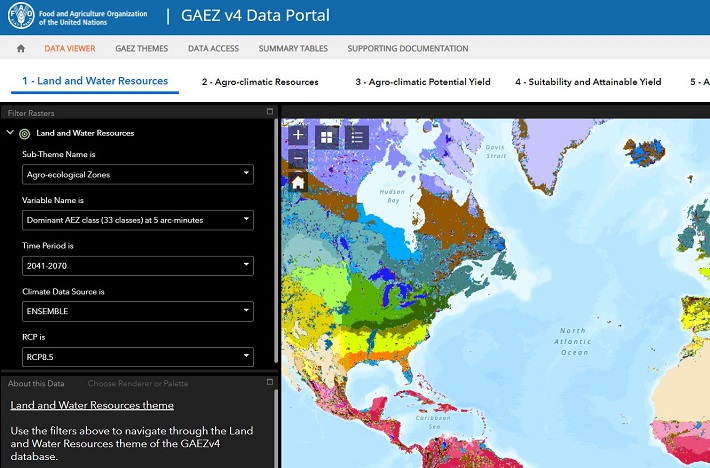
GAEZ v5
Global Agro-Ecological Zoning version 5


INFOODS
Food Composition

Locust Hub
Desert Locust situation

RuLIS
Rural livelihoods

SilvaGRIS
Global Information System on Forest Genetic Resources

WaPOR
Remote sensing for water productivity

WIEWS
Plant Genetic Resources
FAO's statistical work
Sound and timely statistics are key to inform decisions, policies and investments that tackle issues related to food and agriculture, from hunger and malnutrition to rural poverty, from food systems productivity to the sustainable use of natural resources or to climate change.
FAO is dedicated to collecting, analysing, interpreting and disseminating food and agriculture statistics that are relevant for decision-making.
It is for this reason that developing and implementing methodologies and standards to assist countries in generating sound data and information is at the core of FAO’s statistical work.
FAO also supports member countries in the collection, dissemination and uptake of data to formulate policies and plans or to better orient investments.
Major areas of FAO’s statistical work


How we work
FAO’s statistical system operates under the oversight of the Chief Statistician and consists of a statistics division, statistics units embedded in technical departments and a Data Lab for Statistical Innovation.
- Statistics Division (ESS)
- Digitalization and Informatics Division (CSI)
- Agrifood Economics Division (ESA)
- Food Systems and Food Safety Division (ESF)
- Food and Nutrition Division (ESN)
- Inclusive Rural Transformation and Gender Equality Division (ESP)
- Markets and Trade Division (EST)
- Fisheries and Aquaculture Division (NFI)
- Forestry Division (NFO)
- Animal Production and Health Division (NSA)
- Land and Water Division (NSL)
- Plant Production and Protection Division (NSP)
- Office of Climate Change, Biodiversity and Environment (OCB)
- Office of Emergencies and Resilience (OER)
FAO has three statutory bodies on statistics, composed of senior statistics officials from member countries, which meet every two years:
- African Commission on Agricultural Statistics (AFCAS)
- Asia and Pacific Commission on Agricultural Statistics (APCAS)
- Latin American and the Caribbean Commission for Agricultural Statistics (LACCAS)
Their role is to review the state of food and agricultural statistics in their respective region, to advise Members on the development and standardization of agricultural statistics within the general framework of FAO’s work and to convene the study groups or other Subsidiary Bodies of national experts required for this purpose.
FAO Statistics and Data Quality Assurance Framework (SDQAF, 2023) and the FAO Data and Statistical Standards Series adopted more recently, set out the principles and recommended best practices to ensure that FAO statistical production processes and statistical outputs are of the highest possible quality. The SQAF is based on the Fundamental Principles of Official Statistics and the Principles Governing International Statistical Activities (CCSA), which guide the statistical activities of national and international organizations, and is inspired by the quality frameworks adopted by other supranational and international organizations [e.g. European Central Bank (ECB), Eurostat, Organisation for Economic Co-operation and Development (OECD) and International Monetary Fund (IMF)]. In 2020, FAO has also endorsed the ISI’s Declaration on Professional Ethics (2010) to encourage all its statisticians to adopt high-standard professional values and ethics in statistics.
FAO makes a significant contribution to global discussions related to food and agricultural statistics through its participation in international and regional statistical fora.
As the UN agency responsible for the development of methods and standards on food and agriculture statistics and for their implementation in countries, the Organization acts as the Secretariat of the United Nations Committee of Experts on Agricultural and Rural Statistics (UN-CEAG), the United Nations Expert Group on Food Security and Nutrition Data and Statistics (UN EG-FSN) and the Coordinating Working Party on Fishery Statistics (CWP).
The Organization also participates in several Committee of experts and working groups under the United Nations Statistical Commission (UNSC) (the highest body of the global statistical system bringing together the Chief Statisticians from all UN member states) as well as other regional statistical coordination bodies relevant to FAO’s statistical mandate.
Finally, FAO also co-organizes, in collaboration each time with a different member country, the International Conference on Agricultural Statistics (ICAS), which is held every three years under the auspices of the Committee on Agricultural Statistics of the International Statistical Institute (ISI).
Meetings and Events
Virtual Event
Meetings and Events
International Day of Awareness of Food Loss and Waste
29/09/2026
The seventh observance of the International Day of Awareness of Food Loss and Waste is calling for the expansion and strengthening of stakeholder...

Hybrid Event, Rome (Italy)
Meetings and Events
Strengthening the Evidence Base for Agricultural Science, Research and Innovation: How ASTI Supports Agrifood Systems Transformation
16/10/2026
The fifth edition of the FAO Science and Innovation Forum (SIF 2026) will be held from 12 to 16 October 2026 under the umbrella of the World Food...

Hybrid Event, Riyadh (Saudi Arabia)
Meetings and Events
United Nations World Data Forum 2026
09/11/2026 - 12/11/2026
The UN World Data Forum will take place in Riyadh, Saudi Arabia between 9 and 12 November 2026.
Stay connected

Work with us
Statistician (Agricultural Censuses), P-4
Statistician (Food Security and Nutrition Statistics), P-3
Deadline: 23 October

FAO data and statistics newsletter (September 2026)
Welcome to this issue of the FAO data and statistics newsletter, where we bring you up-to-date on recent developments related to data, statistics and the SDG indicators under FAO custodianship in the Organization.
Useful links
FAO statistics: 80 years of feeding minds, guiding action
