
Empowerment
Empowering Women for Stronger Political Parties: A Good Practices Guide to Promote Women's Political Participation
UNDP & NDI, 2012
How women participate in political parties – and how those parties encourage and nurture women’s involvement and incorporate gender-equality issues – are key determinants of women’s political empowerment. They are also key to ensuring gender-equality issues are addressed in the wider society. If strategies to promote women’s involvement in the political process are to be effective, they should be linked to steps parties can take across the specific phases of the electoral cycle and to the organization and financing of the parties themselves. The most effective strategies to increase women’s participation in political parties combine reforms to political institutions with targeted support to women party activists within and outside party structures, women candidates and elected officials. These strategies require the cooperation of a variety of actors and political parties from across the political spectrum. The Guide identifies targeted interventions that political parties can take to empower women.
The Women’s Empowerment in Agriculture Index
USAID, IFPRI, OPHI, February 2012
The Women’s Empowerment in Agriculture Index (WEAI) is the first measure to directly capture women’s empowerment and inclusion levels in the agricultural sector. The WEAI focuses on five areas: decisions over agricultural production, power over productive resources such as land and livestock, decisions over income, leadership in the community, and time use. Women are considered to be empowered if they have adequate achievements in four of the five areas. The Index also takes into consideration the empowerment of women compared with men in the same household, based on asking women and men the same survey questions.
Empowerment: A journey not a destination
Pathways of Women’s Empowerment, January 2012
Pathways of Women’s Empowerment is an international research and communications programme established in 2006 which links academics with activists and practitioners to find out what works to enhance women’s empowerment. It has generated a rich and varied portfolio of studies. Our findings have led us to understand women’s empowerment as a journey, not a destination. Understanding what enables women to embark on these journeys, what pathways are available to them, which routes they take, and what assists them along the way is essential if we are to support women to empower themselves.
Understanding and Measuring Women’s Economic Empowerment - Definition, Framework and Indicators
ICRW, October 2011
Economically empowering women is essential both to realize women’s rights and to achieve broader development goals such as economic growth, poverty reduction, health, education and welfare. But women’s economic empowerment is a multifaceted concept so how can practitioners, researchers and donors design effective, measurable interventions? This brief report lays out fundamental concepts including a definition of women’s economic empowerment; a measurement framework that can guide the design, implementation and evaluation of programs to economically empower women; and a set of illustrative indicators that can serve as concrete examples for developing meaningful metrics for success.
Women Entrepreneurs in Mobile Retail Channels: Empowering Women, Driving Growth
Cherie Blair Foundation for Women, 2011
This report investigates the gender composition of the ‘mobile value chain’ (MVC) in 11 different markets around the world. It examines the current level of women’s participation in the MVC and the benefits of such participation both for MNOs and for women entrepreneurs. In addition to undertaking an analysis of the MVC, we broadened our scope to encompass the wider political, social and institutional conditions in each market. We interviewed policy makers and spoke to other stakeholders who have an interest in women’s economic empowerment in the markets concerned.
Population Dynamics and Poverty in the LDCs: Challenges and Opportunities for Development and Poverty Reduction
UNFPA, 2011
This report outlines major population dynamics in Least Developed Countries (LDCs) and addresses their implications for development and poverty reduction. It identifies five areas of intervention that can help countries anticipate, shape and plan for changes in their population: focusing investments on adolescents and youth; increasing access to sexual and reproductive health care and empowering women; strengthening capacity to integrate population dynamics in the framework of sustainable development; linking population to climate change; and effectively utilizing data in public policy and development.
Strong Women, Strong Communities. CARE’s holistic approach to empowering women and girls in the fight against poverty
CARE, May 2010
Increasingly, CARE’s work focuses on addressing the injustice, discrimination and exclusion that prevent women and girls from achieving their full potential. CARE concluded a four-year study assessing programs serving women and girls in 24 countries in Asia, Africa and Latin America. The learning from this research illustrates what “empowerment” really means for women and girls in developing countries, the obstacles they face in realizing their potential – and steps policymakers and practitioners can take to help.
Innovation for Women's Empowerment and Gender Equality
ICRW, 2009
In this new study, ICRW examines how cutting-edge innovations can transform women’s lives. The report analyzes how a variety of innovations that used technology, changed social norms and strengthened economic vitality have helped women. Researchers identified seven core approaches – or levers – needed for any innovation to create meaningful change for women. They include:
- Creating strategic partnerships among governments, the private sector and civil society.
- Including women in the design and implementation of innovative ideas.
- Having committed support from governments as well as efforts at the grassroots level.
Women’s Empowerment in Pastoral Societies
IUCN, July 2009
When reading about women in pastoral societies it is common to find reference to their marginalised roles, their hardship, their oppression and their lack of power as opposed to men’s domination, men’s ownership, men’s power and associated patriarchal relations. However, pastoral women are extremely strong and powerful people. Despite the many challenges women face, they do find ways to ensure that the household’s basic needs are met; they do find ways to access resources and within the pastoral system do have ‘rights’ to ownership and use of many of them; and they do find ways to get their voices heard. This report focuses on pastoralist women from pastoral communities across the world producing a global good practice study on pastoralist women’s empowerment.
Give Girls a Chance: Tackling Child Labour, a Key to the Future
ILO, June 2009
This report notes that while recent global estimates indicate the number of children involved in child labour has been falling, the financial crisis threatens to erode this progress. It says the danger of girls being forced into child labour is linked to evidence that in many countries families give preference to boys when making decisions on education of children. Because of the increase in poverty as result of the crisis, poor families with a number of children may have to make choices as to which children stay in school. In cultures in which a higher value is placed on education of male children, girls risk being taken out of school, and are then likely to enter the workforce at an early age.
Rural Women Reporting
CMFD Productions/FAHAMU, March 2008
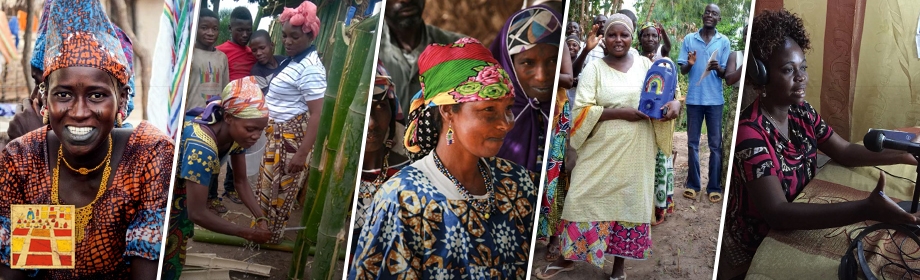
This report documents the process and key outputs of the Rural Women Reporting workshop series initiated by FAHAMU Networks for Social Justice and CMFD Productions. According to the report, rural women are rarely heard in the media; even more rarely do they actually have the opportunity to create media. The project was developed to both produce programmes that speak to the issues rural women face, and to empower those who participated through skills and confidence-building to support ways to make their voices heard. The programmes were made available to local radio stations and places where people gather, and were distributed over the internet as podcasts.
Pathways of Women's Empowerment
Pathways of Women's Empowerment links academics, activists and practitioners working to advance women's empowerment locally, regionally and through global policy processes. It wants to identify where women are achieving real gains and discover the positive and negative factors which have influenced their journey. Its aim is to make these pathways of change visible and to build on them to inspire a radical shift in policy and practice. By involving policy actors and practitioners directly in its research and learning, it hopes its work will be in itself a catalyst for change.
From microfinance to macro change: integrating health education and microfinance to empower women and reduce poverty
UNFPA, 2006
This advocacy booklet (26 pages) calls for integration of reproductive health education with microfinance services in developing countries. It presents individual stories, case studies and dramatic findings to show the impact this combination can have on reducing poverty and improving individual lives.
Arab Human Development Report 2005 - Empowerment of Arab Women
UNDP, December 2006
Gender inequality is generally recognized as one of the main obstacles to development in the Arab Region. This volume of the Report focuses on the history and contemporary dynamics of Arab women's economic, political, and social empowerment. It details the processes in which gender impacts on Arab development while suggesting means of overcoming some of the challenges and building more equitable societies.
Bringing Women Into Governance
CEDPA, November 2006
This handbook focuses on efforts to bring women into governance, illustrating ways that organizations and activists around the world can foster greater gender equity in civic engagement, advocacy, voting and governance efforts to improve the quality of life for everyone. Six chapters highlight key approaches to supporting women's leadership to make governments worldwide more responsive to the needs of women.
Engaging boys and men to empower girls: Reflections from practice and evidence of impact
UN Division for the Advancement of Women (DAW), September 2006
This 10-page text reflects on the ways boys are socialized to see girls and women as sexually subservient. It also documents lessons learned from some of the emerging experiences in engaging boys and men in empowering girls and women in diverse settings. The author argues that experience shows that men and boys can and do change attitudes and behaviours in the short-term as a result of programme interventions, and that such outcomes are, in nearly all cases, positive for the well-being of women and girls, and men and boys themselves.
Empowering Young Women to Lead Change - A Training Manual
World YWCA / UNFPA, June 2006
This resource manual is designed to enable young women to prepare and facilitate training on a host of issues that are important to them. The manual was developed by young women and contains modules on young women's leadership, economic justice, HIV and AIDS, human rights, peace, self esteem and body image, sexual and reproductive health and violence against women. The issues are complex and the publication has been developed for young women to lead themselves in learning more about the issues through fun and participatory activities and on to action. Trainings and workshops can be designed using the entire manual or pulling out modules of interest for shorter sessions.
Progress of the World’s Women 2005: Women, Work & Poverty
UNIFEM, 2005
This report marks the fifth anniversary of the UN Millennium Declaration and the tenth anniversary of the Beijing Platform for Action. It argues that unless governments and policymakers pay more attention to employment and its links to poverty, the campaign to make poverty history will not succeed and the hope for gender equality will founder on the reality of women’s growing economic insecurity.
Gender Equality: Striving for Justice in an Unequal World
UNRISD, , March 2005
This report of the United Nations Research Institute for Social Development (UNRISD) provides a useful complement to the formal review and appraisal of the implementation of the Beijing Platform for Action that the Division for the Advancement of Women is undertaking. It is divided into four broad sections: macroeconomics, well-being and gender; women, work and social policy; women in politics and public life; and gender, armed conflict and the search for peace.
Monitoring the Millennium Development Goals from a rural perspective
FAO Discussion Paper, February 2005
This paper offers some reflections on the monitoring process for the Millennium Development Goals (MDGs) and highlights FAO relevant activities. It offers some recommendations for strengthening the rural component of the MDG process, because the MDGs represent an unprecedented international commitment to address the root causes, and mitigate some of the effects of underdevelopment.
The mainstreaming of gender issues into MDG goals and targets as well as reporting procedures has raised particular challenges. There is general concern that the MDGs may not accurately reflect the urgent issues of social inequality and the institutional changes that are required to achieve gender equality.