


Sharm el-Sheikh joint work on implementation of climate action on agriculture and food security
The 27th Conference of the Parties (COP27) to the United Nations Framework Convention on Climate Change (UNFCCC) marked a critical step for the implementation of the Koronivia Joint Work on Agriculture process with the adoption of decision 3/CP.27 on the “Sharm el-Sheikh joint work on implementation of climate action on agriculture and food security” (SJWA).
The Koronivia Joint Work on Agriculture (KJWA) is a landmark decision that recognized the unique potential of agriculture in tackling climate change. The KJWA was established at COP23 in 2017 as a new process to advance discussions on agriculture under the UNFCCC, addressing six interlinked topics and two additional intersessional elements.
The four-year Sharm el-Sheikh joint work marks a crucial step in shifting focus to the implementation of the KJWA outcomes, previous activities under the UNFCCC that addressed issues related to agriculture ( 1, 2, 3, 4, 5), as well as future topics.
The Sharm el-Sheikh joint work (SJWA) recognizes the fundamental priority of safeguarding food security and ending hunger, and the particular vulnerabilities of food production systems to the adverse impacts of climate change. It highlights the role of farmers, including smallholders and pastoralists, as key agents of change recognizing that solutions are context-specific and take into account national circumstances.
As mentioned in paragraph 14 of decision 3/CP.27, the Conference of the Parties agreed on seven objectives to address issues related to agriculture and food security in the context of the SJWA, which can be summarised as follows:
- Promoting a holistic approach taking into consideration regional, national and local circumstances to deliver multiple benefits;
- Enhancing coherence, synergies, coordination, communication and interaction between Parties, constituted bodies and workstreams, the operating entities of the Financial Mechanism, the Adaptation Fund, the Least Developed Countries Fund and the Special Climate Change Fund in order to facilitate the implementation of action to address issues related to agriculture and food security
- Promoting synergies and strengthening engagement, collaboration and partnerships among national, regional and international organizations and other relevant stakeholders;
- Providing support and technical advice to Parties, constituted bodies and the operating entities of the Financial Mechanism on climate action;
- Enhancing research and development on issues related to agriculture and food security and consolidating and sharing related scientific, technological and other information, knowledge (including local and indigenous knowledge), experience, innovations and best practices;
- Evaluating progress in implementing and cooperating on climate action; and
- Sharing information and knowledge on developing and implementing national policies, plans and strategies related to climate change.
Pursuant to decision 3/CP.27, the UNFCCC Secretariat has:
- been requested to prepare an annual synthesis report each year on the work undertaken by constituted bodies and financial and other entities under the Convention, as well as by relevant international organizations, on activities related to the four-year Sharm el-Sheikh joint work (para. 15a);
- been requested to hold in-session workshops in hybrid format, facilitating both virtual and in-person participation, on agreed topics related to agriculture and food security at the first regular sessions of the subsidiary bodies each year (para. 15b);
- been requested to establish the Sharm el-Sheikh online portal under the joint work for sharing information on projects, initiatives and policies for increasing opportunities for implementation of climate action to address issues related to agriculture and food security (para. 16); and
- requested the Subsidiary Bodies (SBs) to report on the progress and outcomes of the joint work to the Conference of the Parties at its thirty-first session (COP31) in 2026 (para. 20)
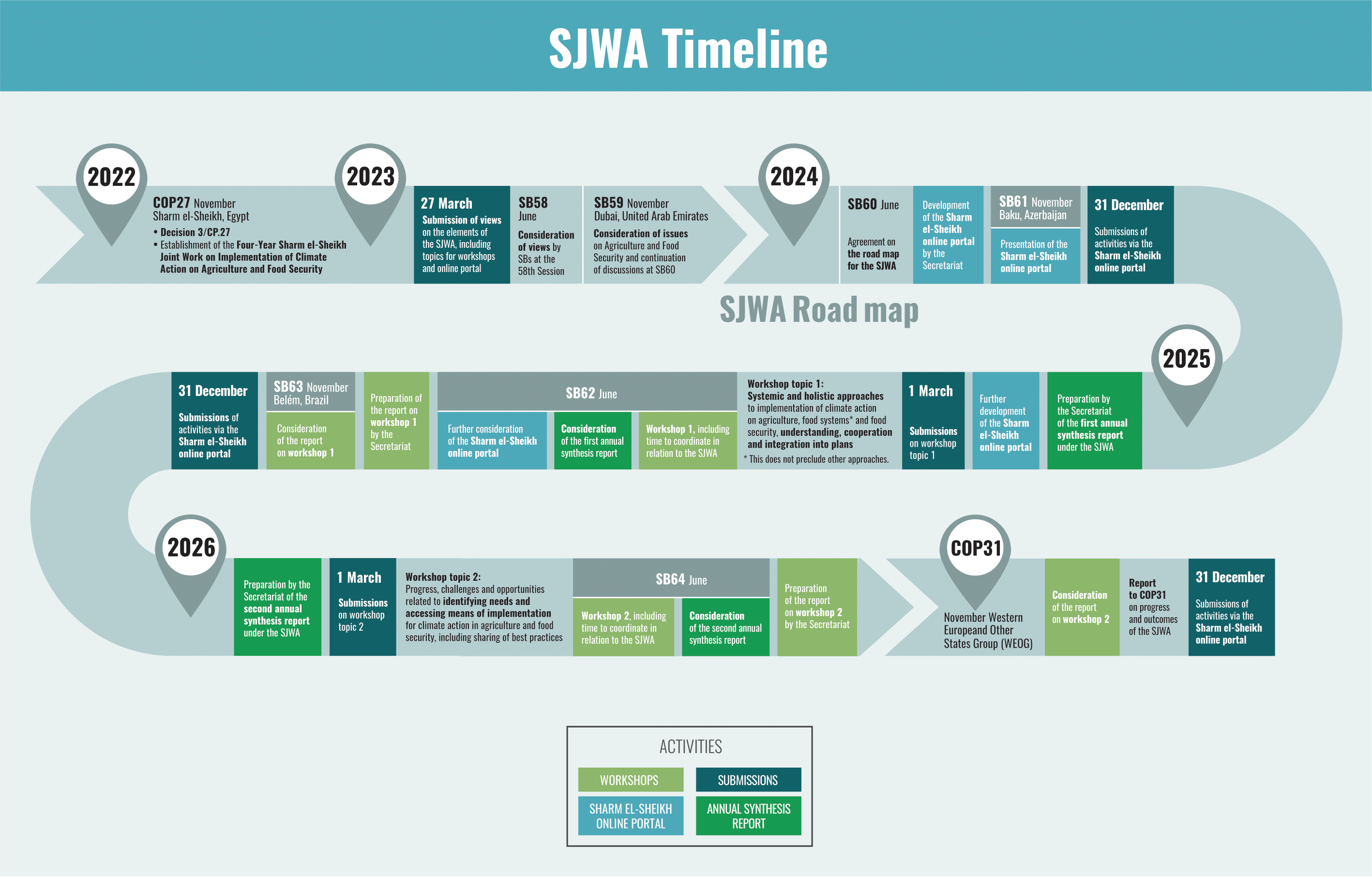
At 60th Session of Subsidiary Bodies to the UNFCCC (SB60), Parties took an essential step in laying the groundwork for the next two years of work by agreeing on a road map for the Sharm el-Sheikh joint work. The road map sets out the timeline for the different activities to be carried out from 2024 to 2026, including:
Time to coordinate in relation to the joint work during the in-session workshops, agreeing to include this when reporting back on the progress and outcomes of the joint work to the COP31 (para. 2).
The submission of information by relevant international organizations on activities related to the joint work via the Sharm el-Sheikh online portal by 31 December each year (para. 4). Read FAO's first submission to the UNFCCC on projects, initiatives and policies (31 December 2024).
The preparation of the annual synthesis report by the UNFCCC Secretariat, taking into account the information of submissions to the online portal (para. 4) and the progress under and the outcomes of current climate initiatives (para. 3), for consideration at the first regular sessions of the Subsidiary Bodies each year, starting in 2025.
Holding two agreed in-session workshops in hybrid format, facilitating both virtual and in-person participation at the 62nd and 64th sessions of the UNFCCC’s Subsidiary Bodies, focusing on:
Workshop topic 1 (SB62):
Systemic and holistic approaches to implementation of climate action on agriculture, food systems* and food security, understanding, cooperation and integration into plans.
*This does not preclude other approaches.
Workshop topic 2 (SB64):
Progress, challenges and opportunities related to identifying needs and accessing means of implementation for climate action in agriculture and food security, including sharing of best practices.
The preparation by the UNFCCC Secretariat of a report on each of the in-session workshops for consideration by the Subsidiary Bodies at their sessions following the respective workshop.
Submission of views by Parties and observers on the subject of each workshop, options for its format and suggested speakers by 1 March 2025 (workshop 1) and by 1 March 2026 (workshop 2).
The development of the Sharm el-Sheikh online portal by the UNFCCC Secretariat, to be presented at the 61st session of the Subsidiary Bodies under the UNFCCC (SB61) for further development and consideration at the next meeting of the SBs in June 2025 (SB62).
2024
- The Sharm el-Sheikh online portal was presented at SB61. A template for submissions was developed by the Secretariat on the basis of the structure outlined by Parties at SB61, and first submissions of information by Parties and international organizations have been included.
Read FAO submission to the Sharm el-Sheikh online portal in 2024
2025
- The first annual synthesis report on activities related to the joint work was prepared by the UNFCCC Secretariat in May 2025. It includes work undertaken by constituted bodies and financial and other entities under the Convention, as well as by relevant international organizations, covering the period starting from 2013.
- A first in-session workshop was held in hybrid format at SB62 on topic 1: “systemic and holistic approaches to implementation of climate action on agriculture, food systems (this does not preclude other approaches) and food security, understanding, cooperation and integration into plans”, and a workshop report was subsequently prepared for consideration by SB63 in Belém, Brazil.
- The SBI and SBSTA invited the Standing Committee on Finance (SCF) to present the outcomes of the 2025 SCF Forum on “accelerating climate action and resilience through financing for sustainable food systems and agriculture”
- At SB62, Parties also recalled guidance provided at SB61 on the submission of information to the online portal, with a view to further developing its structure, functionalities and accessibility.
- At SB63 in Brazil, the SBSTA and the SBI reiterated the importance of cooperating on the implementation of climate action to address issues related to agriculture and food security in accordance with the SJWA, and agreed to continue consideration on this matter at SB64 in June 2026, taking into account the draft text prepared in Belém.
Read FAO submission on the first in-session workshop under the SJWA
See FAO presentation at the first in-session workshop
Read FAO submission to the Sharm el-Sheikh online portal in 2025
Read FAST Partnership submission to the Sharm el-Sheikh Online Portal
2026
- The second annual synthesis report under the SJWA was prepared by the UNFCCC Secretariat in March 2026, covering activities related to the joint work undertaken in 2025.
- The Secretariat further developed the structure, functionalities and accessibility of the Sharm el-Sheikh online portal, upgrading its interface and introducing new features, taking into account the key points from Parties’ presentations and discussions on this matter at SB61 (captured in annexes I–II to documents FCCC/SBSTA/2024/10 and FCCC/SBI/2024/25).
- A second in-session workshop was held from 08 to 10 June 2026 at SB64 in hybrid and interactive format on topic 2: “Progress, challenges and opportunities related to identifying needs and accessing means of implementation for climate action in agriculture and food security, including sharing of best practices”, including a World Café, and time to coordinate in relation to the joint work.
- At SB64, Parties considered the report on the first in-session workshop on “systemic and holistic approaches to implementation of climate action on agriculture, food systems and food security”, as well as the second annual synthesis report on activities related to the joint work undertaken by constituted bodies, financial entities and relevant international organizations in 2025. Parties also took note of the oral presentation delivered at SB63 by the Standing Committee on Finance on the outcomes of the 2025 SCF Forum.
Read FAO submission on the second in-session workshop under the SJWA
See FAO presentation at the second in-session workshop and the additional information provided following the discussions during the workshop
2026
- Preparation by the Secretariat of the workshop report on topic 2 and consideration of the report at SB65.
- Report back on the progress and outcomes of the joint work to the Conference of the Parties at its thirty-first session (COP31) in November 2026.
The SJWA reaffirmed the importance of:
- taking into account the vulnerability of farmers and other groups exposed to the effects of climate change, in particular smallholders, Indigenous Peoples, local communities, women, youth and children, as well as their knowledge, experience and leadership; and
- strengthening actions and support, in particular with regard to capacity building, access to finance and technology development and transfer.
The effective implementation of the objectives agreed as part of the SJWA decision depends on cooperation between all stakeholders including Parties, constituted bodies under the Convention, operating entities of the Financial Mechanism, UN organizations and other relevant institutions, agencies and entities, the research community, the private sector, civil society and farmers' organizations, among others.
The Conference of the Parties also invited current and future COP Presidencies, high-level champions and other actors to take into account the recommendations on the KJWA referred to in decision 3/CP.27, paragraph 2, and to promote information and knowledge exchange on best practices and means of implementation when promoting climate initiatives.
Strengthened collaboration and innovative partnerships will reinforce the links between science, policy and practice, and the potential to catalyse climate action to address issues related to agriculture and food security.
Timeline
Regional and global support
For over 10 years, FAO has been supporting and facilitating knowledge exchange through dialogues, workshops, webinars, and a wide range of information products, including analyses of submissions, workshop summaries, briefs and multimedia content to help stakeholders navigate agricultural topics under the UNFCCC.
Working in close collaboration with the UNFCCC and other actors at the international and national level, FAO will continue to support the implementation of the four-year Sharm el-Sheikh joint work and its online portal, building on previous achievements under the Koronivia process and on knowledge-sharing platforms, such as FAOs Climate Change Knowledge Hub. Through this work, FAO provides countries with technical support, expert knowledge and capacity building to adapt to and mitigate climate change.
From 31 October to 2 November 2023, FAO hosted the first Informal Expert Dialogue on the Sharm el-Sheikh Joint Work (SJWA) at its headquarters in Rome. The dialogue came at a strategic time, as agriculture experts were laying the groundwork for the next steps of the SJWA.
FAO and its partners have deepened their engagement with regional negotiation groups on agriculture, including through workshops and consultations in Africa, Asia and the Pacific, and Latin America and the Caribbean in 2024, 2025 and 2026. These meetings have provided opportunities for Parties to review scientific and technical evidence, share experiences, consolidate positions and build capacities ahead of the Subsidiary Body sessions in Bonn (June 2026) and COP31 in Antalya, Türkiye (November 2026), where Parties are due to report back on the outcomes and progress of the Sharm el-Sheikh Joint Work and define the way forward for climate action on agriculture and food security under the UNFCCC.
FAO remains committed to supporting Parties in their engagement under the UNFCCC, ensuring that agriculture and food security remain at the heart of global climate negotiations and implementation of climate action.
At COP28, the UAE Presidency, FAO, CGIAR, and the World Bank announced the creation of the Agrifood Sharm El-Sheikh Support Programme, a three-year initiative to facilitate dialogue and knowledge sharing among global and regional policymakers. The programme aims to unite stakeholders in the UNFCCC process to facilitate consensus and accelerate coordinated efforts for the implementation of climate action on agriculture and food security in the lead-up to the 31st Conference of the Parties (COP31) in 2026. The initiative forms a vital bridge between negotiation spaces and the implementation of the Emirates Declaration on Sustainable Agriculture, Resilient Food Systems, and Climate Action.
With the support of the German Federal Ministry for Economic Cooperation and Development (BMZ), and building on the earlier contributions of the German Federal Ministry of Food, Agriculture and Regional Identity (BMLEH) and the Government of Japan to the Koronivia process, FAO has continued to enhance country engagement on agriculture and food security under the UNFCCC through two complementary initiatives: the Enhancing Agrifood Negotiations (2024–2025) and the IMP-ACT 2030 projects (2025–2030). Together, these initiatives have reinforced regional and global collaboration and negotiation capacities, through peer-to-peer exchanges and technical capacity building that enable countries to align positions, share experiences and advocate more effectively for agrifood systems in global climate action processes.
Resources
.png?sfvrsn=bff26071_2 "Navigating climate action on agriculture and food security under the United Nations Framework Convention on Climate Change (UNFCCC)")
Technical Paper
Navigating climate action on agriculture and food security under the United Nations Framework Convention on Climate Change (UNFCCC)
01/04/2026
This technical note provides an overview of the United Nations Framework Convention on Climate Change (UNFCCC) and related progress in areas relevant...

Publications
Advancing climate action on agriculture and food security – Progress on agriculture-related climate change negotiations and the Sharm el-Sheikh Joint Work (SJWA) from COP27 onwards
01/01/2024
Climate Change (UNFCCC), Parties adopted Decision 3/CP.27 establishing the Sharm el-Sheikh Joint Work on the Implementation of Climate Action on Agriculture...

Book
Navigating the waters of the United Nations Framework Convention on Climate Change: A guide for the aquatic food sector
01/01/2024
Amid growing awareness of climate risks and solutions in the aquatic food sector, this guide aims to equip stakeholders from the sector — including...

Book
Land use and the Sharm el-Sheikh joint work on implementation of climate action on agriculture and food security
07/06/2024
Land use and land-use change (including related policies) interact with climate and climate change (including related policies) in multiple ways. Land-use...

Policy Brief
Outcomes and lessons learned from the Koronivia UNFCCC negotiations on agriculture and food security and the way forward after COP27
05/05/2023
The Koronivia Joint Work on Agriculture (KJWA) was established at COP23 to address six topics in the agricultural sector's role in climate change. KJWA...
Relevant news

News
FAO showcases new technical note on agriculture and food security at Bonn climate talks
10/06/2026
As climate negotiators convene in Bonn for the annual June climate meetings, FAO is supporting the talks with a new technical note outlining progress...

News
FAO-IPCC Expert Meeting on Agriculture and Food
02/06/2026
Agriculture and food systems are highly vulnerable to climate impacts, but they are also major contributors to greenhouse gas emissions. With over 8%...

News
Transparent data, stronger agrifood action: Colombo workshop sets direction for COP31
16/03/2026
Countries across Asia-Pacific and Central Asia are stepping up efforts to meet their climate commitments. A regional workshop held in Colombo delivered...
Useful links
- Agrifood Sharm El-Sheikh Support Programme
- Food and Agriculture for Sustainable Transformation Partnership
- New FAO Strategy on Climate Change
- Koronivia Joint Work on Agriculture
- FAO submission on Sharm el-Sheikh joint work
- Sharm el-Sheikh online portal
- Climate Change Knowledge Hub (CCK-Hub)
- UNFCCC Agriculture