
E-consultation on ethical, legal and policy aspects of data sharing affecting farmers
Day 4: Actions to be taken in 2018-2021 to ensure smallholder farmers benefit from agricultural data in the future
21/05/2018
Moving to the present and near future: what actions should be taken in 2018-2021 to ensure smallholder farmers benefit from agricultural data? Which actors would you expect to take specific roles?
Example: if one of the policy changes identified is more institutional collaboration to improve the international, national and local governance of farmers’ data rights, which are the best ways and immediate steps to foster this now? Which actors should take these steps?
Actions à entreprendre en 2018-2021 pour assurer que les petits agriculteurs bénéficient des données agricoles à l'avenir.
Passons au présent et au futur proche: quelles actions devraient être entreprises en 2018-2021 pour s'assurer que les petits agriculteurs bénéficient des données agricoles? Quels acteurs vous attendez-vous à jouer des rôles spécifiques?
Exemple: si l'un des changements de politique identifiés est une collaboration plus institutionnelle pour améliorer la gouvernance internationale, nationale et locale des droits des données des agriculteurs, quels sont les meilleurs moyens et les mesures immédiates pour encourager cela? Quels acteurs devraient prendre ces mesures?
Cuáles son las acciones que deben adoptarse del 2018 al 2021 para asegurar que los pequeños agricultores se beneficien de los datos agrícolas en el futuro?
Moviéndonos al presente y futuro cercano: Qué acciones deberían adoptarse en 2018-2021 para asegurar que los pequeños agricultores se beneficien de los datos agrícolas? Qué actores esperaría Usted asumirían roles específicos?
Ejemplo: si uno de los cambios políticos identificados es más sobre colaboración institucional para mejorar la gobernanza internacional, nacional y local de los agricultores sobre sus derechos sobre los datos, cuáles son las mejores formas y pasos inmediatos para fomentar esto? Qué actores deberían seguir estos pasos?
The question about how to ensure farmers benefit from agriculture data in the future goes hand in hand with how to ensure farmers can benefit from digital solutions in the first place. We can't have one without the other. To this point I recently published an article specific to agriculture digital finance and the need for more human capital but it equally applies to the broader agriculture digital solution space. The article is here
https://medium.com/@leebabcock/digital-agriculture-finance-more-human-ca...
During 2018-2021 our farmers will be served if we think about how to transfer knowledge to farmers about agriculture data and digital solutions. Maybe a starting point is the knowledge transfer we currently do about good agriculture practices year after year, season after season. Maybe another starting point is to amend the national financial inclusion strategies that countries are crafting to integrate agriculture data into their awareness raising and education about the feature and benefits of agriculture digital finance.
Good day everyone,
A warm welcome from a cold South Africa on the 4th day of this E-Consultation on the ethical, legal and policy aspects of data sharing affecting farmers. I am Nicolene Fourie and have the privilege of moderating Day 4 of the discussion.
The objective of the days discussion will be to position ourselves for the present and near future and to have a discussion to reflect on the required actions that should be taken in 2018-2021 to ensure smallholder farmers benefit from agricultural data. In addition we should also consider the landscape in terms of the actors and to attempt to define the roles of these actors.
The discussion will draw on the past three days discussions and relevant literature to propose practical and actionable outcomes. The following documents can serve as reference material for the discussion:
[1] De Beer, J. Ownership of open data: Governance options for agriculture and nutrition. Wallingford: GODAN, 2016. https://f1000research.com/documents/6-1002
[2] Maru, A. et al. Digital and Data-Driven Agriculture: Harnessing the Power of Datafor Smallholders. GFAR, GODAN and CTA, 2018. https://f1000research.com/documents/7-525
[3] Boyera, S. et al. Farmer profiling: Making data work for smallholder farmers. CTA Working Paper 17/09. Wageningen: CTA, 2017.
[4] Chaves Posada, J. Achieving Farmers Rights in Practice: GFAR Discussion Document. Rome: Global Forum on Agricultural Research, 2013. http://www.gfar.net/sites/default/files/cgiar_farmers_rights_report_final_aug_13.pdf.
[5] Chaves Posada, J. Rights of farmers for data, information and knowledge. Rome: Global Forum on Agricultural Research, 2014. http://www.gfar.net/sites/default/files/rights_of_farmers_for_data_information_and_knowledge.pdf
[6] Jellema A. et al. Open data and smallholder food and nutritional security. CTA Working Paper 15/01. Wageningen: CTA, 2015.
From the preceding days discussions and the literature it is evident that that the value and potential reuse of data is the driving force for open data. But the impact or potential impact is questioned in the smallholder communities because of the lack of data/ information flowing to the smallholder communities to inform their operations and planning.
Some initiatives such as the Open Data Journal for Agricultural Research (ODjAR) (http://library.wur.nl/ojs/index.php/odjar/) aim to bridge the gap from a research perspective by providing a mutually beneficial environment for the researchers and potential users alike. This “opening” of agricultural research data will create an access channel that can inform development in smallholder communities.
From a governmental and spatial perspective we have initiatives from the UN-GGIM with regional and local governments implementing open data initiatives and the adoption of Spatial Data Infrastructure as governance models to make data accessible. The above mentioned provides perspective on two potential actors and the roles they can play in the provision and governance of data. The actors draw on a combination of legal and policy drivers for their actions and mandates.
With this I would like to open the discussion for today: What will be the steps required in the present and near future (2018-2021) in terms of ethical, legal and policy aspects to move towards the desired scenarios of open data for farmers /smallholder level? I am looking forward to this engagement and a robust solution orientated discussion.
Thank you Nicolene. As for the cold we could exchange place, I am a winter person :-) .
One best talk about what knows best. In my case, access and benefit for smallholder farmers of data relative to plant health (ICM, IPM, including the products) is possible only if we do the following:
1- Have the National, regional, international players (private and governmental) agree on who does what, collaborate, and avoid by all means duplication. Concretely, the owners of data (private and governmental) (ex. FAO, CABI, Agrobase-Logigram, etc ) have to come to the table and agree on a way how this information is going to be made public and how to finance this access. Of course there are ways but that would take us beyond the scope of the day.
2- Smallholders have to experience the positive change that this information brings, in terms of safety, quality of the production, and trade opening (non-tariif trade irritants are gone), level playing field between countries. This means training for one crop/pest scenario/region. Once experienced, they know how to do the next ones.
3- Smallholders have to participate with the regulators (gov), with the IPM promoters and the plant protection products industry to the shaping of the plant protection toolbox. Ideally, and practically once a year, regionally. Again, without duplication... cooperation between institutions and the private sector is the key word. And yes it challenges the way things are done now. And yes it is a paradigm shift that leads to sustainability, ... by experience.
Thank you Jacques, I like the accent you put on different actors and what is expected of them and the idea that farmers should participate in the shaping of tools..
Your scenario is that of big data providers making their data available to farmers, but I think the idea of co-development or co-design with the farmers is very important also in other scenarios, like precision-agriculture software or cloud/app farm management services.
Not only because then the service responds to the actual needs of farmers, but also because having the farmer involved in the design of the service cotributes to building trust, as the farmer, if really fully involved and made aware of data flows, can see and influence where the data comes from and if and how it is reused.
Given that the topic today is next steps in the near future, I guess a practical recommendation could be for instance to advocate to farmers; associations the idea of negotiating with service providers not only a posteriori on prices and data sharing, but also on co-design of the services.
I would be curious to hear the opinion of someone from the private sector (hardware/software suppliers and data service providers) on this.
To extend your excellent point number 2, to ensure positive benefit to farmers we must consider the ethics of artificial intelligence as regards avoiding the unintentional - as well as intentionally malevolent - bias coded into the algorythm. While the 'highest use' of blockchain is giving farmers ownership and control of their data, the 'highest use' of agriculture artificial intelligence is that we program it to have better ethics than we have. The flip side is that the 'lowest use' of blockchain will be if the private sector monopolistically controls the flow and ownership of agriculture data and the 'lowest use' of artificial intelligence will be its unchecked intentionally malevolent design so as to manipulate outcomes not unlike financial marketplace manipulation.
For 2018 - 2021 it seems we should design and support a research path specific to our sector as is being discussed in medicine, transport, real estate and elsewhere. Such research will further inform our thinking. Finally, that thinking should be multi-disciplinary and include inputs from blockchain and data science experts.
I agree with Valeria Pesce and Lee Babcock that it is worthwhile to involve ICT experts in the discussion about desired social consellations around smart farming. Technologies can foster relationships, but also put them under pressure. As soon as we know how we want to foster our communities around smart farms, it would be good to consult ICT specialists in order to find out what technological possibilities there are to build/foster those communities and avoid the dangers.
Nice submission Jacques.
But a quick addition is the involvement of the data user, that is, the smallholder farmers in development of an innovative agricultural data, considering the fact that each of the climes, most especially the developing nations have both social and intellectual materials challenges in diverse manner. Hence, cohesive collaboration of all stakeholder involvement through action research procedures in data development will be key for the future.
Il est urgent a mon humble avis de commencer par un "rapid appraisal" qui permettra devaluer la situation par rapport a chaque continent ou à des pays ou regions a situation particulière.
Par ailleurs un observatoire pourra etre mis en place pour capter des eventuelles changements et apporter les modifications si necessaire.
La sensibilisation des Etats se fera alors à base des données scientifiques avec un accompagnement le cas echeant dans lelaboration de la reglementation, lois et autres politiques
[Translation]
In my opinion it is urgent to start with a "rapid appraisal", which will allow us to assess the situation comparatively for each continent or for countries or regions in particular situations.
Furthermore, an observatory could be put in place for capturing changes and applying modifications if necessary.
At that point, advocacy to countries wlll be based on scientific data, supporting them if the needs arises in the implementation of regulations, lawsand policies.
Thanks for kicking off discussion Nicolene. In our GODAN research on ownership of open data, we identified 4 strategies for action:
- Institutional cooperation
- Model frameworks
- A certification scheme
- An international treaty
Some of these are long term, while others can be short term.
For example, an international treaty to ensure fair and equitable benefit sharing for farmers is years or probably decades away.
By contrast, action can be taken toward a certification scheme immediately. The idea is to develop a way for stakeholders in the data ecosystem to recognize — through a certification mark — that tells other stakeholders that farmers’ rights have been respected when it comes to the data. Think: “Fair Trade” for data. That’s the concept.
While no individual can make this system a success alone, together we can all take steps to interrogate the data we give and take, asking ourselves whether all in the data value chain have been treated fairly.
What do you think? Could it work?
Speaking about next steps, is this consultation process useful? How should we bring it forward?
Many posts in this discussion have mentioned the need for different actors to come to the table, collaborative platforms, farmers/suppliers decision making platforms, finding business models that benefit all actors, collaboration in general, so it seems that convening different actors in a process aimed at agreeing on principles and perhaps actions could be a good recommendation for the near future?
The organizers of this e-consultation (GFAR, GODAN, CTA, KTBL) are planning on convening a more focused expert consultation on these topics in July in Bonn, from which we expect a set of recommendations and a plan to continue the dialogue with all actors that can help implement the recommendations. All input from this e-consultation will be considered in that meeting and in the recommendations.
In terms of actors that need to be involved because we need their views and they can then act on the recommendations, whom should we involve besides the actors already represented in this discussion?
We have several representatives from government and research, a few from farmers’ organizations (we would need more) and almost none from the private sector.
Besides the generic stakeholder group indication, do you have specific names of organizations or companies where you know there is a strong interest and expertise in the area of ethical, legal and policy aspects of data for / from farmers?
Continued dialog should map out a legal framework for asset backed tokenization on blockchain. This will be the natural progression of the work we are already doing with farm to table traceability for food safety, organic certification and other reasons. An application programming interface (API) from the traceability database can immutably record that data onto the Stellar blockchain (e.g. SmartLands)
, the Ethereum blockchain (e.g. SweetBridge)
and a crop of other blockchain service providers that are sprouting up like wild mushrooms after a rain. This will unlock the economic potential of farmer property and assets, immutably recorded as data on a blockchain, that Hernando de Soto describes in his book The Mystery of Capital. So, legally binding asset backing constructs, trustless registrar framework or such other thinking as might be suggested by the agriculture blockchain practice of the international law firm Perkins Coie
https://www.perkinscoie.com/en/industries/technology-media-entertainment...
I think representatives from those entities and others would welcome the opportunity to join GFAR, GODAN, CTA and KTBL's discussion in July in Bonn.
Thak you Lee, very useful suggestion.
You are very welcome. This June 7 article in CoinDesk
https://www.coindesk.com/software-giant-sap-launches-blockchain-as-a-ser...
describes SAP being another wild mushroom given their launch yesterday(!) of a blockchain-as-a-service product.
SAPs design, on behalf of the multi-lateral African Cashew Initiative, of a software-as-a-service farm(er) management database platform for cashew farmers, as part of the African Cashew Initiative, is portrayed in this 6 minute video
https://www.youtube.com/watch?v=jbefxfhACi0
I am very comfortable in guessing that SAP will establish a link between their cashew platform on the internet cloud and their new private blockchain. Our challenge as agriculture civil society is to not get so far behind our understanding of these technologies that we fail to provide a healthy and robust counterbalance to the private sector's aggressively relentless pursuit of monitizing farmer data on behalf of their shareholders profit expectations.
The CGIAR Platform for Big data in Agriculture has a community of practice on data driven agronomy:
http://bigdata.cgiar.org/data-driven-agronomy/
Here we try to harness the capabilities of big data to improve the livelihoods of smallholders in low and middle-income countries. Doing this requires skills that are not always widely available see recent post by the coordinator of the CoP:
https://www.ictworks.org/data-unicorns-agriculture/#.Wxl4Gt-nFPY
Thank you all for your very interesting and valuable contributions during these three days of consultation.
When thinking of next steps, we are talking abouy the process. Today some participants have identified very important steps of the process and yesterday when discussing about the long term ethical, legal and policy changes needed to move from the current scenario to the desired scenarios, Simone shared the process followed by the IoT pilot in Europe.
Some of these contributions mentioned:
- The need to identify national, regional and international key players (including private and public sector, smallholder farmers, ICT experts, data science experts)
- Bring all stakeholders, including smallholder farmers organizations to the table for an open dialogue
- Consult stakeholders, particularly smallholder farmers, about the needs to ensure smallholder farmers benefit from agricutural data in the future
- Develop an assessment of the situation in a certain country or countries in specific situations
- Develop a certain number of case studies from which we could identify lessons learned, best practices, gaps and needs
- Identify and implement capacity building activities for smallholder farmers to harness their participation in decision making
G. Kruseman mentioned the CGIAR Platform for Big Data in Agriculture which aims to harness the capabilities of big data to improve the livelihoods of smallholder farmers in low and middle-income countries. I would like to ask him if they developed a consultation with smallholder farmers about their needs and if there has been any evaluation about the impact of such Platform to improving the livelihoods of smallholder farmers. Do you have any lesson learned or good practice that could be helpful for our discussion on how to ensure smallholder farmers benefit from agricultural data in the future? Also in terms of process and next steps? How would you see this process adding value to the CGIAR work in relation to the Platform for Big Data?
Thanks for the excellent posts. It has been good reading them and learning from others. I am in agreement with many of the things expressed. I believe that an action to be taken in 2018-2021 to ensure smallholder farmers benefit from agricultural data in the future would be capacity development as already mentioned. Indeed this would help the farmers directly to know about agricultural data and be trained accordingly to use this data. Helping farmers to know about the tools available for their work and the rights they have available under the law will be of great benefit to them and their communities.
Though i wasn't able to discuss for the past two days, i have been following. Eevryone has contributed greatly to the consultation. what Michael Brobby has suggested "capacity building", is the core and the front runner for a smallholder farmer's success.
I agree that capacity building is the key to building trust in data-driven agriculture. There are many good examples of how capacity building can be delivered on farm. We have started developing on on-line digital toolbox for farmers in Australia so that they can access checklists for data licences, information sheets about data control and access etcand the plan is to build this and extend the range of materials and tools to help farmers gain the skills to engage in the dialgoue around the sharing of benefits derived from on farm data collection and aggregation.
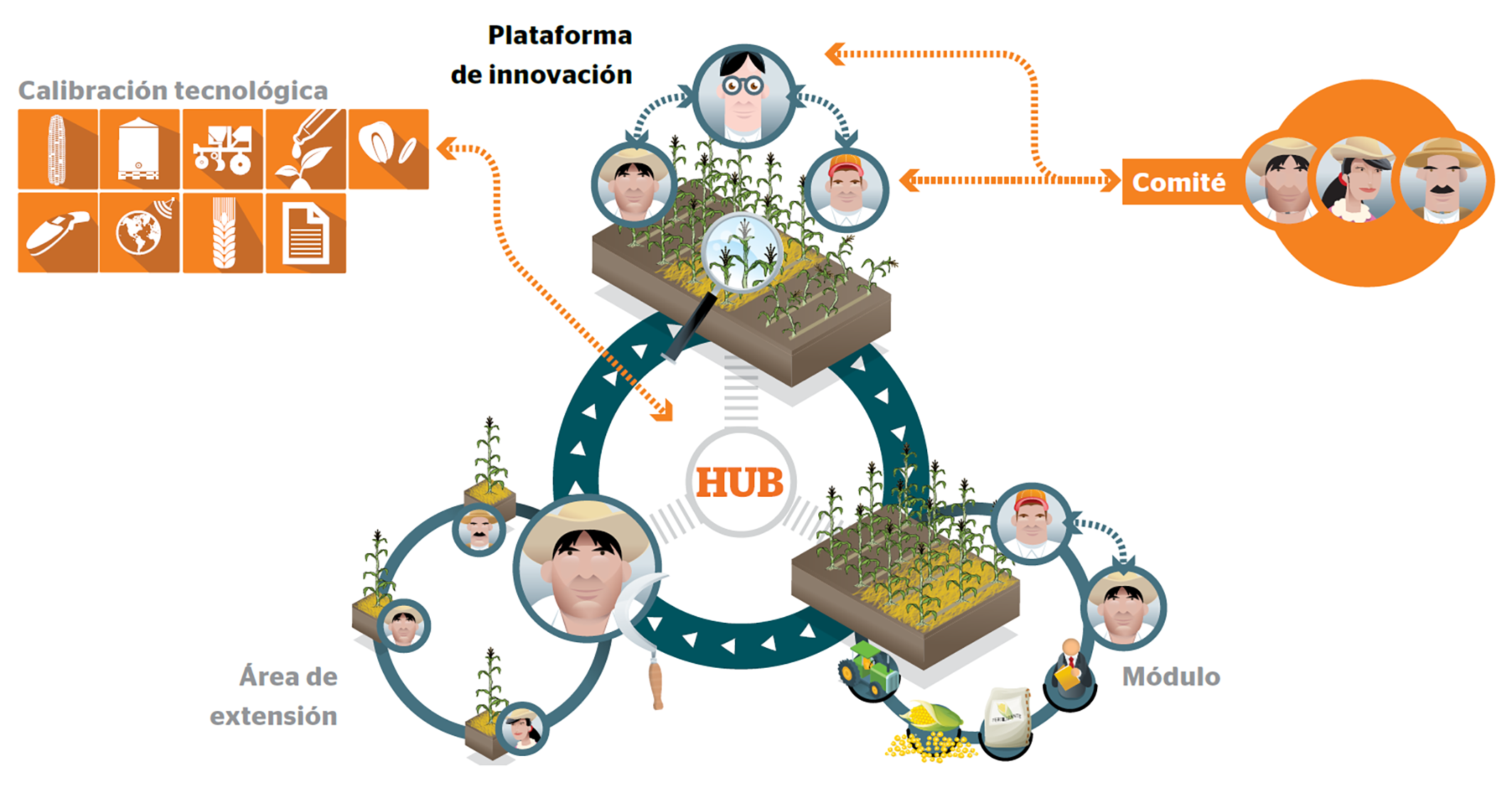
Let me start by pointing to an example in Mexico where the MasAgro project funded by the Mexican government and implemented by CIMMYT is providing online tools to farmers:
http://masagroguanajuato.cimmyt.org/herramientas.html
You won't be able to access most links since it is meant for farmers.
The principle behind the project is to have innovation hubs that link agricultural research, extension agents and farmers. Because a picture says more than a thousand words:
Finally, there are some early learnings about translating all we at the CGIAR Platform for Big Data in Agriculture have learned and continue to learn about communicating in the cultural context of smallholder farmers. Moving together into the digital realm, in which small holders are participating. Bridging formal and informal knowledge, folksonomies with taxonomies/Ontologies, mediated by digital technology. A couple of good examples come from two of our Inspire awards: read more…
- ILRI animal health experts interacting in a mix of English and Swahili within a Facebook chat group of around 30,000 farmers who share pictures and tips with each other; read more…
- CIMMYT and VIAMO are developing user-centered design approach to develop and deploy interactive voice response (IVR) content in local languages with several types of participants in market systems. Read more...
We need to start by asking ourselves two fundamental questions:
- How did we get here? I mean really....how did we let things get to this state of affairs?And i think very many answers to this have been given. We ought to thoroughly document these facts and thoughts for reference and benchmarking.
- What do we already know? Which information does each of the stakeholders have? How can we start aggregating all this big data and processing it for consumption by all stakeholders, especially the smallholders, before we start creating a square wheel?
In my opinion this should be the beginning of the change process, moving from the known to the unknown. And, we must focus our efforts towards empoering the smallholder farmers to start DEMANDING for answers - actionable data, fairness, accountability, respect, etc. Until smallholder farmers start feeling comfortable to ask questions and to demand for answers, then e-agriculture will not solve issues of equity and inclusion.
Let me try and answer your two questions.
1. How did we get here?
In my opinion we are in the very early phase of what Thomas Kuhn called a "Paradigm Shift" in agriculture and Agri-food Systems. We are shifting from Agriculture 3.0 to Agriculture 4.0 (See Internet for more information on Agriculture 4.0). Documenting and looking at the past will not help charting the future when there is a paradigm shift.
2. What do we already know?
In my opinion, as we go through this e-consultation and from my previous experience, very little in the context of this paradigm shift. At the moment, most of what is stated are opinions, many a times romaticised. For example, of holding a view that a smallholder wants to continue to farm and would want his/her future progeny also to make farming their livelihoods.
This online consultation showed that it is a very good opportunity for all of us
coming from different areas of expertise and knowledge to discuss ,exchange
opininos, information, also learn and of course propose scenarios and if possible solutions, for the smallholder farmers in the data driven agriculture.
The 4th day of consultation is about which actions to be taken in 2018-2021 to
ensure smallholder farmers benefit from agricultural data in the future.
In my opinion and I agree completely with Robert Katende before talking about the
future,we should think first about the present and current situation in
agriculture. How did we get here and what do we already know.
In order to give information to farmers first we must have it ourselves!
Studying case studies is very important, as very well pointed Simone van der Burg.I agree
100% and I think that only then we can see in practise which problems,needs and
gaps the farmers are facing in their every day work.Then we can focus on best practises and solutions.
Leanne Wiseman also said that by studying cases they discovered that there were very different attitudes in each industry to what data they needed to access and what data they wanted to share and how best to go forward.
These next years 2018-2021 we should focus on how we can transfer knowledge to
farmers about agriculture data,the benefits of it,their rigths.
We should be more informed about the national law in the developing countries about data in agriculture ,also it would be nice if we search the legislation in other countries about data such as in Germany(lawabout open data),South Korea (public data) and use it as a guide.And of course we should’nt forget the GDPR. Yes some of it may be not be applicable but I think that a lot should be taken into consideration (consent, data rights such portability right ,the right to object, codes of conduct, fines, transperancy).
The government of each country should get more involved by supporting financial and by law the establishment of any scenario of data sharing in agriculture,by collecting accurate farmer information so the farmer can have access (platforms). Governments should also adopt policies that oblige companies to ensure that smallholders actively participate and have a voice in every step of development of digital agriculture.That there is
legislation that protects the farmer’s rights.
“Organised data communities” should be developed as Thembani Malapela suggested.
The role of agricultural organisations should be more empowered by legislation in order to represent farmers to stakeholders and agribusinesses ,negotiating data access on their behalf and assure farmers interest when they are negotiating the terms of a contract.
As I already mentioned in day 1 there should be also concern about the contacts and their policies. There should be binding rules concerning contracts so the farmer could be more informed and more protected.
Valeria mentioned the EU Code of conduct that gives a good example of how developing
'best practice' in data sharing can help to build trust farmers and agri-businesses to ensure that data sharing arrangements are more transparent and equitable.
Leane Wiseman also referred to the introduction of Unfair Terms legislation to protect smaller businesses against the terms and conditions imposed by larger companies by their use of standard form contracts that contain terms that are presented on a 'take it or leave it' basis eg with smart farming technologies - farmers enter into these contracts when software is downloaded or farm machinery is turned on.
Legal rights that guarantee open access, processes and some form of proprietary ownership should be given to small holder farmers, so that they no longer consider digital technology as an “enemie”,but as something that they own and they can use and benefit from it.
I couldn’t akwoledge the importance and achievements but also the challenges of technology and more specific in agriculture. Besides that’s mostly the purpose of this online consultation. It would be good to work on finding the possibilities and provide
safeguards such as blockchain by consulting ICT specialists, empowering farmers
to minimize risks.
During the online consultation someone posed the question if agricultural/farm data is
sufficient meritorious of a new indipendent treaty or the international shift
such as the GDPR are sufficient to provide coverage for the issues arising from
the increasing collection, aggragation and dissemination of agricultural data.
I found the question quite interesting. In my opinion now more than ever these next
years we should work more on legislation in national and international level, set
the legal framework and policies and provide the farmers the knwoledge about their rights, the legal form of an agricultural organisation and their organised data communities, the information of a fair contract.