François STEPMAN

This member participated in the following Forums

Forum Forum: "ICT and producer organizations" November, 2012

Question 2 (opens 14 Nov.)

Submitted by François STEPMAN on Fri, 11/16/2012 - 15:46

The key for development actors is to understand the traditional process of farmer innovation in order to succeed in bringing ICT in line to support this. 

Video solutions are offering increased opportunities to record and disseminate innovative agricultural technologies from and to farmers:

  • Growing interest in extension
  • Attention to farmer innovation
  • More organizations want to enhance their impact at regional level
  • Many service providers have expressed their interest in using quality videos
Context:   From June to September 2011, Agro-Insight conducted a scoping study for SDC, GFRAS and SAI Platform on the production, dissemination and use of farmer training videos in developing countries, with a focus on sustainable agriculture. Literature was consulted, the internet screened, experts and users consulted and a global on-line survey launched in English, French and Spanish.
  • About 85% of the respondents found local languages very important for farmer training videos. To ensure that videos are sharable and of use to the global community of extension service providers and farmers, producing many poor quality local language videos is not cost-effective.
  • Organizations are willing to translate and use videos made in other countries if they are relevant and of good quality, and if video scripts are available. Lower quality videos serve intermediaries only and are rarely used to actually train farmers.
  • The five priority areas for new video productions are: crops and trees, water management, plant health, soil health and farmer organizations.
There is a general consensus that farmers need good agricultural training videos, but they do not browse the web in search of them. For watching videos they rely mainly on outside agencies. 
  • Farmers would watch videos on their own with their family or neighbours if video disc distribution mechanisms were in place. And they are willing to pay for video discs and video shows.
  • Only about 20% of all respondents have never used video to train farmers and have never searched the web for agricultural videos.
  • Many of those didn’t know where to look for videos, hadn’t found videos on the right subject or hadn’t found videos in their local language.
  • Ideally, videos should entice multiple organizations to use them in multiple settings, facilitated or not, depending on the local context . Well-made videos can serve farmer organizations, extension services, radio broadcasters, and can be modified for use on mobile phones or in any other way.
  • In terms of efficiency and scope to disseminate, it makes much more sense to translate one quality video into ten languages, rather than to completely reproduce the same video (or minor variations) in each single language.
To reach farmers with agricultural videos, a web-based platform is required, but not sufficient. Efforts to link people with different professional backgrounds and to establish regional and national communication, translation and video disc distribution mechanisms have to be established.   A not-for-profit organization, called Access Agriculture, facilitates content creation and sharing of agricultural training videos through its web-based platform and an evolving network of linkages and experts.   http://www.accessagriculture.org/       


Submitted by François STEPMAN on Thu, 11/15/2012 - 19:39

The East and Southern Africa (ESA) Division of IFAD (Rome) is supporting the East Africa Farmers’ Federation (EAFF, based in Nairobi) for Strengthening the capacity of East African farmer organizations through knowledge management and institutional development. (project of 3 years, USD 1 200 000)

Following activity:  Promoting an innovation culture: systematization and sharing may add something to our debate about identifying What are the priority areas for producer organizations.


Context:

Knowledge management and institutional development are core functions and priorities of the EAFF regional secretariat. 

Through this Project, EAFF will link the different national members and support them in their own organizational development to ensure that  information and knowledge is generated and shared within and across the national unions, associations and at farmer level.

  • National farmer organizations’ strategic plans focus mainly on lobbying and advocacy, capacity building, value chain development, and communication and information dissemination.
  • This Project will build capacity of national FOs to generate information and translate it into knowledge to improve their lobbying and advocacy, and integration in value chains. 
  • The project will complement the EC-funded Support to Farmers Organizations in Africa Programme (SFOAP), by deepening SFOAP’s impact in ESA, in particular in the areas of institutional strengthening and KM and learning. 
  • Projects in Burundi, Kenya and Tanzania countries where there is a great overlap between the FOs and the IFAD/ESA project areas, will benefit directly. Projects in other countries will benefit through knowledge sharing. 


Promoting an innovation culture: systematization and sharing.  

The objective of this component is to promote a culture of innovation in the farmer organizations at all levels.

  • The project will assist EAFF in setting up and managing a lean innovation sharing facility. The project will help EAFF to put in place the systems, processes and mechanisms for knowledge sharing, and coach the concerned staff on how to systematize information.
  • Selected staff will be trained in how to select, analyse, document and share innovative practices, technologies and approaches. Each year, the most promising innovations will be packaged and shared through a variety of communication tools, tailored to the needs of specific audiences. It is envisaged, for example, that EAFF will organize an annual innovation competition among farmers and facilitators.
  • Facilitators, who will work directly with FOs and farmers, will scout for innovations and pass them on to the innovation sharing facility,  which will then validate innovations, systematize them in a way that can be used and applied to other contexts and disseminate them at all levels.
  • Tools and approaches such as write-shops and systematization will be made available. 

Remark:

As several other contributions mentioned: apart from identifying the best tools to comminicate among farmers, capacity building at the level of national farmer organisation on how to manage them is crucial.

I also confirm what Jimmie said about (mobile phone applications) : Frontline SMS has increased a lot the efficiency of f.i. radio broadcasting for farmers. They most of the time only find by coincidence a program which is interesting for their cultivation. But receiving an sms alert about a forthcoming program makes them tune in. Farmer  organisations are therefore to work closely with community radios.

Submitted by François STEPMAN on Thu, 11/15/2012 - 19:03

Google has launched a text message-based version of its email service targeted at users in Africa.

Gmail SMS can run on so-called "dumb phones" which only have very basic features and no access to the internet.

The service has so far been made available in Ghana, Nigeria and Kenya.

http://www.bbc.co.uk/news/technology-18898967

Forum Week II, second question, final question starting 26 November 2008

Week 2 - Question 2 (the final discussion!) 26 Nov. 2008

Submitted by François STEPMAN on Fri, 11/28/2008 - 17:00
[quote=krishna mishra]The future depends on upscaling and acceptability than on piloting and forgetting. [/quote] Challenges for upscale: 1 - Innovative information initiatives invite farmers to use and share their traditional knowledge using modern ICT. Rural community and scientists have come together for weather forecasting, blending frontier science and traditional knowledge which influence the decision-making process. But when plenty of farmers are reached by a particular farmer information provider the service may become controversial if no consensus was reached prior to the upscale about the content with a large community of agricultural and rural actors. 2 - A second challenge for the upscale of (the presently mainly pilot) ICT and mobile phone projects will be the necessary alliance with a mobile phone company. Several mobile phone providers compete for this "last frontier market". Also politicians challenge the major mobile phone providers: "Your competitor reaches the rural population with mobile credit services, how do you intend to service the farmers?" 3 - A third challenge is to make sure the information platforms are inter-operational. In an upscale each of the platforms on which farmers' information is delivered has various advantages and limitations, and is often an inadequate solution when used on its own. It is observed here that to provide an effective solution many platforms need to be carefully integrated in such a way as to harness the benefits of individual platforms while avoiding their limitations. In other words, an effective solution must contain all these individual platforms organised carefully so that each falls in its place to fulfill a set objective. The solution then becomes an information matrix whose elements are the individual platforms and whose composition is done on the basis of the set objectives. For the farmers' information service the elements of the information matrix include the following: (a) SMS (text) Platform; (b) Voice platform; (c) Web-portal; (d) Call centre; (e) Extension workers; (f) Libraries; (g) Researchers. 4 - As pointed out by Laura Drewett: A last challenge is that [quote]it is typically difficult to attract the private sector to invest in such ventures in Africa because these entrepreneurs are primarily risk averse. This is where the public sector and NGOs can play a huge role by fast tracking these private enterprise initiatives and partnering with local business so that the solution can be sustainable after the time period of any given project. [/quote]
Submitted by François STEPMAN on Wed, 11/26/2008 - 19:47
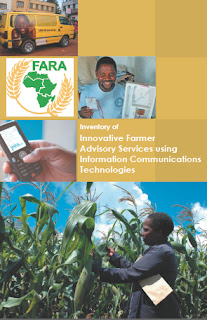
I already regret our discussions are coming to a close on Friday. One way forward is to share research papers on this issue. We are finalizing this week the [url=http://www.fara-africa.org/media/uploads/File/Announcements/Innovative%…] FARA Inventory on Innovative Farmer Advisory Services[/url]. (54 pages) This inventory was the result of an online consultation with the FARA [url=http://www.fara-africa.org/networking-support-projects/rails/]Regional Agricultural Information & Learning System (RAILS)[/url] held during the month of October + desk study. We are still receiving comments from IICD, CTA and IDRC which we will integrate in the final version. We will send on Friday 28/11 a summary of this inventory for the [url=http://www.ist-africa.org/home/]IST Africa call for papers and workshops[/url] (May 2009 Uganda conference). The presentation of the findings of the inventory will be integrated as one of the presentations in the AFRIFITA workshop at the IST conference. Information Technology in Agriculture, Food and Environment (AFRIFITA). Sure Africa can learn a lot from the Indian, Sri Lankan, and other experiences! We should convince the organisers of IST Africa about this.
Submitted by François STEPMAN on Wed, 11/26/2008 - 18:59
[quote=harsha de silva] The future is to use ICTs [here mainly mobile telephony] to reduce information search costs in the agriculture value chain and to link the decision to grow with that of to sell. [/quote] Harsha - Your study is the type of analysis which can move us forward. The farmer looks for his/her economic interest or benefit (see also Aker,2008 ) also in his/her information searchers. The donors want this evidence to be reflected in progress reports. The final objective is reducing total transaction costs to increase the incentives for small-holder farmers to participate in commercial agriculture as opposed to being stuck in subsistence farming. The breakdown of stages of information needs and searches is clarifying. The farmer has information needs and searches for information related to 6 stages: 1. Deciding 2. Seeding 3. Preparing and Planting 4. Growing 5.Harvesting, packing and storing 6.Selling. Your remarkable finding is that - for a group of small-holder farmers in Sri Lanka growing tomatoes, onions, brinjals and chilies - the information search costs amount to 11.0 percent of the total costs incurred by the farmers in the six stage process. Your figure which I reproduce here is an eye opener: [img]http://2.bp.blogspot.com/_BN_Idjmg_Hs/SS1HA5GLZvI/AAAAAAAABlI/icK74v32q…] [quote]"When the total information search costs in different stages of the agricultural value chain is considered, we find that the highest percentage of cost of information is incurred during the growth stage, followed by the decision stage and selling stage."[/quote] [quote]"In terms of proportion of cost of information in each stage in the agricultural value chain, the decision stage comes first with the cost of information search to total cost ratio being 3:1, followed by growing stage with a ratio of 1:4 and the selling stage with a ratio of 1:5."[/quote] But the intrigue comes for me in your statement: [quote]"The reason for the unusually high percentage of information search costs during the growing stage [53%] we found is caused by the idiosyncratic government procedure on fertilizer subsidy to farmers in that area. We expect the growing stage to be less pertinent in countries without such inefficient fertilizer subsidy policies and hence it is not analyzed further". [/quote] The absence of effective marketing chains is precisely a plague in Africa. It directly relatives the impact information and the use of mobile phone therein can have. A marketing chain can be seen as a multi-stakeholder network that is highly integrated and shares a common perspective or goal: to deliver a product as cheaply and efficiently as possible to the consumer. Increasing the efficiency of the whole chain - the purpose of providing agricultural information - is in the interest of all stakeholders, whether they are farmers, processors transporters, retailers or others. Threat of competition leads chain partners to be highly aware of the "competitive position' of their chain vis-à-vis others. This awareness leads to "chain thinking'. Creating such "chain awareness' is a big challenge in Africa. Two examples suffice. a) In [u]Benin[/u], a large number of unproductive people "eats' from the export earnings of the cotton produced by small farmers. Benin refuses to sell effective but cheaper pesticides that are available and that could reduce farmers' pesticide cost substantially, simply because that would cut the salesmen's profit. b) In [u]Ghana[/u] the Cocoa Marketing Board is directly involved in pesticide production. They have so far not cooperated in the certification of organic cocoa, which would undermine the rationale for mass spraying of synthetic chemicals. Mobile phone alerts can be used as advocacy tools here as mobile conferencing does. A lady farmer in [u]Uganda[/u] refused to tell the other farmers what she learned from a cheese making workshop she attended in [u]Italy[/u] (!). The extension worker found the information on internet and gave some technical cheese making training with mobile phone conferencing follow up. The "chain awareness': "Only large quantities of cheese justify a truck of cheese to Kampala" made the lady join the rest of the group. Let me quote you again: [quote]There are a lot more verticals and horizontals[/quote] PS. I posted your study on the [url=http://2.bp.blogspot.com/_BN_Idjmg_Hs/SS1HA5GLZvI/AAAAAAAABlI/icK74v32q… Secretariat blog[/url]
Submitted by François STEPMAN on Wed, 11/26/2008 - 11:53
Alexander, A scenario wherein user-generated multimedia content on local and indigenous knowledge is shared and reused among user networks or communities through their mobile devices is indeed most promising because it corners the traditional overwhelming supply driven approach of agricultural information. In remote areas in Africa the access to such multimedia content is probably not for tomorrow. But in the meantime farmers experiment with similar very creative multi media approaches. An example is the project Collecting & Exchange of Local Agricultural Content (CELAC) in Uganda. The project enables farmers to voice record their own innovative techniques. They disseminate their experiences with radio/CD players during group sessions. See: Video interview during the MobileActive 2008 World Summit (Johannesburg, South Africa) with Mary NAKIRYA, Program coordinator BROSDI, Busoga Open Source & Development Initiative, ICT enabled rural development. CELAC - Uganda. [url]http://farastaff.blogspot.com/2008/11/interview-during-mobileactive-200…]
Forum Week II Discussions - starting Monday 24 November

Week 2 - Day 1, question 1 - 24 November 2008

Submitted by François STEPMAN on Wed, 11/26/2008 - 11:46
Shehzaad, Picking up your comment: "Perhaps a combination of related technologies i.e. mobile phones and PC based technologies still could be a better approach to assess initially the impact" is another promising link between RADIO and MOBILE. Mobile's answer to radio is f.i. Freedomfone. Freedomfone (still in Beta version) gives users access to dial-up information and services over their mobile. Dubbed 'dial-up radio', the service will be invaluable in societies where many people own cellphones but draconian governments have restricted access to newspapers and the airwaves. The project is run by Kubatana out of Zimbabwe with funding from US based Knight Foundation. See interview with Brenda Burrell at the MobileActive 2008 conference: posted on YouTube: [url]http://www.youtube.com/watch?v=vKB8HQB0w7s[/url] Unfortunately, when this project Dial-up Radio: Agricultural Information on Demand was presented at the September 24-26 World Bank Development Marketplace it did not get selected! See: [url]http://farastaff.blogspot.com/2008/09/sustainable-agriculture-for-devel…]
Submitted by François STEPMAN on Wed, 11/26/2008 - 10:46
Héléne, You are right, using mobile phones for evaluation is promising. An example: ï‚§ [u]Mobiles max Mexican coffee industry:[/u] Digital ICS mobile phone software for collecting survey data for agricultural collectives is helping coffee growers in Mexico. Yael Schwartzman tells about the package and process of collecting and analysing data from coffee farmers to improve their produce. Posted on YouTube [url]http://www.youtube.com/watch?v=vKB8HQB0w7s[/url]
Submitted by François STEPMAN on Tue, 11/25/2008 - 14:55
Michael Riggs' question: [color]How can we monitor the impact [of rural mobile telephony in the agricultural sector] [/color]requires a better understanding of the farmers' context for the adoption and adaptation of an innovative information tool. There are many initiatives on ICTs and small-scale farmers in Africa. However, these tend to be un-coordinated, and information on the different initiatives is not easily accessible, let alone information on their impacts (see FARA inventory). The nature or mobile technology development for farmers itself is highly contentious and requires careful research and development to make it "right' especially when it comes to livelihoods improvement and poverty reduction in Sub-Sahara Africa. Although it is recognized that the uptake of promising information technologies like rural telephony can be influenced greatly by the availability and/or functioning of input supply, credit systems, land-tenure arrangements, organization of marketing, distribution of benefits, etc., such social-organizational phenomena have mostly be considered as conditions that hamper or enhance adaptation of rural telephony. When trying to measure the impact of rural telephony the question is thus not just to seek to develop an appropriate information dissemination technology but also to alter the boundaries and conditions that affect the space for change. Resource poor farmers in high risk and diverse, rain-fed environments face very small windows of opportunity for innovation. The mobile phone projects as listed in the FARA inventory often create special conditions to enable and stimulate farmers to utilize the recommended technologies (f.i. Questions and Answer Services - QAS based on text messages). Such special conditions might include access to subsidized inputs, guaranteed marketing of the surplus generated, the creation of special credit schemes, the availability of highly qualified staff or in the case of QAS accurate and timely information. But, equally invariably, such projects turn out to leave few traces after the special conditions have been withdrawn. Replicability of the development gains is a key issue. The best guarantee for such replicability is to ensure that new communication technologies work within the prevailing physical, socio-economic, cultural and institutional conditions and, if necessary, to stretch those conditions. This approach requires special procedures to adopt a new communication tool on the basis of decision making that is informed by an understanding of the farmers' context. [img]http://www.mobileactive08.org/files/images/STA40008_0.full%20view.JPG [/img]A good example is the adoption of mobile phone conferencing. In a video interview I took with Mary Nyakira of BROSDI/CELAC Uganda during the MobileActive 2008 conference, she explains how the mobile phone conferencing works and how farmers are enjoying it. It not only contributes to a particular form of democracy and transparency but farmers like having group discussions around a mobile phone with the loudspeaker facility on. The extension worker is "beeped" when the group of farmers is ready to start the training session. The discussions are a follow up on a previous field visit. But this time the extension worker gives advice out of his/her office. Taking into account the considerable distances and the fact that extension workers can not afford visiting on a weekly basis a particular group of farmers, mobile phone conferencing is having a tremendous impact. [url]http://farastaff.blogspot.com/2008/11/mobile-phone-conferencing-among-f…] Rural telephony technologies can only work if they fit within the small windows of opportunities that African small-scale family farmers face. As pointed rightly by Ravi Shankar - even if the farmer is taking first time a specific service, more due to curiosity, next time he will not subscribe to it, if the service offered is not valuable. Contrary to political activism in Christian Kreutz' example, the majority of farmers is not that well organized, they have no political clout and cannot exert effective demand on agricultural information services. Despite the number of Market Information Prices Services using mobile phone for price information dissemination the market prices information remain often not freely available so that prices are set locally and rather arbitrarily given the actual relative scarcity. More often than not, market prices are determined by the vagaries of weather, transport, monopolistic traders, and so forth. [color]Conclusion.[/color] In order to answer the question: How can we monitor the impact? We need to look into the broader innovation opportunities of farmers. To monitor the impact of the tool we need to look into: the most effective ways of reaching farmers with timely agricultural information and knowledge (indigenous and external); mechanisms for harnessing the potential of FM radio stations and digital telephony as technologies for communicating agricultural information; options for repackaging agricultural information and knowledge for small scale farmers; the potential role of and an e-repository (of local agricultural content) in Africa for purposes of disseminating local agricultural content. [img][/img]

Become a member

As e-Agriculture Forum member you can contribute to ongoing discussions, receive regular updates via email and browse fellow members profiles.