


Integrating gender in the project cycle
Gender equality is essential to achieve the mandate of the Food and Agriculture Organization of the United Nations (FAO) to build a world free from hunger, malnutrition and poverty. FAO recognizes that persisting inequalities between women and men are a major obstacle to agriculture and rural development, and that eliminating these disparities is essential to building sustainable and inclusive food systems and resilient and peaceful societies.
The Organization is committed to gender equality and women’s empowerment. In alignment with the priorities set by the international agenda, the FAO Policy on Gender Equality (2020–2030) identifies four main objectives to guide the Organization’s normative and technical work and sets of minimum standards to ensure that the gender dimensions are adequately addressed across all organizational functions. One of these minimum standards focuses on the FAO project cycle and recommends that “all projects and programmes integrate gender-related results and indicators, based on the findings of a gender analysis.” In addition, under FAO’s Commit to Grow Equality initiative, FAO’s Director General has committed to ensuring that 10 percent of FAO’s projects include gender transformative activities by 2030.
Gender analysis provides the evidence to address gender inequalities in projects and can be conducted at household, community and national levels, across different life stages. It highlights the root causes and effects of gender inequality and explores how gender interacts with other social identities, such as race, ethnicity, class, age and disability status, to determine multiple forms of discrimination and exclusion.
Conducting a gender analysis during project formulation means understanding:
- What roles men and women play in and outside of the household
- What resources and services can they access
- What their needs and priorities are
- What power relations are and how decisions are taken
- What gender norms shape these roles and dynamics and why
The outcome of the gender analysis provides an understanding of women’s and men’s specific priorities and responsibilities, thereby reducing the risk of designing a project based on incorrect assumptions and stereotypes. It also provides insight on how men and women are affected by the problem identified, so that solutions can be developed.
Approaches adopted in gender-responsive project formulation:
Intersectional approach: this approach recognizes that gender often intersects with different factors such as age, ethnicity, disability, and socioeconomic status. This can create and reinforce specific forms of discrimination and social exclusion, not only between women and men but also among women and among men. For example, Indigenous Women may suffer double discrimination, based on their gender and ethnicity.
Gender transformative approaches: these approaches not only consider the different needs of women and men, but also seek to redress and overcome unequal power dynamics, resource allocations and role distributions, by challenging and transforming structural barriers that are at the root of persistent gender inequalities, such as discriminatory social norms, behaviors and attitudes, and by supporting individual and collective actions.
The steps required to formulate a gender-responsive project are:
- Assign a gender marker at project identification, based on the extent of gender-related work being planned
- Conduct a comprehensive gender analysis to identify the specific needs and capacities of men and women, engage with relevant stakeholders, and identify potential gender-based challenges that might affect their participation and benefits from the project.
- Incorporate the findings of gender analysis into the project strategy, develop actions to address gender-based challenges, and include gender-related outcomes in the project's framework.
- Design and implement a gender-sensitive monitoring and evaluation framework with indicators to track project engagement and benefits across all genders, ensuring gender objectives are consistently met.
- Allocate an adequate budget to support the implementation of activities aimed at gender equality and women’s empowerment.
- Define clear gender-related responsibilities for project staff and include gender expertise to guide the project towards gender equality.
- Execute the project with a consistent focus on gender-related outcomes, periodically reviewing and adjusting activities based on feedback and monitoring insights.
- Include elements that address power structures, agency, empowerment and norms to make the project gender transformative.
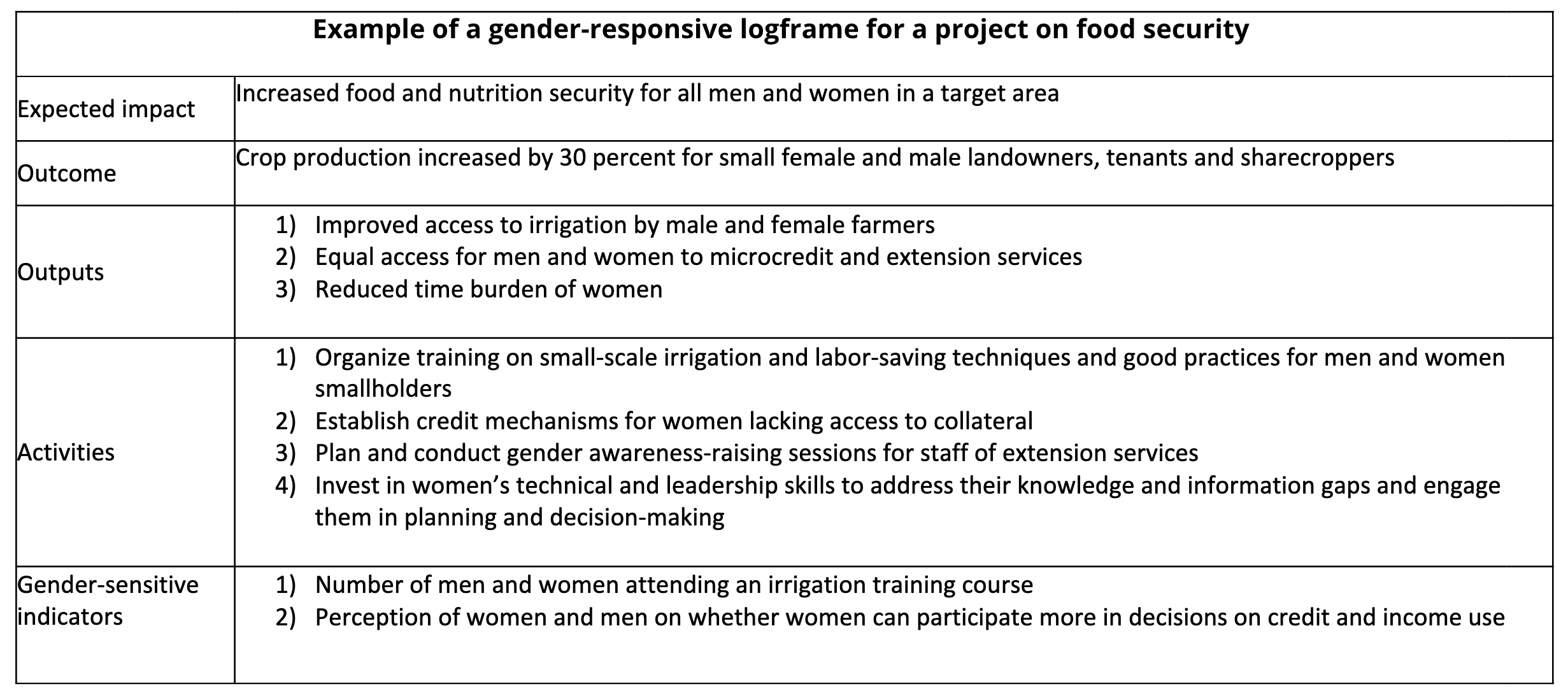
Addressing gender issues in the project cycle implies ensuring that women and men have equal access to productive resources, services and technologies, and same opportunities to participate in planning and decision-making, so and they can benefit equally from the expected outputs and/or outcomes.
It is crucial to understand how a project might influence the role and status of men and women, especially those at high risk of poverty and food insecurity.
Recognizing the intersectionality of gender with other social identities such as age, ethnicity, disability status and socioeconomic status is crucial for identifying and addressing multiple and overlapping forms of discrimination, affecting particularly women and girls.
Addressing gender issues in a project means targeting the specific needs and priorities of men and women and analyzing their access to and control over productive and natural resources, services and decision-making power, and how they allocate their time to different activities.
To achieve gender equality and women’s empowerment, gender issues need to be addressed at project identification and throughout the whole project cycle. Projects which seek to effectively support an increase in women’s empowerment have better results in terms of household incomes, dietary diversity and resilience to shocks, including climate shocks (SWAF 2023).
Monitoring and evaluating gender-related impacts are crucial for taking corrective measures, if needed, during project implementation.
Analyze the different needs and priorities of men and women at the project identification stage.
Collect and analyze sex-disaggregated data for producing a baseline and for monitoring gender-related progress and impacts.
Plan gender-responsive outcomes, outputs and activities to address the identified gender inequalities, include a specific budget to implement them and formulate gender-sensitive indicators to monitor progress and evaluate gender-related results and impacts. Where possible plan gender-transformative outcomes, outputs and activities.
Consult men, women and local institutions during stakeholder analysis, collect their views and identify how to best engage them in the planning, implementation and monitoring of the project.
Include gender-related tasks and responsibilities in the Terms of Reference of the project team, when relevant, or make sure gender expertise is available or recruited to support the implementation of the project, if the focus is on gender equality and women’s empowerment.
Key Resources

Publications
Step-by-step guide to integrating a gender transformative approach throughout the project cycle
01/12/2024
This guide provides assistance to development professionals to integrate the gender transformative approach (GTA) in project interventions that focus...

Publications
Guide to mainstream gender in the FAO project cycle
01/04/2024
This is an updated version of the 2017 Guide to mainstreaming gender in the FAO project cycle. It provides project formulators with practical guidance...