


Publications

The impact of COVID-19 on gender equality and food security in the Arab region with a focus on the Sudan and Iraq
16/02/2022
This rapid gender analysis (RGA) explores the impact of the COVID-19 pandemic on gender equality and food security in the Arab region. The findings and successes of this initiative are intended to strengthen the relationship between gender and food security actors regionally, and in particular within Iraq and the Sudan, while increasing the availability and transparency of gender analysis in the sphere of food security. 106 pp.

Mapping women’s small-scale fisheries organizations in Ghana - Results from assessing current capacities, gaps and opportunities to strengthen women's organizations in the sector
04/02/2022
Through the FAO-NORAD project, survey data was used to “map” women’s organizations and assess their present capacities and needs in the small-scale fisheries sector. To support sustainable food systems and nutrition in sub-Saharan Africa, NORAD provided funding for initial project activities in five countries – Ghana, Malawi, Sierra Leone, United Republic of Tanzania and Uganda. This publication discusses the strengthening of women's roles in post-harvest processing 32 p.

Mapping women’s small-scale fisheries organizations in Sierra Leone - Results from assessing current capacities, gaps and opportunities to strengthen women´s organizations in the sector
04/02/2022
As part of the FAO-NORAD project “Empowering women in small-scale fisheries for sustainable food systems”, this publication focuses on gender equality and women’s small-scale fisheries organizations. The project supports activities in five countries – Ghana, Malawi, Sierra Leone, Uganda, and United Republic of Tanzania – with a focus on strengthening women’s roles in post-harvest processing and trade. 30 pp.

COVID-19, land, natural resources, gender issues and Indigenous Peoples' rights in Asia
01/02/2022
This policy brief addresses what impact COVID-19 has had on Indigenous Peoples’ rights, especially women, with a focus on Asia and on land and natural resources rights. 19 pp.

A methodological guide for mapping women's small-scale fishery organizations to assess their capacities and needs
20/01/2022
The purpose of this methodological guide is to outline how to conduct an empirical assessment of the current landscape of women’s small-scale fishery (SSF) organizations. Applying this methodology will enhance understanding of where women are organized in SSFs (both geographically and within the value chain); what their present organizational characteristics and capacities are; and their primary needs. 74 pp.

Country Gender Assessment of the Agriculture and Rural Sector: Egypt – Brief
17/01/2022
This brief is a summary of the Country Gender Assessment of Agriculture and the Rural Sector for Egypt.The CGA provides up-to-date information on the situation of women in the rural sector and was developed based on a desk review of information, reports and studies as well as on stakeholder consultations. 20 pp.
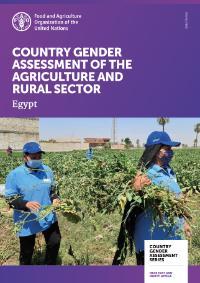
Egypt: National gender profile of agriculture and rural livelihoods (Country Gender Assessment Series)
17/12/2021
This Country Gender Assessment describes the specific roles and responsibilities that women and men perform in agriculture and documents the main gender inequalities that still affect the sector. The analysis also aims to assess rural women’s ability to influence the decision-making processes that affect their lives, particularly in the context of rural organizations, communities and households. 52 pp.

Women’s participation in wood-based value chains in VPA-implementing countries. MALEBI: Women at the forefront of sustainable charcoal production in Côte d'Ivoire
13/12/2021
This brief describes the constraints as well as opportunities of women in the wood-based supply chain, from a case study that focuses on The Association of Women Producers and Traders of Secondary Forest Products (MALEBI) in Côte d’Ivoire. Within the framework of an agreement with the Ivorian government, MALEBI produces and sells charcoal from wood harvested in the Ahua gazetted forest and, in return, is committed to reforesting 5 hectares per year in the same forest area. 30 p.